GreenVibe has raised $12 million to date to close what it describes as a longstanding blind spot in construction: whether poured concrete actually matches its specification. The company embeds wireless sensors into concrete before pouring, delivering strength and status readings every 30 minutes.
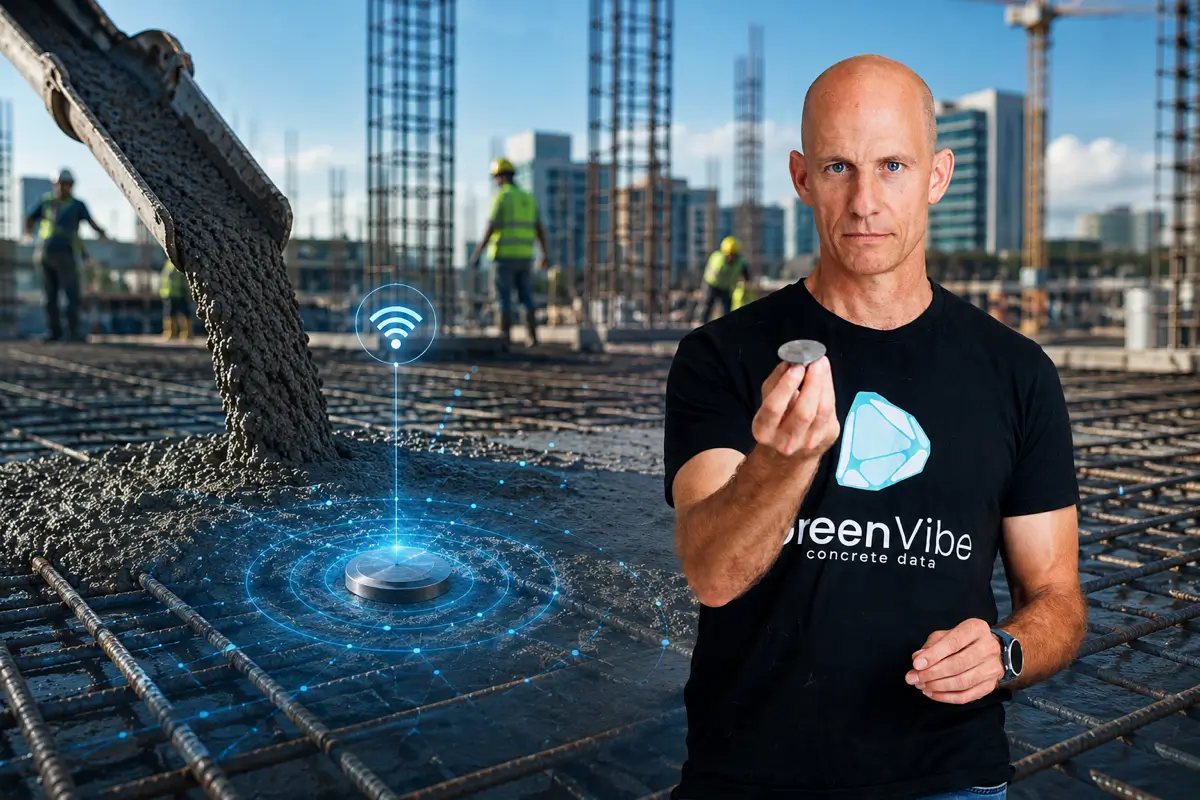
Image created for this article using AI tools
The 24 June 2026 doublet earthquake in Venezuela killed roughly 3,000 people and has since drawn a $200 million reconstruction fund. Earthquake frequency has not risen in recent years. Seismologists at the British Geological Survey and the University of Hawaii both note that major quakes have stayed close to their long-term historical average of around 15 magnitude 7-or-greater events annually. What has changed is exposure: several of the deadliest recent earthquakes, including Myanmar and Afghanistan in 2025 and now Venezuela in 2026, struck densely populated areas, raising the stakes attached to construction quality even without a change in underlying seismic activity.
Against that backdrop, capital providers financing reconstruction and infrastructure work are placing greater weight on verification before releasing funds. GreenVibe’s pitch centers on replacing the standard cylinder test, which the company says carries an inherent error of 10-50%, with in-element sensors it says reach 95% correlation with the concrete actually poured.
GreenVibe’s sensors are deployed across more than 20 projects and labs, including Beyond by Tidhar, the tallest building in Israel, alongside The Spiral at Azrieli, Toha 2 by Amot, Rothschild10 by Tidhar, Midtown Jerusalem, and the Herling Bridge. Internationally, the company has worked with Ferrovial on the Malpartida bridge in Spain and completed a pilot with Clark Construction in the US.
The company reports ROI exceeding 10x on most projects and says it has cut waste and inefficiency by up to 50% through reduced quality issues and optimized concrete mix. On one bridge project, it says the cure-wait cycle fell from five or six days to two.
“Data driven construction is the only way to be sure that what is poured is what was specified,” said Roee Reshef, CEO and Co-Founder of GreenVibe. “GreenVibe supports mega projects by delivering data-driven solutions that improve efficiency, accelerate delivery, and enhance construction quality.”
The company is in the process of entering the ASTM and Eurocode standards frameworks, a step it says would position its sensor data as a replacement for lab testing as the global verification baseline. GreenVibe is backed by Insight Partners, Tidhar Construction, Israel-Canada, and Shikun and Binui.