NMI’s September 23, 2026 release expands Business Capital with term loans and starter offers for its partners’ merchants, two weeks after a low-code component suite for software platforms. Back in May it bought Dwolla for bank-to-bank rails. A gateway company that dates to 2001 is turning into a wider embedded payments platform, and rivals now get measured against more than a gateway.
Key takeaways:
- NMI sells only through partners. Leaving costs $0.50 per record with a $500 floor, and its network tokens can’t go to another gateway at all.
- UniPay, eComCharge and Akurateco offer a version you can run yourself, which we couldn’t find at NMI.
- UniPay prints the numbers, from $15,000 a month hosted to $150,000 on-premise. NMI publishes no gateway price list.
Do you want a broad platform you resell, or a gateway you own outright? The five NMI competitors below are ranked for an ISO, PSP or software company comparing a white label payment gateway, with figures read directly from vendor sites and filings since early October 2026.
NMI in 2026
Size is NMI’s first argument, and its partner-only model is the second.
What it sells
A white-label gateway sits at the core of what NMI now calls its embedded payments platform. Merchants reach it only through a partner, whether bank, ISO, PayFac or SaaS company. By its own count that adds up to 6,000 channel partners and 1.2+ million active merchants, with annual volume above $700 billion. On the integration side, its gateway page counts 200+ payment processors and 125+ shopping carts, while the homepage says 150+ processor connections.
Merchant Central combines CRM and underwriting tools, and NMI Payments handles underwriting and onboarding on a partner’s behalf, with partners sharing in the net payment revenue. If you’re coming from another gateway, the Gateway Emulator avoids reworking your software. Moving the other way is priced.
Exports of Customer Vault and recurring data must be requested by the affiliate partner, with a 25-record minimum and a non-negotiable fee, and the receiver must be PCI DSS Level 1. Its pages show no self-hosted or source-code option, and nmi.com/pricing returns a 404.
What changed
NMI has spent 2026 adding products on top of the gateway:
- On May 19 it bought Dwolla, its sixth acquisition in recent years, with terms undisclosed and more than 400 Dwolla customers joining.
- On June 2 it bought Fee Navigator, an AI tool that analyzes merchant statements for pricing.
- It entered the smart terminal market on July 21 with Android-based SmartPOS devices.
- A low-code embeddable component suite followed on September 9, covering branded payment acceptance, transaction history and deposit reporting.
- On September 23 it added term loans and starter offers to Business Capital.
Dwolla is the move to weigh. More than 1,800 financial institutions are now live on FedNow, and Same Day ACH carried 470.4 million payments in the third quarter, up 36.7% from a year earlier. If your merchants ask for bank payments, test that on every shortlist.
What users say
Trustpilot shows 1.9 from 17 reviews (as of October 27, 2026), 88% of them one-star, on an unclaimed profile that hasn’t asked for reviews. That’s a small sample for a company with 1.2+ million merchants. Most end users meet NMI through a reseller, so your partner’s support record tells you more.
NMI competitors at a glance
Whether it’s a gateway or an orchestration layer, the buying question for a reseller stays the same: who holds the acquiring, and who holds the code.
| # | Competitor | Best for versus NMI | Acquiring | Hosting | Pricing |
|---|---|---|---|---|---|
| 1 | Akurateco | Running the gateway in your own environment | Acquirers you sign | SaaS, own servers or cloud | Quote |
| 2 | UniPay | Owning the source code | Your banks or processors | Cloud, hosted or on-premise | From $15,000 a month |
| 3 | Fluid Pay | A partner-only gateway at smaller scale | The partner’s own | Hosted on Google Cloud | Activation + monthly fee |
| 4 | eComCharge | A lifetime license for PSPs | Your acquiring account | SaaS, on-premises or license | Setup + monthly fee |
| 5 | Celeris | A fast start with Latin American methods | 75+ acquirers | Vendor’s gateway | Illustrated at €2,000 a month |
UniPay is the only one with a firm public price, and Celeris’s €2,000 comes from an illustration that doesn’t say what it covers.
How the competitors compare
NMI’s strength is its channel, so these profiles of NMI alternatives focus on what you’d get by not joining it.
1. Akurateco: the gateway in your own environment
NMI hosts its gateway as a service. Akurateco’s white-label payment gateway runs as SaaS too, or on your own servers, or in an Azure, Oracle Cloud, AWS or Google Cloud account of yours, and a payment orchestration platform for merchants sits next to it. A self-hosted launch needs about 30 days in a cloud account and about 60 on dedicated infrastructure. A named payment team helps each PSP choose acquirers and set routing and fraud rules.
No acquiring comes in the package. Sign your own, and connect them via any of 700+ ready connectors. Protection comes from 150 built-in configurable fraud filters, uptime from a 99.95% SLA. A new integration takes about 14 days. You’d start processing in 5 business days on average. Protocol emulation exists for supported gateways, so ask whether NMI’s API is covered.
Best for: a PSP with its own compliance team that wants the gateway and the data under its roof.
Watch out for: you’d lose the underwriting help NMI Payments gives partners, since Akurateco doesn’t move funds or open merchant accounts.
2. UniPay: a route to owning the code
United Thinkers in New York built UniPay as a processor-agnostic gateway, with one API for card and ACH transactions. Pay-as-you-go runs at 2.9% + $0.25 a transaction, a hosted white label from $15,000 a month, and a licensed on-premise copy from $150,000 on one page and $250,000 on another, with source code access and no transaction fees.
A hosted customer can later license the product. United Thinkers will help migrate data and servers. UniPay claims 20K+ merchants and 100+ bank integrations.
Best for: a PayFac with the budget to own its stack over time.
The trade-off: allow 3-6 months for planning each added bank or processor, and a much bigger budget from the start if you go on-premise.
3. Fluid Pay: the closest match on channel
A former NMI co-founder joined the executive team at Fluid Pay, a Tennessee gateway that has sold only through partners since 2017. ISOs, ISVs and vertical SaaS firms are its buyers. Legacy request formats work through its own Gateway Emulator, so a move mostly means new endpoints, and the REST API accepts cards, ACH and digital wallets.
Economics differ from NMI’s, since on the white-label gateway you pay to activate and then monthly, with no markup per transaction, though no amounts appear. Hosting is on Google Cloud with multi-region failover.
Best for: a US ISO that likes NMI’s channel model and wants a smaller vendor behind it.
Watch out for: underwriting and merchant accounts aren’t offered, so your acquirer comes from elsewhere, and you can’t host it yourself.
4. eComCharge: a license with a time estimate
eComCharge sells to PSPs, acquiring banks, iGaming and forex PSPs and marketplaces, and lists three models with lead times attached. SaaS starts from 1 week, while on-premises and a lifetime license each start from 3 months. It runs its own 3DS Server and MPI, and Smart Routing offers 50+ conditions, including BIN, geography and 3DS status.
You need a registered company, a domain, a bank account and an acquiring account before you buy. Formerly branded beGateway, it says it has launched more than 125 payment service providers.
Best for: a PSP that wants a license it can manage on its own servers.
The trade-off: its site has no price list or SLA page, and connector timing differs by page, from 1 week to 2-3 weeks. Talking to your merchants and banks on your behalf costs extra.
5. Celeris: quick starts and Latin American reach
Celeris was called WLPayments until a rebrand, and PayRetailers announced its acquisition on June 26, 2025. It sells a white-label platform to PSPs, ISOs, fintechs and acquirers, covering 75+ acquirers and 100+ payment methods. The PayRetailers integration adds 20+ Latin American methods, with Pix and OXXO named.
Its page advertises setup “in just 24 hours”, while the FAQ on that page says integration “takes weeks, not months”, and the same page sets an illustrative €2,000 a month against €29,000 to build your own.
Best for: a PSP adding Latin America that wants to launch without a large upfront cost.
Watch out for: we found no published price or SLA terms, and its Terms disclaim any warranty on availability despite a 99.99% uptime claim.
Where NMI sits among 70 payment platforms
NMI is among the minority that spell out how cards leave. Across the vendors in this competitor series, 22 of 63 describe a route for stored cards to move, and NMI’s published fee is what makes that route concrete. UniPay and eComCharge are outside that group, while Akurateco and Fluid Pay are in it.
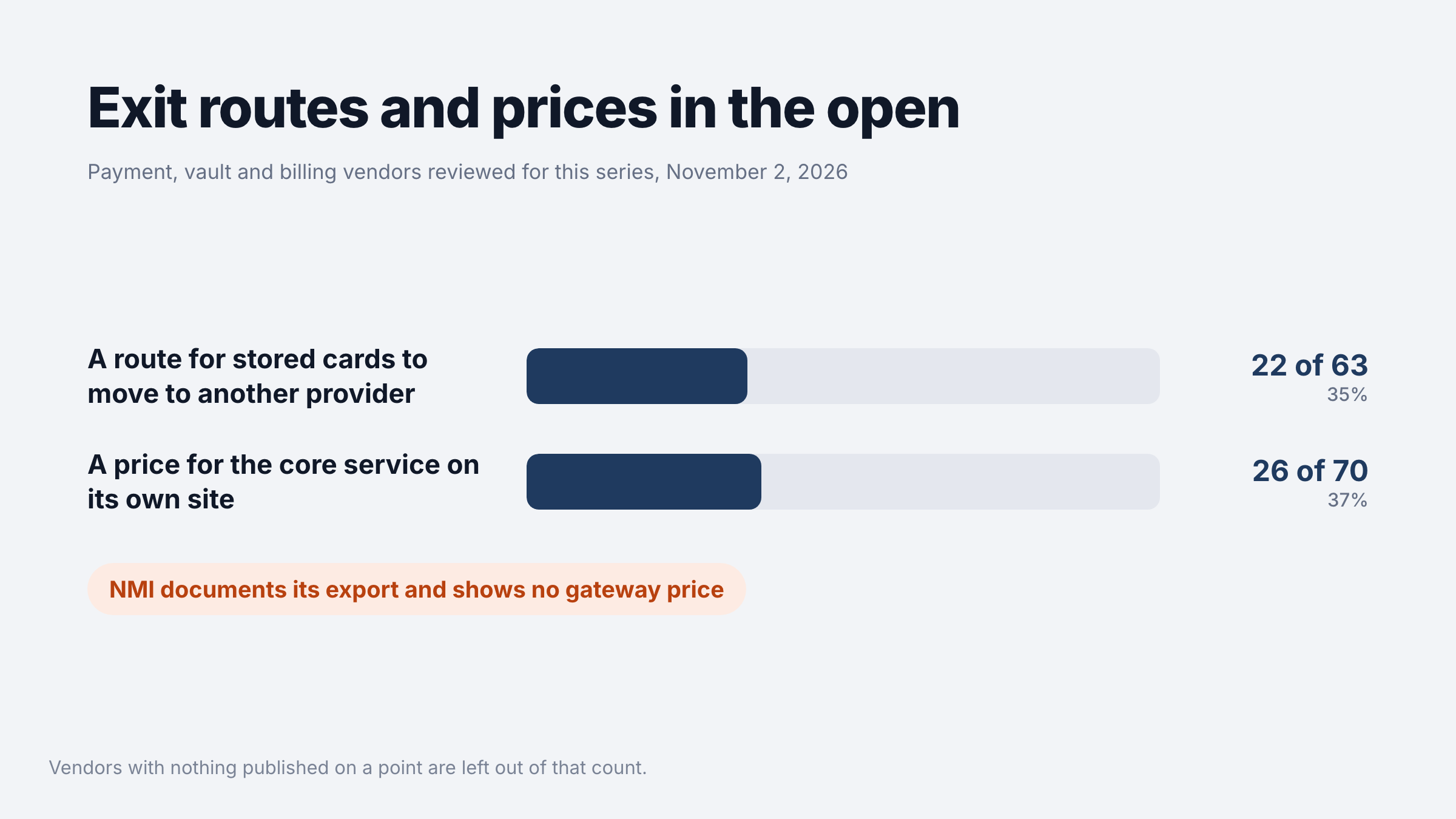
Prices are another matter, with 26 of 70 vendors showing one for their core service. NMI publishes an export fee and no gateway price, so it doesn’t count. Network Merchants, its legal entity, holds a PCI DSS validation in Visa’s registry through April 30, 2027. These counts date from November 2, 2026.
What to verify before you sign
Reselling a gateway means your merchants inherit whatever your vendor’s contract says, so ask these before your first merchant goes live.
| Decision area | Question to ask | Evidence to request | Red flag |
|---|---|---|---|
| Exit cost | What does it cost to export 100,000 stored cards? | The fee schedule, in dollars at your volume | A fee quoted per record with no cap |
| Network tokens | Do our network tokens survive a move? | The token export policy | Tokens tied to one gateway or reseller |
| Bank payments | Are ACH, RTP and FedNow live or planned? | Live merchants on each rail | A roadmap slide instead of a live example |
| Merchant ownership | Who owns the merchant relationship if we part ways? | The contract clause on merchant data | Merchants routed back to the vendor |
| Hosting | Can we move to our own servers later? | The license terms and migration help | A license priced only after you ask to leave |
Work out the first row with your real card count, since a per-record fee looks small until you multiply it.
The bottom line
Pick NMI if you want a large channel, underwriting help and new products to resell, and you accept what leaving costs. Pick Akurateco, UniPay or eComCharge if you want to run the system yourself, Fluid Pay if you like the partner model at a smaller vendor, and Celeris for Latin America. Among NMI competitors, none of the five claims NMI’s scale, so decide how much of that scale your merchants actually use.
Questions about NMI competitors
Can merchants buy from NMI directly?
No. NMI sells only through partners, meaning banks, ISOs, PayFacs and SaaS providers.
How much does it cost to leave NMI?
An export costs $0.50 per record with a $500 floor, and 25 records is the smallest batch. Network tokens can’t be exported to other gateways or moved between NMI accounts under separate resellers. Its platform terms also say it has no obligation to hand over data after termination, so arrange the export before you give notice.
Which NMI alternatives can you self-host?
Akurateco runs on your own servers or cloud account, UniPay sells an on-premise license from $150,000, and eComCharge offers on-premises and lifetime license models.
Who is NMI’s closest competitor?
Fluid Pay comes closest on channel, as a partner-only gateway for ISOs and ISVs, and UniPay suits PayFacs that want to own the code.
Does NMI support bank payments?
Yes, and more so since it bought Dwolla in May 2026. Fluid Pay’s API and UniPay’s gateway also handle ACH, so ask each for live examples on the rails you need.