Inai’s site still opens with the banner “Inai is now part of Chargebee!”, more than a year after the deal was announced in September 2025. By December 2025 Chargebee was describing Inai’s revenue-recovery features as part of its own smart dunning. We found no statement from either company on whether Inai is still sold on its own, and that uncertainty is a reason to look at alternatives.
Key takeaways:
- Ask Chargebee first whether Inai is still available standalone, since neither company has said so publicly.
- Hyperswitch is the closest independent match, with free self-hosting, and Akurateco adds a branded gateway on your own infrastructure.
- Recurly and Orchestra print real prices, $249 a month plus 0.9% on Recurly Starter and $350 plus $0.03 a request on Orchestra Growth. Primer and Hyperswitch’s paid editions quote privately.
Do you want Inai’s analytics inside a billing suite, or an orchestration layer that stands alone? The five Inai competitors below are ranked for payment businesses and merchants looking at a payment orchestration platform. Prices and limits come from vendor pages and filings as of October and November 2026.
Inai in 2026
The product still exists on its own site, so it’s worth knowing what you’d be replacing.
What it sells
Inai is a no-code platform with three products. Observe handles payment analytics and optimization, Reconcile handles reconciliation and fee checks, and Revive retries failed payments with machine learning. Its orchestration layer reaches 50+ vendors and 300+ local methods across 180+ countries, with pay-ins, payouts and adaptive routing.
An active processor account of your own is required, at Stripe, Braintree or dLocal for example. Reconciliation connects without code to Adyen, Stripe, Braintree, PayPal and Cybersource, while processors such as Checkout, Worldpay and Fiserv go through its accounts team. Since joining Chargebee, Inai has told customers they can keep using its customer success address for support.
Its pricing page still lists Starter plans at $99 a month with one payment connector, but it also still advertises a December 2023 webinar, so confirm those prices with Chargebee.
What changed
The story here is ownership, and the timeline is short:
- Inai was founded in 2021, went through Y Combinator’s Summer 2021 program and raised a $4 million seed round led by Paua Ventures.
- In September 2025 Chargebee announced it had acquired Inai’s team and technology, on undisclosed terms, and said it would integrate them into its billing product.
- By December 2025 Chargebee said smart dunning already included Inai’s revenue recovery, and it sells Chargebee Reveal for payments intelligence.
What does that leave you to check? Whether a new contract would be with Inai or Chargebee, and whether payment orchestration across several providers stays on the roadmap outside a Chargebee subscription.
What users say
There’s nothing public to weigh. TrustRadius and SourceForge show no reviews and Trustpilot has no profile (as of October 29, 2026), so ask for a current customer on the same processors you use.
Inai competitors at a glance
The five vendors below cover the jobs Inai did, routing, recovery and fee visibility, but rarely all at once.
| # | Competitor | Best for versus Inai | Deployment | Pricing | Standout |
|---|---|---|---|---|---|
| 1 | Hyperswitch | An independent, open-source replacement | Self-hosted or hosted | Free community edition | Payment data in your own infrastructure |
| 2 | Akurateco | A branded gateway you can host | SaaS, own servers or cloud | Quote | Automated reconciliation included |
| 3 | Primer | Provider cost analytics at larger scale | Hosted API | No public price | Costs Overview benchmarks providers |
| 4 | Recurly | Keeping recovery inside billing | Vendor-run | From $249 a month + 0.9% | Payment orchestration on All-Access |
| 5 | Orchestra | Platforms whose customers bring providers | Library and REST API | $350 a month + $0.03 a request | New providers added at no cost |
Recurly and Orchestra are the two you can budget for now, and Hyperswitch’s free edition has engineering costs of its own.
How the competitors compare
We ranked a specialist first here, because Hyperswitch is the most direct swap for a merchant that wanted Inai’s independence.
1. Hyperswitch: open source and independent of any billing suite
Juspay open-sourced Hyperswitch in 2022. You can run the free Self-Host Community Edition, pay for a Self-Host Enterprise Edition or use Hyperswitch Cloud. Run it yourself and the payment data never leaves your infrastructure, on retention and residency rules you set. Reconciliation and revenue recovery, the jobs Inai’s Reconcile and Revive did, are listed as paid add-ons on the community edition.
Self-hosting rates as high overhead in its own docs, and PCI DSS becomes your problem. The enterprise sizing guide works from a reference of 25 million transactions a month. Stored cards can go out only to a compliant processor, encrypted and sent by SFTP.
Best for: a merchant with payment engineers that wants no dependence on one vendor’s roadmap.
Watch out for: Enterprise and Cloud prices aren’t published, and public reviews are few (4.9 from 9 on Product Hunt, 5.0 from 1 on SourceForge, as of October 29, 2026). The self-hosting checklist asks for Kubernetes, Rust and Postgres skills, and support on the free edition comes through public Slack and GitHub.
2. Akurateco: orchestration or a white label, wherever you host it
Inai’s reconciliation has a direct counterpart here. Akurateco’s payment orchestration platform matches transactions across providers and tracks settlement with automated reporting, and it lists failed-transaction recovery among its use cases. A white-label payment gateway, sold alongside it, lets PSPs and banks run the system under their own name.
Where it runs is your decision, whether SaaS, your servers or your own Oracle Cloud, Google Cloud, AWS or Azure account, at about 30 days for cloud and about 60 for dedicated infrastructure. Bring your acquirers through its 700+ ready connectors. Standard items include 150 built-in configurable fraud filters and a 99.95% uptime SLA. Allow 5 business days on average to go live, plus about 14 days for each new integration.
Best for: a PSP or merchant that wants orchestration with no billing suite attached.
Watch out for: funds and merchant accounts are outside what Akurateco does, so you need your own acquirers and any license.
3. Primer: cost analytics at scale
Primer’s Manage group is the nearest thing here to Inai’s Observe, with Observability, Monitors across providers, Reconciliation and a Costs Overview that benchmarks providers. Like Inai it isn’t a processor, so your processor contracts stay in place. It also raised a $100 million Series C in May 2026, which answers the question of whether it will keep investing, though its status page logged 11 incidents in the 90 days before October 23.
A support request gets you the card details on exit. Network tokens stay behind, tied to its requestor ID, and the next provider has to create new ones.
Best for: a larger merchant whose main goal is seeing and cutting provider costs.
The trade-off: it has no public rate card, and your order form sets a minimum term.
4. Recurly: recovery and billing in one contract
If you like the idea of Chargebee absorbing Inai, Recurly is the same shape from a different vendor, a subscription platform with routing inside. Accel-KKR, a private equity firm, took a majority stake in 2020. Starter runs $249 monthly and takes 0.9% of volume above the first $40,000 of billings each month, after a 90-day free trial. That covers 20+ payment gateways and 1 dunning campaign.
Payment orchestration across multiple gateways sits only on All-Access, sold on request at a $1 million billing volume minimum.
Best for: a subscription company that wants recovery and billing from one supplier.
Watch out for: after termination Recurly keeps your data for 30 days and then deletes it, exporting is your responsibility, and retrieval in that window may carry professional-services fees. Terms renew for a year at a time. Extras add up too, with Engage from $1,600 a month and RevRec from $850.
5. Orchestra: for platforms whose customers bring their own provider
Orchestra comes from the founders of InterFAX.net and PCIBooking.net, and it’s built for vertical SaaS, booking, membership and commerce platforms that take payments for their own customers, so you store each customer’s provider credentials and name the account on each transaction. It reaches 130+ payment providers and adds requested ones at no cost, in under two weeks after a review of the provider’s API.
Orchestra never holds funds, and pricing is public. Its own worked example has 3,000 requests a month on Growth costing $350 base plus 3,000 x $0.03, totaling $440, and refunds and captures count as requests.
Best for: a software platform with customers on different payment providers.
The trade-off: the docs say it isn’t a fraud engine or a reconciliation system, so Inai’s Reconcile has no equivalent here. Cards already stored at a provider stay there.
Where Inai sits among 70 payment platforms
Card export is the one measure we can apply to Inai from the data behind this competitor series, since the series holds no price or registry reading for it. Of the 63 vendors that publish anything on stored cards, 22 describe a route for them to move elsewhere. Inai’s setup rests on your own processor account, and it isn’t one of them.
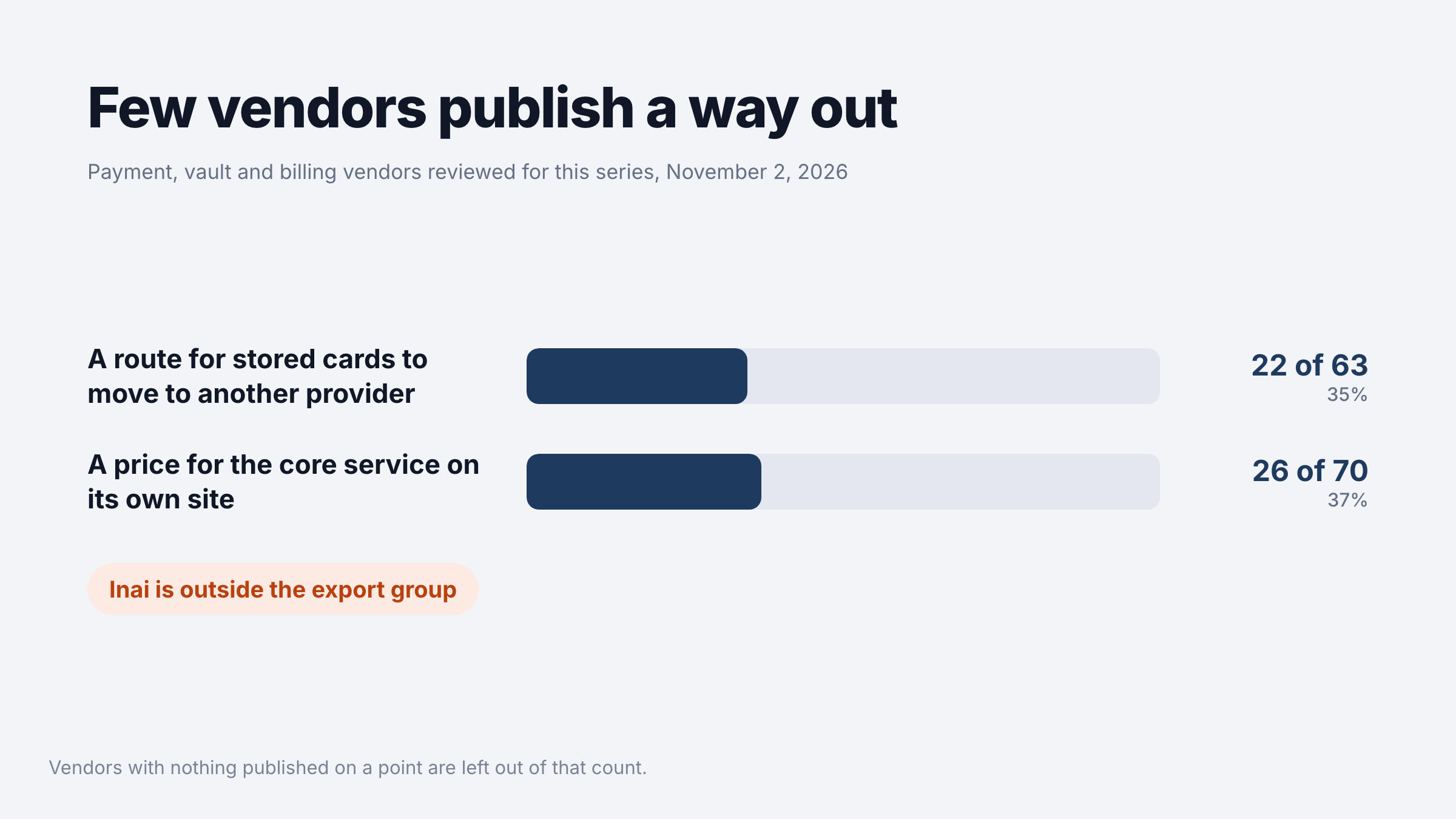
Hyperswitch, Primer, Recurly and Akurateco are in that group of 22, while Orchestra isn’t. Recurly and Orchestra are also among the 26 of 70 vendors showing a price for their core service. We ran these counts on November 2, 2026, leaving out any vendor silent on the point.
What to verify before you sign
Inai’s fee checks mattered for a reason. The UK’s Payment Systems Regulator found core scheme and processing fees rose by at least 25% in real terms from 2017 to 2023, and the Federal Reserve counted $34.12 billion in US debit and prepaid interchange in 2023. Whoever replaces Inai should show you those costs clearly.
| Decision area | Question to ask | Evidence to request | Red flag |
|---|---|---|---|
| Vendor status | Is this product sold standalone, and who signs the contract? | A named legal entity and a written roadmap | A product page with no contract owner |
| Fee visibility | Can we see scheme and processing fees per transaction? | A sample reconciliation report | Fees shown only as a monthly total |
| Recovery | How are retries billed and measured? | Recovered revenue on a control group | Recovery claims without a baseline |
| Processors | Does our processor connect without code? | The list of no-code connections | “We’ll check with our accounts team” |
| Data on exit | What can we take, and for how long? | The retention and export clause | Deletion without notice after termination |
A real sample report will tell you more than the demo, so ask for one with your own processors’ fee lines in it.
The bottom line
Start by asking Chargebee where Inai is heading. If the answer doesn’t satisfy you, Hyperswitch is the independent choice for teams with engineers, and Akurateco suits a payment business that wants its own branded platform. Primer fits larger merchants focused on provider costs, Recurly keeps billing and recovery together, and Orchestra fits software platforms. With any of these Inai competitors, see a fee report before you sign.
Questions about Inai competitors
Who owns Inai?
Chargebee does, having bought the team and technology. The deal was announced in September 2025, with terms undisclosed.
Is Inai still available on its own?
We couldn’t find out. The inai.io site still describes its products under a Chargebee banner, and we found no statement from either company, so ask Chargebee directly.
What are the best Inai alternatives for reconciliation?
Akurateco matches transactions across providers and tracks settlement, and Primer offers Reconciliation in its Manage group. Hyperswitch lists reconciliation as a paid add-on, and Orchestra says it isn’t a reconciliation system.
Are there free Inai alternatives?
Hyperswitch’s Self-Host Community Edition is free to license. You still pay for servers, from about USD 100 a month by its own estimate, and for the engineers who run them.
Did Inai sell payment orchestration?
Yes. Inai’s site describes routing across its payment vendors, and Chargebee said the deal lets merchants orchestrate payments across multiple providers.