From wending £10 at a time to contactless mobile cash facilities – a brief overview of ATM evolution
While modern financial operations are steadily moving towards digitalization, cash transactions are still the most convenient payment method in many cases. Rare sellers at local markets, taxi drivers in small private companies, elderly people, or residents of remote rural areas may shy away from technologies or see no point in them. Cash is still used to tip waiters, or even bribe some officials (not that we support that). Therefore, it seems that ATMs will remain part of an industrial landscape for a while. Where did they come from and how did they develop? That’s what this article is about.
On June 27, 1967, the first ATM was installed. So, next year ATM will celebrate its happy 60th anniversary.
What is ATM
The ATM is an Automated Teller Machine. It bears this name as it performs the functions of the nineteenth-century bank teller. Initially, it was created to substitute human efforts needed to grant a required sum to every individual bank client. Before ATMs and bank cards, all cash could only be received through the long process of counting and handling money personally at the bank cash desk. The ATM was a great revolution in the banking industry and may be considered one of the first steps to self-service and user comfort – an integral part of the modern financial world.
In their early days, ATMs were bulky, prone to fraudulent activities, and easily brought out of service by weather conditions. However, they kept being promoted and financed. The banking industry had an extreme necessity of reducing human labor costs and creating favorable working hours for their personnel. Their customers also craved more flexibility and smaller queues.
A few engineering teams were simultaneously working on the same concept around the globe, so the authorship of the invention is still under dispute among historians. Some track it down to Japan, while most common versions attribute ATMs to European and American inventors.
How ATM Concept Changed Throughout the Years
Throughout the decades the machines have evolved greatly. Starting from the simple vending machine able to deliver small cash amounts, the ATM was upgraded to decipher PIN-codes, print receipts, and identify customers by digital signatures. Most of them also offer direct buying of additional services and products, numerous bill payment options, charitable donations, or transferring money. Some ATMs are being fully transformed into contactless mobile cash facilities. Those allow getting cash without inserting a physical debit or credit card. Others support that function along with traditional cash withdrawal options.
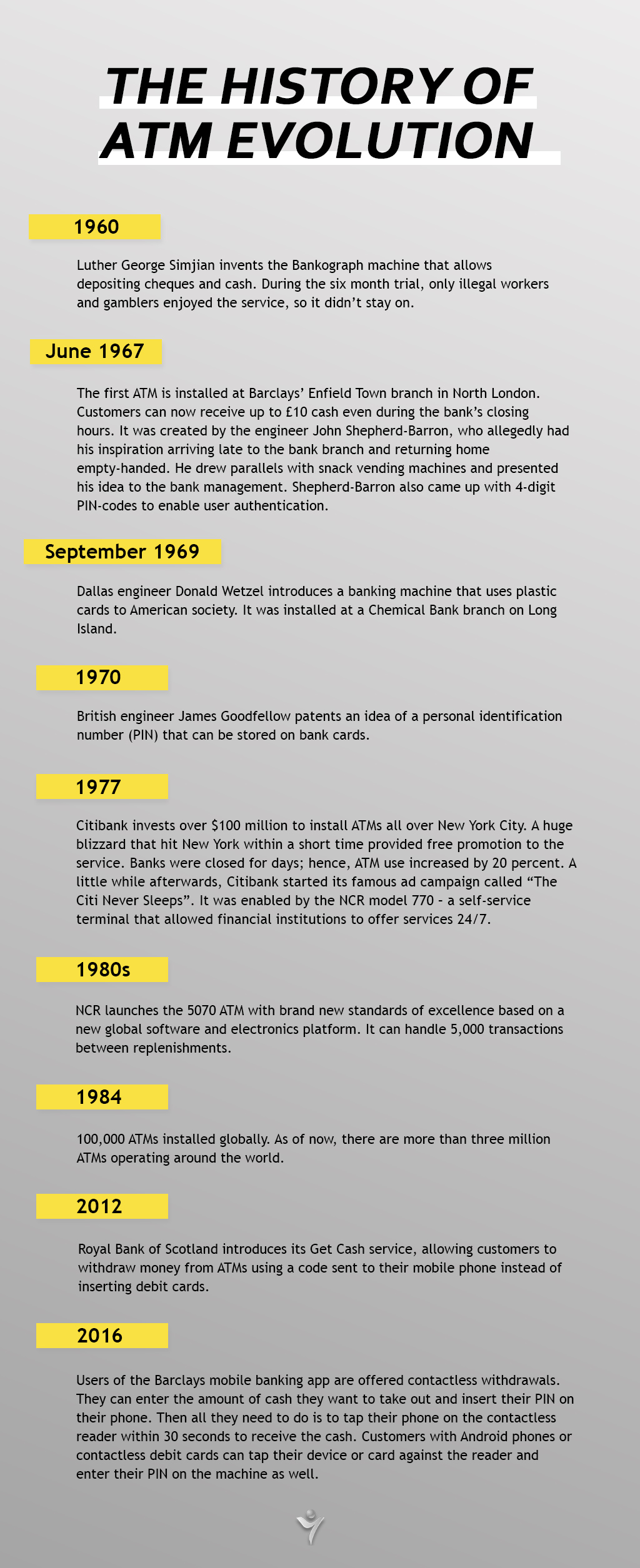
This short infographic illustrates the history of ATM evolution.
ATM Evolution in the Last Decade: From Plastic to Palm Scans
If the first half-century of ATM history was about teaching a machine to hand out cash, the last ten years were about teaching it to do so without a card, a PIN, or sometimes even a wallet. The ATM did not disappear in the age of apps. It simply learned a few new tricks.
Going cardless
One of the most visible changes was the rise of cardless withdrawals. Banks around the world began enabling customers to tap a smartphone or smartwatch on an NFC reader, or scan a QR code on the screen, and get cash without inserting plastic. The pandemic accelerated the trend, as nobody was keen on touching keypads, and many banks have since made contactless access a standard feature rather than a novelty. It also helped security: no card means nothing for a skimmer to copy.
Security gets personal
Fraudsters have never given up on ATMs, from card skimming to “jackpotting” attacks on the machine’s software. The industry responded with chip-and-PIN migration, anti-skimming hardware, and stronger encryption, and moved away from outdated operating systems. Some markets also began testing biometric authentication, including fingerprint, facial, and palm-vein recognition, so that the customer becomes the “card” (and, unlike a PIN, can’t be forgotten or shoulder-surfed).
Smarter, more flexible machines
Cash-recycling ATMs, which accept deposits and reuse the notes for withdrawals, cut cash-handling costs for banks. Interactive teller machines with video links to remote bank staff let branches operate with fewer people on site. Meanwhile, cloud-based management and “ATM-as-a-service” models allowed operators to update software and monitor fleets remotely rather than sending technicians to every machine.
Crypto joins the party
A newer type of machine appeared on the scene: the crypto ATM. These kiosks let people buy, and in some cases sell, digital assets for cash. Their number grew rapidly over the decade, along with regulatory attention. Authorities in several countries introduced licensing requirements, transaction limits, or outright restrictions, citing scam and money-laundering concerns.
Fewer machines, more attention
Interestingly, while ATMs became more advanced, their numbers in some mature markets began to shrink as card and mobile payments took over. This raised concerns about cash access for rural communities and vulnerable groups. In the UK, for example, regulators and industry bodies have worked on protecting free-to-use machines and shared “banking hubs.” So the cash-reliant customers we mentioned earlier are no longer an afterthought but part of a policy conversation.
What it adds up to
In ten years, the ATM has gone from a card-swallowing box to a connected, increasingly personalized touchpoint. Whether it will celebrate its 60th anniversary as a cash dispenser, a biometric kiosk, or a bit of both, it’s clear that reports of its death have been greatly exaggerated.