Google’s February 2026 Discover Core Update changes how content is recommended to users. Unlike traditional search, which focuses on queries, Discover shows content based on user interests, location, and authority. For media professionals, this update may have brought some visibility challenges, highlighting the importance of trust, expertise, and relevance.

In February 2026, Google rolled out a major Discover Core Update, changing how content is recommended to users in mobile and app feeds. Let’s face the truth, consumers are tired of completely irrelevant tons of “shocking” content literally attacking them at every corner. They just want their doom-scrolling to be perfectly aligned with what actually makes them excited or shocked.
The latest update emphasizes local relevance, author expertise, and content quality over all, moving away from engagement-focused signals like clicks, shares, or likes. Media professionals have been directly affected immediately: early reports show some publishers losing up to 40–50% of Discover impressions, especially for short, generic news pieces or content without visible expertise.
For outlets that rely on Discover as a traffic source, the update has created both a challenge and an urgent need to adapt editorial and content strategies. For more details on the update essentials, see the Google Search Central blog.
What Changed with the February 2026 Update
Local Relevance Matters More
Discover now favors content that is specific to a country or region over global coverage. For example:
- Spanish fintech media should reference an official CNMV release or Banco de España news instead of global or US-based news outlets.
- Brazilian financial media might benefit from citing a Banco Central do Brasil press release, CVM guidance, or IBGE data.
Generic international content may struggle to appear in local feeds. Moreover, the materials should be localized as well. You cannot possibly refer to the data of a specific central bank if you do not offer a local perspective on the topic at hand.
E-E-A-T Signals Are Stronger
Google now evaluates Experience, Expertise, Authority, and Trustworthiness (E-E-A-T) at the topic level:
- Articles by verified experts with visible credentials are prioritized.
- Financial and fintech content is reviewed for accuracy and sourcing.
- Original reporting and analysis are preferred over short news rewrites, media stories generated by AI, or aggregated content. See Google E-E-A-T guidelines for best practices.
You may think this must have long been the practice, but apparently, the search system honed its algorithms to the extent that what seemed like an expert opinion last year might appear superficial in the February 2026 Discover Core Update scrutiny.
Quality Over Clickbait
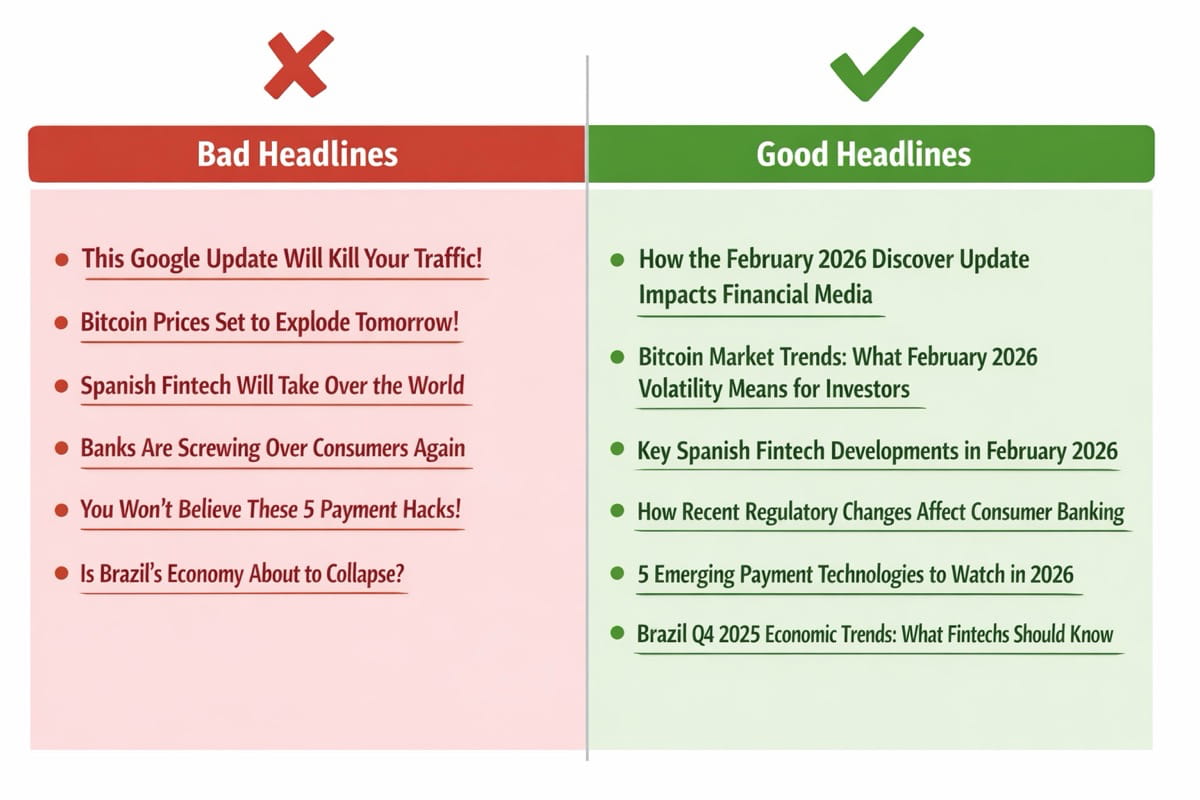
Content that uses sensationalist language or artificial urgency is being demoted. Bad news for publishers that relied on viral hooks. They may now see traffic drops if the content behind that flashy title lacks depth or credibility. Here are just some examples of the clickbait language one should not abuse these days:
Why Media Professionals Are Affected
For finance, fintech, and business outlets, Discover has been an important traffic source. The update affects:
- Traffic: Early reports show some Spanish publishers losing 40–50% of Discover impressions when content lacked local context or expert signals. Similar situation is observed in other regions too.
- Audience trust: Low-quality or generic content can drive readers away, not to mention trying to block your resource for the future.
- Editorial strategy: Teams must balance speed with depth, accuracy, and authority. If you report something first, you may get more user clicks, but the material will likely be more superficial, thus lacking in E-E-A-T terms.
Steps to Protect Your Discover Traffic
Given the Discover Core Update focus, the stay-in-the-loop tips are not that original and actually simple in practice.
Localize Content
- Include local market data, regulatory references, and country-specific examples.
- Spanish media: link to CNMV official release and Banco de España news. Reference INE statistics for economic data.
- Brazilian media: reference Banco Central do Brasil press release, CVM guidance, and IBGE data.
Strengthen Author Expertise
- Make contributor credentials visible in bylines.
- Maintain consistent topic coverage to show expertise.
- Focus on original analysis, not just reporting news from other sources.
Focus on Depth Over Volume
- Produce fewer, longer articles with detailed insights.
- Include expert quotes, regulatory commentary, and data-backed insights.
- Differentiated content performs better than short, generic updates.
Improve Visuals and Layout
- Use high-quality, localized images (minimum 1200px width) with captions in the local language.
- Avoid generic stock images.
- Embed charts from official sources like CNMV charts or Banco Central/IBGE graphs to illustrate trends.
- Ensure fast mobile performance and clean layouts.
Maintain Neutral, Accurate Language
- Avoid sensationalism or speculation, especially in finance.
- Use clear, precise headlines that match article content.
Country-Specific Checklist for Discover Success
- Official regulator link — CNMV, Banco de España, Banco Central do Brasil, CVM.
- National statistics — at least one concrete figure (INE for Spain, IBGE for Brazil).
- Author credentials — visible and verifiable, with links to past coverage.
- Local expert quote — regulator, academic, or industry professional.
- High-quality visuals — images with captions in local language, 1200px+ width.
- Fact-based language — avoid exaggeration or clickbait.
How to Pitch and Link for Discover
- Include official source links for credibility.
- Provide a short “why it matters locally” note to help editors contextualize.
- Offer mini data packs (like charts from INE, IBGE, CNMV, or central banks) in the local language.
Key Takeaways
The February 2026 Discover Core Update shows that Google prioritizes trust, expertise, and relevance over engagement tricks. For media in fintech, finance, and YMYL sectors, here are a few practical tips on staying relevant:
- Localize content and cite authoritative sources
- Strengthen author and topic expertise
- Focus on analytical depth and original insights
- Use quality visuals and mobile-friendly layouts
- Maintain clear, factual language
Publishers who adapt quickly will not only protect their Discover traffic but also gain a competitive advantage as weaker, less credible content is demoted.