Retail forex and CFD brokers compete hard on the word “free”. Free trading platforms, free market data, free education, and for active clients a free virtual private server to run trading software around the clock. None of it is a gift. All of it is paid for from the same place: the spread and commission on the client’s own trades.
Following that money explains a lot about how the retail trading business works. It shows why perks are designed the way they are, why a large affiliate industry sits between brokers and their clients, and why the most active traders hold more bargaining power than most of them use.

Where a broker’s revenue comes from
A retail broker earns most of its trading revenue in one of two ways. On a standard account, the cost is built into the spread: the broker quotes a slightly wider price than it gets from its liquidity providers and keeps the difference. On a raw or ECN-style account, the spread is close to the market price and the broker charges an explicit commission instead, commonly around $7 per round-turn standard lot. A round turn is one full trade, opened and closed, and a standard lot is 100,000 units of the base currency.
Some brokers also take the other side of client trades rather than passing them to the market. That model raises its own questions and is outside the scope of this piece. What matters here is the basic shape of the business: revenue scales with client volume, while much of the cost base (technology, licences, staff, compliance) is fixed. An active client who trades hundreds of lots a month is worth far more to a broker than a casual one, and brokers price their marketing accordingly.
Perks are a marketing budget
Seen from the broker’s side, every perk is a line in the client acquisition and retention budget. The question is never whether the perk is free, but whether it costs less than the revenue the client it attracts will generate.
That is why the better perks come with conditions. A free VPS is typically offered to clients who keep a minimum balance or trade a minimum monthly volume, set so that the commission from the client comfortably covers the hosting bill. At scale, a basic Windows server that can run a trading terminal costs a broker very little. To the client it looks like a meaningful benefit.
Perks also share a structural feature that is easy to miss. Their value is fixed. A server is worth the same to a client who trades 10 lots a month as to one who trades 500. The revenue the broker earns from those two clients is not remotely the same.
The partner layer: affiliates and introducing brokers
Perks are only one way a broker spends money to win clients. The other is paying the people who bring them in.
Almost every large retail broker runs a partner programme for affiliates and introducing brokers (IBs). The terms are published as ceilings rather than fixed rates. Pepperstone, for example, advertises partner earnings of up to 50% of the spread and commission its referred clients generate. Exness advertises up to 40% of its revenue from referred clients. Some programmes pay a one-off fee per funded client instead, which aggregator sites list in the hundreds of dollars for major brokers.
Revenue share is the model that matters most for active traders, because it is paid per lot for the life of the account. Rebate services, which sign up as IBs and pass part of their share back to traders, advertise figures of around $1.50 per round-turn lot on popular raw accounts.
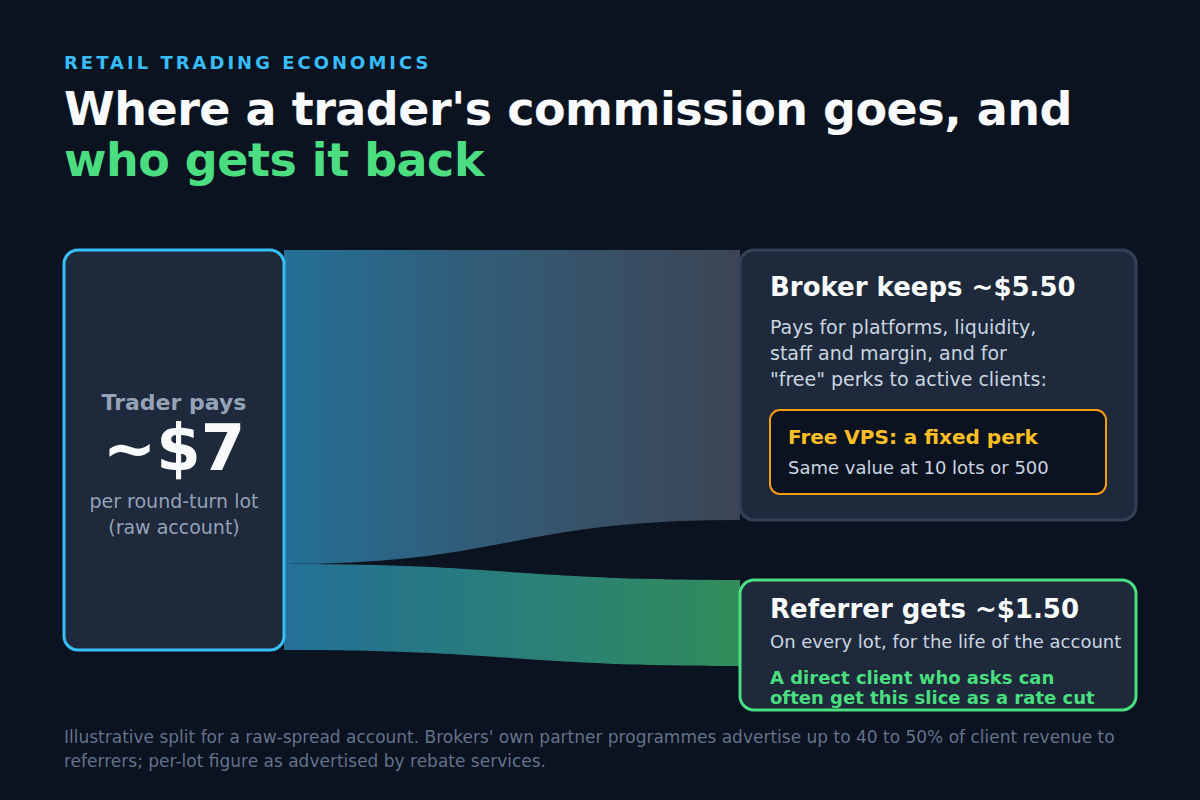
The point is not the exact figure, which varies by broker, account type and region. It is that on every lot a referred client trades, a slice of the commission already exists that the broker has decided it can give away.
Rebate services: a fintech layer built on the IB model
The partner model has produced its own small fintech sector. Cashback and rebate services register as introducing brokers with dozens of brokers at once, then return most of the per-lot payment to the traders who sign up through them, keeping a margin for themselves. Some run dashboards that track volume and rebates across several broker accounts, much like a loyalty programme sitting on top of the trading relationship.
For the broker, nothing changes: it pays the IB share it had already budgeted for. For the trader, part of their own commission comes back in cash. Rules on referral payments and client inducements vary between regulators, and some jurisdictions restrict how these arrangements can be offered, so the model looks different from one market to the next.
What it means for active traders
Put the two spending lines side by side and a choice appears. A broker can return value to an active client as a fixed perk or as a variable rate. The perk is simpler to market. The rate is usually worth more.
Consider a trader on a raw account doing 100 round-turn lots a month. A reduction of $1 per round-turn lot, well within what the partner economics above suggest a broker can afford, is worth $100 a month. That is more than a typical retail VPS costs to rent, and it keeps growing as volume grows, while the perk stays the same size. For the hosting question specifically, this breakdown of what a free broker VPS really costs works through the numbers lot by lot, including the volume at which a rate cut overtakes the free server.
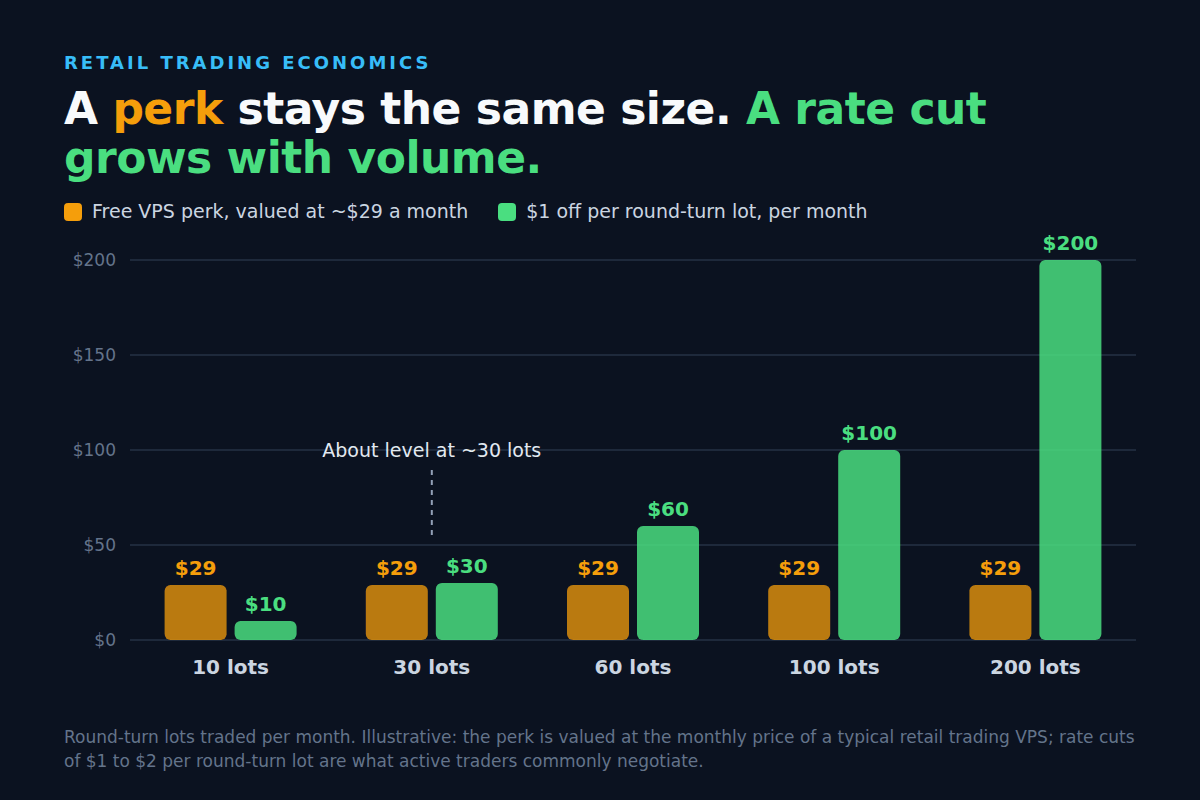
None of this means perks are a bad deal. For a client trading a few lots a month, a free VPS is worth more per lot than any rate cut a broker is likely to offer, and taking it is sensible. The trade-off only tips the other way once volume rises.
For active traders, the practical steps are straightforward:
- Know your real volume. Use the last three to six months of statements, not plans.
- Ask for the active trader terms. Many brokers have volume tiers that are not advertised on the main pricing page.
- Put a number on each option. Multiply any per-lot saving by monthly volume and compare it with the cash value of the perk.
- Ask for both. A broker that wants to keep a high-volume client has room to offer a rate and a perk together.
What it means for the industry
The “free” model persists because it works for brokers. Visible, fixed-cost perks are cheap to advertise and easy for clients to understand, while per-lot pricing is harder to compare and easier to leave unexamined. The growth of rebate services suggests that a meaningful share of traders have worked out the underlying economics and want the variable value rather than the fixed one.
For fintech companies building around retail trading, whether in payments, partner technology, or trading infrastructure, the lesson is the same one the brokers already apply: the economics run per lot. Any product that sits in that flow is ultimately priced against the slice of the round-turn commission that someone, somewhere, has decided can be given back.