ACI Worldwide set November 5, 2026 for its third-quarter results, after a busy September. It agreed to buy card-switching developer Cranium Ventures on September 1, and on September 22 it said ACI Connetic will support payments orchestrated through Swift’s ledger. Both moves sit on the banking side, so a retailer or PSP looking at the ACI Payments Orchestration Platform is buying a different product from the same company.
Key takeaways:
- ACI sells to banks, billers and merchants, and most of its 2026 news concerns Connetic, its banking hub, rather than merchant orchestration.
- Aurus and Payrails are the closest here for in-store payments, ModoPayments promises a move by changing a URL, and PaymentIQ is built for iGaming.
- Akurateco’s white-label gateway serves PSPs and banks who want their own brand, on servers they can control.
Are you buying for your stores, your website or your own merchants? The five ACI Worldwide competitors below are ranked for retailers and PSPs choosing a payment orchestration platform. Vendor numbers were read on each company’s own site or in its filings in October or November 2026.
ACI Worldwide in 2026
Founded in 1975 and listed on NASDAQ, ACI runs three businesses, so be clear which one you’re being sold.
What it sells
ACI Connetic serves banks, ACI Speedpay handles bill payments, and the ACI Payments Orchestration Platform serves merchants and PSPs. That last one processes without tying you to an acquirer and routes across 160+ countries, with clients in 94 countries and fraud prediction drawing on a pool of 1 trillion+ transactions.
In stores it supports PAX, Android and Apple terminals on existing hardware, with point-to-point encryption and gift, private-label and loyalty cards, and its omnichannel tokens aren’t tied to an acquirer, stay under your control and can be imported from elsewhere. There’s no rate card. The page routes buyers to Contact Sales. Total 2025 revenue was $1.76 billion, up 10%, of which $1.21 billion was recurring.
What changed
Four of these five updates concern banks or investors:
- On August 6 it reported Q2 revenue of $430 million, up 7%, raised full-year guidance and said it had signed two US customers for Connetic.
- An August 27 survey found retail payments professionals picked richer payments data as orchestration’s top benefit (47%) and cost reduction through competitive routing the least (19%).
- It agreed on September 1 to acquire Cranium Ventures for Connetic for Cards.
- On September 22 it extended Connetic to Swift’s ledger.
- It set November 5 as the date for third-quarter results.
On the merchant side, PaySpace Magazine reported Paze going into its Pay.On platform. The bank work follows the Swift ISO 20022 cutover of November 22, 2025. For retailers, the US Census Bureau still puts e-commerce at 17.1% of total retail sales in Q2 2026, so most retail spending happens offline.
What users say
Public scores are barely usable. Gartner Peer Insights shows 5.0 from 2 ratings, in a retired Online Fraud Detection market, and Trustpilot shows no reviews (as of October 29, 2026). Oracle Retail’s partner guide gives ACI its own chapter for Xstore, which is better evidence of retail use than either.
ACI Worldwide competitors at a glance
Read the “best for” column as a question about where your money comes in.
| # | Competitor | Best for versus ACI | Deployment | Pricing | Standout |
|---|---|---|---|---|---|
| 1 | Akurateco | PSPs and banks wanting their own brand | SaaS, own servers or cloud | Quote | White-label payment gateway |
| 2 | Aurus | Grocers and convenience retail | Vendor platform across stores | Flat fees, no list | 95+ processors in 25+ countries |
| 3 | ModoPayments | A move with little integration work | Vendor-run | No public price | API Transpose |
| 4 | PaymentIQ | iGaming operators | SaaS | Quoted per operator, per a third party | 260+ PSPs |
| 5 | Payrails | Online and in-person on one stack | Vendor-operated vault | No public price | US Merchant of Record option |
None of ACI’s rivals here prints a full price, so a detailed request for quotation will do more work than any comparison page.
How the competitors compare
ACI’s size is hard to match, so each profile looks at what you gain from a narrower vendor.
1. Akurateco: software a PSP can make its own
ACI offers PSPs a route to local and cross-border acquirers. Akurateco gives them the platform itself, through a white-label payment gateway that PSPs and banks brand on dashboards, domains and merchant portals, next to its payment orchestration platform for merchants. Its bank page also covers merchant onboarding, routing, a brandable payment page and merchant settlements.
The stack can stay SaaS or move onto your own servers or an AWS, Oracle Cloud, Google Cloud or Azure account, taking about 30 days if it’s a cloud account and about 60 if it’s dedicated hardware. Acquirers are yours, joined up through 700+ ready connectors. Numbers to hold against ACI include 150 built-in configurable fraud filters, a 99.95% uptime SLA, 5 business days on average to start processing and about 14 days for a new integration.
Best for: a PSP or bank that wants its own branded platform rather than a seat on a vendor’s.
Watch out for: Akurateco won’t process funds or open merchant accounts for you, and in-store terminals aren’t a focus of its product pages.
2. Aurus: store payments for grocers
Stores come first here. AurusPay is a unified payments platform across 95+ processors in 25+ countries, serving grocers, convenience and neighborhood stores. The product list runs from X-Switch, certified with multiple processors and device agnostic, to StorePlace for three-way reconciliation and TokenVault, where only the token is shared with the merchant.
Pricing is a contrast with percentage models, described as flat fees with no per-transaction fees and hardware passed through at cost. It’s a founder-led company whose newsroom lists partnership announcements.
Best for: a grocery or convenience chain that puts terminals first.
The trade-off: no price list exists, and the site publishes no terms of service or page on exporting TokenVault data, so request both.
3. ModoPayments: a move by URL change
ModoPayments says it has been orchestrating payments since 2010 and builds for Fortune 500 companies and high-volume platforms. The pitch is speed. Its API Transpose presents an API matching the one you use today, so integration is often a single URL endpoint change. Its CyberSource docs describe swapping the hostname while Modo mirrors the rest.
Banks and processors can buy white-label orchestration, APIs, routing and fraud tools through a separate enablement offer.
Best for: an enterprise on CyberSource or Stripe that wants orchestration with minimal engineering.
Watch out for: there’s no price on the site, and its legal index carries website terms rather than a customer agreement. If you let Modo hold your provider credentials, its docs describe no hand-back process.
4. PaymentIQ: built for iGaming
Worldline finished selling PaymentIQ to Incore Invest on March 2, 2026, making it a standalone company. It connects merchants to more than 260 PSPs through a single integration and calls itself the leading orchestration platform for iGaming. Cashier Plus, launched on September 8, 2026, lets payments teams design and test the cashier without developers.
Its homepage cites 630M+ transactions a year and 99.99% system uptime. That figure isn’t an SLA.
Best for: an online casino or sportsbook that wants a specialist.
The trade-off: no price list exists on its site, and it says nothing public on token export, contract length or notice period.
5. Payrails: in-person and online without the bank business
In-person payments, still in preview in its docs, sit next to online ones on Payrails’ modular platform, which also handles payouts, analytics and reconciliation. It connects to SAP and Forter as well as PSPs, counts Puma and Vinted as customers and struck a strategic partnership with Mastercard in 2025. A Merchant of Record option covers digital products, though its docs support only the United States so far.
Best for: a fast-growing merchant that wants ACI’s channel mix from a company focused only on merchants.
The trade-off: no price list is public. At over $52 million raised it’s also a far smaller company, so ask about its roadmap for stores.
Where ACI Worldwide sits among 70 payment platforms
Visa’s provider registry lists ACI products by name, including the ACI ReD1 Gateway and BASE24, which puts it with the 52 of 61 vendors we found there. For this competitor series we also checked whether vendors describe a route for stored cards to leave. Only 22 of 63 do, and ACI’s tokens page covers importing rather than exporting.
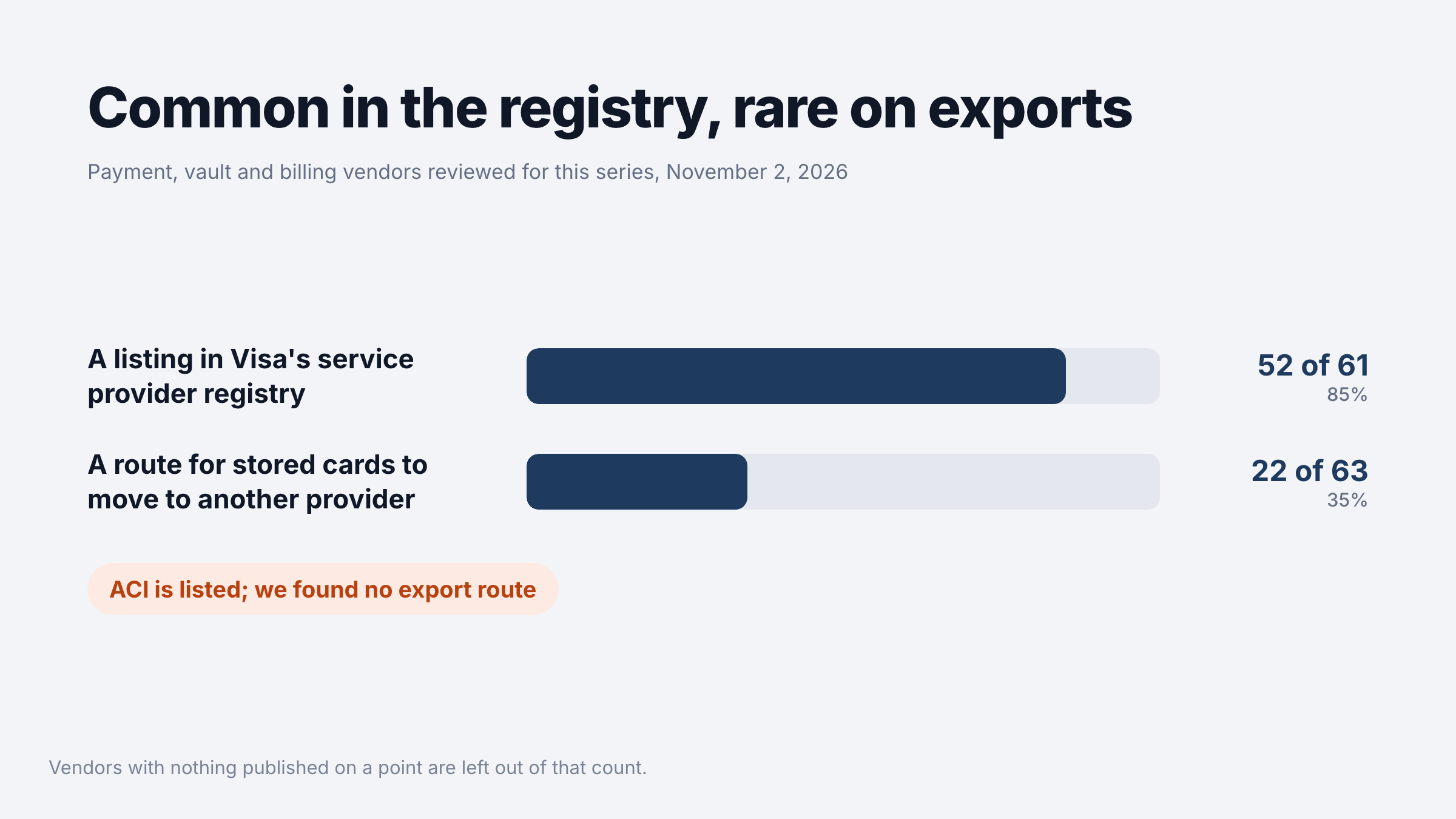
Payrails describes an export route and Akurateco’s migration guide says card data goes back to the client on request, while Aurus documents no export in what we read. We found no ModoPayments listing in Visa’s registry. All counts are as of November 2, 2026, and they skip vendors with nothing published on the point.
What to verify before you sign
ACI’s own survey found 47% of retail payments professionals valued richer data most, and only 19% picked cost reduction through competitive routing. So ask about data first, whichever vendor you’re meeting.
| Decision area | Question to ask | Evidence to request | Red flag |
|---|---|---|---|
| Product roadmap | How much of your investment goes to merchant orchestration? | The merchant roadmap for the next 12 months | A roadmap that talks only about banks |
| Store terminals | Do you support our existing devices? | The certified device list | A forced hardware swap |
| Data access | Which fields can we export per transaction across channels? | A sample export | Channel data in separate reports |
| Tokens | Can tokens leave as easily as they arrived? | The written export procedure | Import documented, export not |
| Pricing | What is the full fee at our volume, by channel? | A signed quote by channel | A blended figure with no breakdown |
Make the first row a formal question in your request for quotation, because a company with three businesses has to choose where its engineers go.
The bottom line
If you’re a large merchant with stores, ACI’s reach and history are real strengths, as long as the merchant product stays a priority. Grocery chains should look at Aurus, enterprises in a hurry at ModoPayments, iGaming operators at PaymentIQ and growing merchants at Payrails.
Among ACI Worldwide competitors, a PSP or bank that wants its own branded platform should start with Akurateco.
Questions about ACI Worldwide competitors
What does ACI Worldwide sell?
ACI Connetic for banking, the ACI Payments Orchestration Platform for merchant payments and ACI Speedpay for bill payments.
Who are ACI Worldwide’s main competitors in orchestration?
For merchants, Payrails and ModoPayments come closest, Aurus competes in grocery and convenience, and PaymentIQ focuses on iGaming.
Akurateco competes for PSPs and banks.
Does ACI Worldwide publish its prices?
No. The orchestration page routes buyers to Contact Sales, and the ACI Worldwide alternatives here mostly do the same.
Which ACI Worldwide alternatives work in stores?
Aurus specializes in store payments across 95+ processors, and Payrails lists in-person payments on its platform. Akurateco and PaymentIQ focus on other channels.
When does ACI Worldwide report its next results?
It set November 5, 2026 for its third-quarter results, with a conference call at 8:30 a.m. ET, so check its investor page for anything newer.