Why haven’t we seen stablecoin checkout options at major retailers and businesses in dozen years since their inception and which financial technologies can radically change that now?
We explore that together with Juan Pablo Ortega, the co-founder and CEO of AI-native financial infrastructure company Yuno. In this interview, Juan Pablo explains stablecoin checkout changing mechanics, regional regulation differences that affect how crypto payments might be implemented, and the role payment orchestration plays in facilitating crypto checkout.
Stablecoins are slowly but steadily reaching mainstream checkout. What’s the simplest way to explain what a merchant actually gets from turning them on?
Stablecoins give merchants one more way to get paid, built for the customers that cards serve poorly. In practice that means faster settlement, fewer intermediaries on cross-border payments, and access to buyers in markets where card access is uneven or local currencies are volatile. With Yuno, it is a toggle rather than a project: merchants switch it on through their existing integration, keep the rest of their payment stack as it is, and can receive funds as soon as the same day.
During the time you’ve dealt with crypto checkout options, what are your observations on who drives most demand: merchants, infrastructure providers, or end customers?
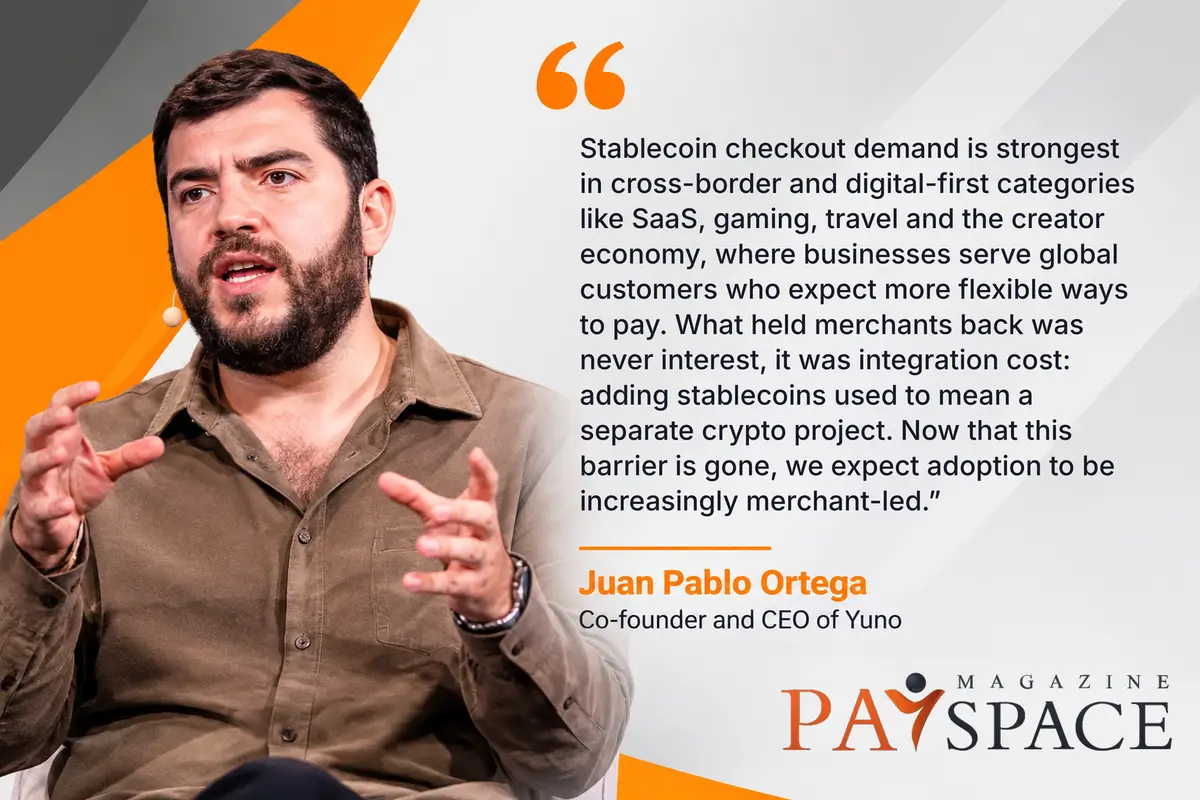
End customers start it, merchants respond, and infrastructure is what makes it scale. Demand is strongest in cross-border and digital-first categories like SaaS, gaming, travel and the creator economy, where businesses serve global customers who expect more flexible ways to pay. What held merchants back was never interest, it was integration cost: adding stablecoins used to mean a separate crypto project. Now that this barrier is gone, we expect adoption to be increasingly merchant-led.
Many businesses say they would pay in stablecoins, but a recipient still has to convert and withdraw to a local bank. Whose job is to make that last step as smooth as checkout: the platform, the exchange or the bank?
The platform, because the platform owns the merchant relationship. Exchanges and banks provide the rails, but the merchant should never have to stitch them together. Historically, accepting stablecoins meant combining a crypto gateway, wallet infrastructure and a separate conversion flow into fiat. Our job as the orchestration layer is to make that invisible: the merchant chooses whether to settle in fiat or stablecoin, and conversion, compliance and payout happen behind a single integration.
In many surveys, recipients claim they would pay/receive payments in stablecoins only at proper levels of regulatory compliance and clarity. How is the situation with that in APAC, where Yuno has one of the HQs?
APAC is moving from consultation to licensing, at different speeds in each market. Hong Kong’s Stablecoins Ordinance has been in force since August 2025, and the HKMA granted its first issuer licences in April 2026. Singapore published draft legislation to implement its single-currency stablecoin framework in September, and Japan already has regulated yen stablecoins live. Korea is still finalising its framework. So the clarity merchants were waiting for now exists in the region’s main hubs, though not yet everywhere.
In APAC, you work with regional PSPs like Xendit, 2C2P and Ant International. What do local partners offer merchants compared to global providers’ capabilities?
Local depth. Regional partners bring domestic acquiring with higher approval rates, the wallets and QR schemes consumers actually use in each country, local-currency settlement, and licences and regulator relationships market by market. Global providers bring reach and consistency. Merchants need both, and choosing between them should not be a one-time decision. That is exactly what orchestration is for: routing each transaction to the provider most likely to approve it, at the lowest cost.
Can APAC be treated as one stablecoin market? What main national differences should payment providers observe when dealing with this region?
No. APAC is a set of markets with different rules, currencies and licensing models, and no jurisdiction passports another’s licence yet. Payment providers should watch four things: which currencies can be issued locally, who is allowed to issue (bank-led models versus payment-institution routes), where restrictions or outright bans apply, and how far along each country’s legislation is. The right approach is to build locally and orchestrate regionally.
In October, Coinbase named Yuno its first global commerce orchestration partner for Coinbase Payments Acceptance. What does that role involve in practice?
It means stablecoin checkout is now a native payment method in the Yuno stack, sitting alongside cards, bank transfers and local wallets. We integrated Coinbase Payments Acceptance into our platform, so any Yuno merchant can offer one-click stablecoin checkout globally with no additional development work. In practice, Yuno handles the integration, routing, reporting and reconciliation, and merchants activate it the same way they would turn on any other payment method.
Your upcoming SFF session asks whether cross-border mutual recognition through sandboxes is now closer or farther. What’s your honest answer in one sentence?
Closer on paper, still far in practice: regulators are converging on the same principles, but until one market’s sandbox or licence is recognised in another, every cross-border pilot still starts from zero.
Looking ahead to 2027, which is not so far away, are there any payments initiatives in Asia-Pacific we should look forward to that would make stablecoins just another regular checkout option rather than a novelty?
Three things stand out. First, Nexus, which aims to link the instant payment systems of India, Malaysia, the Philippines, Singapore and Thailand, with go-live targeted for 2027. It will force stablecoins to prove their value next to fast, cheap fiat rails, which is healthy. Second, the completion of Singapore’s stablecoin legislation and Korea’s Digital Asset Basic Act. Third, licensed stablecoins in Hong Kong and Japan moving into real distribution.
Stablecoins become ordinary when merchants stop asking “crypto or not?” and start asking “which rail approves this payment at the lowest cost?”. That is a routing decision, and routing is what we do.
About the speaker
Juan Pablo Ortega is leading the development of Yuno’s global payments platform, helping major brands simplify and improve payment operations across multiple markets. Under his leadership, Yuno has grown rapidly and integrated AI deeper across its platform. Before Yuno, Juan Pablo co-founded Rappi, one of LatAm’s fintech unicorns.