Whop heads into the final weeks of 2026 with a headline most fintechs would envy. The company announced a US$200 million Series D led by Sequoia at a US$5.1 billion valuation, and it now publishes localized versions of its payments pages in more than ten languages, from German and French to Japanese and Turkish. For businesses weighing it against established checkout and billing stacks, the more useful question is what sits behind the funding announcement.
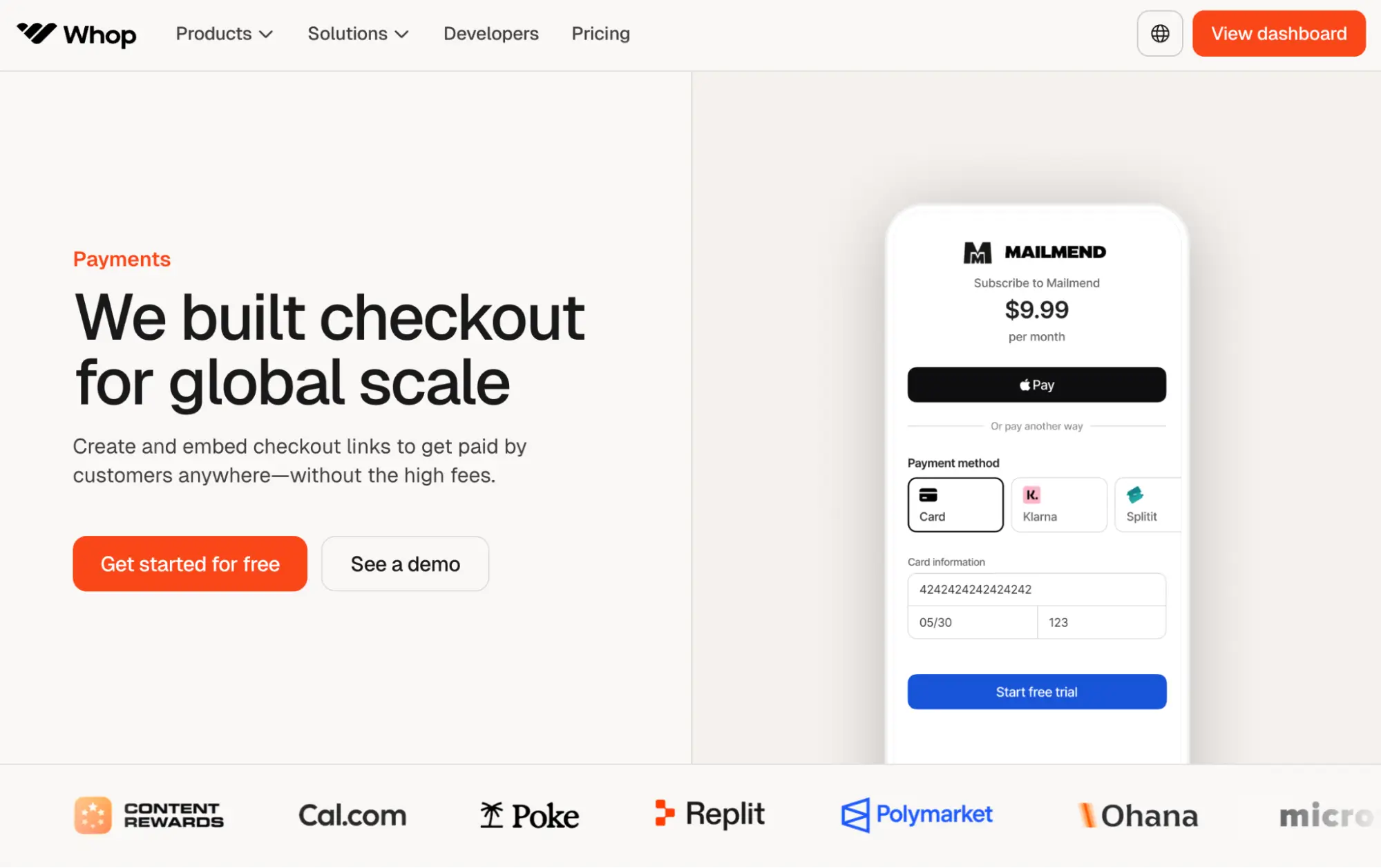
This review looks at Whop’s payments offer as documented on its own site and developer docs, alongside the regulatory backdrop European merchants face in 2026.
Key takeaways
- Whop sells a payment platform built around three things: checkout, subscription billing and global payouts.
- Card payments start at 2.7% + US$0.30 with no subscription to pay; cross-border cards, FX and add-ons push that higher.
- Its orchestration layer chooses a provider for each transaction based on approval odds, which the company says lifts authorisation rates by 5 to 10%.
- Payout coverage is broad, with recipients in more than 160 countries in 2025 according to the company.
- Merchants selling mostly domestically in Europe will often find cheaper card pricing elsewhere.
Whop in 2026
What it sells
Whop groups its payments product into three blocks.
Accept payments. Checkout can live behind a shareable link or sit inside the merchant’s own product. Non-developers get no-code payment links and invoices; engineering teams get payment components and API documentation. Over 100 local payment methods are listed, and instalment options come via financing partners.
Pay users. Businesses that need to send money out, such as referral programmes or affiliate schemes, can pay recipients through Instant ACH, PayPal, SEPA transfer, cash pickup, bank wire and other methods. Recipient verification can run inside the platform’s own app through an embeddable KYC component, and according to Whop a user can earn up to US$5,000 before verification is required.
Send invoices. Invoices can be created and paid without code, and automated billing handles invoice generation, retries and the subscription lifecycle.
What changed
Three developments stand out this year:
- Funding. The Series D gives Whop a much larger balance sheet to invest in coverage and compliance.
- Localization. Whop’s site now carries a language selector covering English, German, Spanish, French, Hungarian, Portuguese, Chinese, Italian, Dutch, Polish, Japanese and Turkish, with market-specific versions of its payments pages.
- Scale. The company says it powers more than 27,000 businesses.
What users say
Whop’s own site features testimonials from founders. Ali Ansari, founder of Micro1, says Whop “has been super great in helping us automate all payouts on our referral platform for micro1.” Dris Elamri, founder of Instinct, says: “we’re using Whop for all payouts and it’s been extremely smooth sailing.” These are quotes selected by Whop and should be read as such. Independent reference calls with merchants of similar size remain the better test.
Pricing at a glance
| Item | Published fee |
|---|---|
| Signup and monthly fee | Free, no monthly or SaaS fee |
| Domestic card | 2.7% + US$0.30 |
| International card | +1.5% |
| Currency conversion | +1% |
| SEPA Direct Debit | 1% + €0.30 |
| Bancontact | 3.9% + €0.30 |
| US bank debit (ACH) | 1.5%, capped at US$5 |
| Financing (BNPL) | 15% per successful transaction |
| Orchestration (optional) | 0.8% |
| Automated billing (optional) | 0.5% |
| Tax calculation and remittance (optional) | 2% when tax is collected |
Source: Whop fee documentation and payments pages, checked 9 November 2026. Rates in Latin America differ and are published separately.
Two details matter for European merchants. First, the fixed portion of each fee is priced in US dollars and converted into the settlement currency when the payment happens. Second, not every local method appears in every checkout: Whop’s documentation states that iDEAL is shown only on store or product page checkout, not on direct links or embedded checkout, and the customer’s location decides which methods appear.
How orchestration works
Most of the interest in Whop among payments teams centres on orchestration. Rather than sending every transaction to a single acquirer, Whop picks, payment by payment, the provider with the best odds of approval and falls back to another when a charge is declined. Stripe, Adyen and Airwallex are among the integrations it lists, and it claims a 5 to 10% lift in authorisation rates. Merchants should treat that figure as a vendor claim and measure it against their own decline data during a pilot.
The regulatory backdrop
European merchants evaluating any payments provider in 2026 are doing so against a changing rulebook. In November 2025 the European Parliament and Council reached a provisional deal on new payment services rules, including stronger fraud protection and a requirement that fees and charges for payment services be transparent. Separately, the European Commission confirmed that from 9 October 2025 payment service providers in the euro area must offer instant euro payments and free payee verification.
Demand is not the constraint. Eurostat reports that 78% of EU internet users bought goods or services online in 2025. The competition is over approval rates, local methods and cost.
What to verify before you sign
- Your blended rate. Model a real month of transactions, including the share of international cards and currency conversion, plus any optional features you would switch on.
- Local method coverage by checkout type. Confirm that the methods your customers use appear in the checkout format you plan to deploy.
- Settlement timing. SEPA Direct Debit, for example, settles in about six business days according to Whop’s documentation, longer than cards.
- Payout corridors. If you pay people in specific countries, confirm the available methods and fees for each one.
- Orchestration results. Ask for a pilot and compare authorisation rates against your current provider.
The bottom line
Whop is a strong fit for businesses that sell across borders, bill on subscription and need to pay people in many countries from the same account. Its orchestration layer and payout coverage are the main differentiators. It is less compelling for merchants whose volume is mostly domestic European cards, where the base rate and US dollar fixed fee will usually cost more than local alternatives. As with any provider, the published price is the starting point, not the answer.
FAQ
Is Whop free to start? Yes. Opening an account costs nothing, and Whop charges per transaction rather than a subscription.
Does Whop work without developers? Yes. Payment links and invoices need no code. Embedded checkout and payment components are available through the documentation.
Which countries can receive payouts? Whop says it supports all non-sanctioned countries, and reports payouts to more than 160 of them last year.
Are Whop’s fees the same everywhere? No. Latin American rates differ, and international cards and currency conversion add to the base rate.