As the world marks International Women’s Day 2026, the fintech sector finds itself at a crossroads: celebrated for its innovation and disruption, yet still grappling with deep-rooted gender imbalances that limit its true potential. The numbers tell a clear story and so do the women working within the industry.

Whether they are front-line practitioners, senior architects, or product leaders, the voices of women in payments, technology, and financial services reveal an uncomfortable truth: meaningful progress has been made, but structural barriers remain. This article brings together industry data and commentary from women leading the charge at Icon Solutions and Nexi Group to mark a day that is, as much as anything, a call to action.
The State of Play: Women in Fintech by Numbers
The gap between aspiration and reality in fintech remains stark. Despite representing half the global population, women are conspicuously absent at the decision-making levels of an industry that is reshaping global finance.
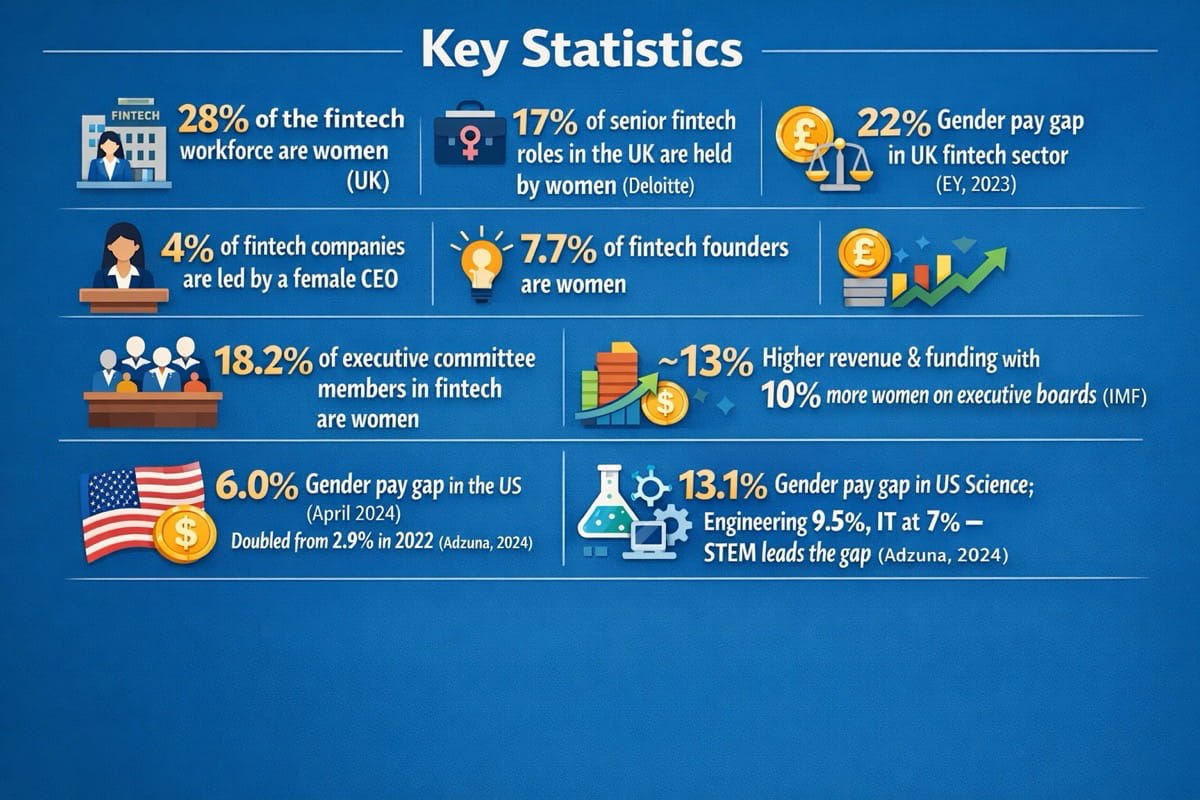
Statistics sources: Cambridge Finance and Society (2024), EY/Innovate Finance (2023), Deloitte, Gartner (2023), IMF Working Paper (2022), Adzuna (2024).
Why Diversity in Fintech Is Not Just an HR Issue
Gender diversity in fintech is a business imperative. Research from McKinsey has consistently shown that diverse teams perform better, hire better talent, and retain workers more effectively. The IMF has also found that a 10% higher share of women on fintech executive boards is associated with roughly 13% higher revenue and funding for those firms. And according to Gartner, getting diversity, equity and inclusion right can give a fintech business up to 30% better overall performance.
However, the actual picture is equally troubling across the Atlantic: Adzuna’s 2024 analysis of over one million US resumes found that the gender pay gap in the US doubled in just two years, reaching 6.0% in April 2024. In 2025, American women earned 83 cents for every dollar men made in full-time jobs and 75 cents for each dollar when including data for part-time and seasonal work. The disparity is sharpest in STEM fields, with a 13.1% gap in Science and 9.5% in Engineering, the very disciplines that power fintech innovation.
Beyond performance metrics, the stakes extend to the very products and services that fintech companies build. An industry that designs financial tools without gender diversity at the table risks building systems that underserve half its potential market, and that may inadvertently perpetuate the biases already present in financial data. The Financial Alliance for Women estimates that lending fintechs could see a 20% increase in gross margins simply by removing gender bias from their credit algorithms.
The triple glass ceiling — at the intersection of finance, technology, and entrepreneurship, identified by Cambridge researchers in 2024, underscores just how compounding these barriers can be. While men in fintech may just face one glass ceiling, women need to tackle three.
Voices from the Industry
This year, senior women representatives from Icon Solutions and Nexi Group shared their perspectives on the challenges facing women in fintech and technology, and what they believe needs to change. Their reflections offer candid insight into an industry that continues to evolve, but not yet fast enough.
On the Pipeline Problem: Starting Earlier
“Women continue to be underrepresented within the payments and technology industries, often shaped by early perceptions that computing is ‘a boy’s hobby’. Real change must start earlier, through inclusive initiatives and education that encourage more girls to pursue careers in technology. Graduate recruitment can still be gender-stereotypical, and this must evolve. Initiatives targeting 50% female graduate intake would help create a more balanced and representative industry.
Within technology, women bring valuable perspectives, particularly in AI training and deployment. Emotional intelligence and empathy, often described as ‘soft skills’, are increasingly critical as AI systems influence real-world decisions. Without gender diversity in AI development, there is a risk of reinforcing existing bias. Diverse teams, guided by ethical thinking and broader perspectives, are better positioned to build responsible AI. Women are already leading important conversations within AI ethics forums. So, the next step is turning those discussions into meaningful industry-wide action.”
Tamsin Crossland, Principal AI Architect, Icon Solutions
On Progression and Creating Space for Every Voice
“International Women’s Day has left many women reflecting not only on progress, but also on where the technology and payments industry still needs to improve. When I first started studying programming, only 4 of the 90 students were women, but now I can see a stronger gender balance in parts of the IT industry. But women remain significantly unrepresented, especially at managerial and c-suite level. Many women enter the industry, but too few progress into leadership roles, despite having the technical and regulatory expertise the sector demands.
One of the biggest challenges is that women’s voices are not always heard. Inclusion is not only about representation, but about creating environments where different perspectives are encouraged and valued. Women often bring intuitive, collaborative approaches that strengthen teams and decision-making, yet it can be difficult to speak up, particularly for those who are quieter or earlier in their careers. Supporting confidence, recognising individual strengths, and actively creating space for women to contribute should be everyone’s responsibility.
My international experience has shown that inclusion looks different across cultures, but the common theme is clear: when women are given the opportunity to contribute, businesses benefit from greater diversity of thought. International Women’s Day reinforces this message. For me personally, it reflects values passed down through generations, that women have a voice, experiences to share, and a responsibility to support others. Through initiatives such as speaking in schools and encouraging young girls to consider careers in technology, we can help ensure the next generation feels confident entering industries where they remain underrepresented today.”
Kimberley Carriere, Senior Project Manager, Icon Solutions
On Cultural Shift and the Triple Glass Ceiling
“Across engineering, architecture, and fintech, women remain noticeably underrepresented, particularly in specialist and decision-making roles. When I first moved from engineering into architecture, it was clear how few women were in the room. While the landscape is becoming more diverse, progress is very slow. Too often, women are held back by preconceived notions, subtle prejudices, or cultural expectations that have been ingrained over many years. These influences often weigh on women and promote the notion that women are only suited for certain career paths. My experience has taught me to ignore the noise, trust in my capabilities, and enjoy the work. We are all human, and talent has no gender label.
Working in solution architecture has been both fun and deeply rewarding, but not without challenges. As with other women within the financial and technology sector, throughout my career, I’ve experienced both gender stereotyping and toxic masculinity, where I’ve often found my voice has been overshadowed by bigger egos. These experiences underscore the need for a genuine cultural shift within the finance and technology industry, one that values diverse perspectives and adopts an environment where everyone can contribute equally. Research has shown that diverse teams make better decisions, challenge assumptions, and build smarter solutions, and International Women’s Day helps keep that message front and centre, reminding us all there is still more work to be done.”
Sirin Sevinc, Head of IPF Solution Architecture, Icon Solutions
On Systemic Change and Leadership Accountability
“International Women’s Day is an important moment to stop and reflect on progress, not just intentions. Over the course of my career, the most meaningful shift I’ve seen is moving away from trying to ‘fix’ women and toward addressing systemic barriers that limit who gets seen, trusted and promoted.
Gender balance remains a glaring issue; women represent half the population but not half of leadership. That said, diversity must go beyond gender alone. Organisations perform better when they bring multiple voices, backgrounds and ways of thinking into the room, and leadership teams should be built with that in mind.
Real change happens fastest when it starts at the top. Measures such as leadership accountability and board-level representation aren’t about giving women an unfair advantage; they help counterbalance unconscious bias that has existed for decades. When diversity is embedded into culture, targets and ways of working, it doesn’t disappear with shifting political or economic narratives, it becomes an extricable part of how an organisation succeeds.”
Sarah Barslund Lauridsen, Chief Product Officer, Nexi Group
A New Frontier: Women, AI, and the Risk of Encoded Bias
Artificial intelligence is rapidly reshaping financial services in every aspect, starting from fraud detection and credit decisioning, and all the way up to customer experience and regulatory compliance. But the gender gap within AI development poses a significant risk. Only 12% of AI researchers globally are women, according to the WomenTech Network. Just 22-30% of the AI-related workforce are women, and they hold only 16% of AI tenure-track faculty roles. Furthermore, women in entry-level positions are less likely than men to be encouraged to leverage AI tools, which may contribute to a gap in real-world usage. At the same time, AI is the technology that shapes the future of our economies, job market, and even financial services.
If AI systems in fintech are built predominantly by men, they risk encoding existing societal biases into automated decision-making at scale. This is not a hypothetical concern one may scoff at. Multiple studies have documented gender and racial bias in algorithmic lending, hiring tools, and facial recognition systems. The solution, as Tamsin Crossland notes, lies in bringing more women into AI development roles and into ethics oversight: turning conversations about responsible AI into concrete industry action.
What Needs to Change
The commentary collected here points to several consistent themes that the industry must act on:
Early education and pipeline: Changing perceptions of technology careers must begin at school, not at the graduate recruitment stage. One example of such initiatives is Girl Scouts of the USA, who have taken tours hosted by the Amazon Tours team to meet women who work in STEM roles at Amazon and get inspired by their professional experiences and career paths.
Inclusive workplace cultures: Representation is necessary but not sufficient. Environments must actively make space for different voices, particularly for women who are quieter or earlier in their careers.
Progression into leadership: Women enter the industry in growing numbers but exit before reaching the top. In senior leadership, they hold just 29% of C-suite roles. Transparent promotion pathways and mentorship are critical.
Pay transparency and equity: The estimated 22% gender pay gap in UK fintech cannot be addressed without consistent salary banding and greater reporting accountability. In the US, Adzuna’s 2024 data shows the pay gap has doubled to 6%, with STEM sectors bearing the sharpest disparity — underscoring that this is a transatlantic challenge. In addition, in terms of diversity in VC funding, some of the Central and Eastern European (CEE) countries and other regions remain far behind.
Board-level accountability: As Sarah Lauridsen argues, real change happens fastest when it starts at the top. Leadership diversity targets, when embedded in culture, outlast political cycles.
Looking Ahead
International Women’s Day 2026 arrives at a moment of genuine inflection. The fintech industry has more female talent, more awareness of systemic bias, and more data on the business case for diversity than ever before. The question is whether the industry will act on what it already knows.
The women quoted in this article are representative of thousands of skilled professionals who are navigating structural barriers, advocating for cultural change, and building the financial infrastructure of the future. Their presence — and the growing community of women behind them — is both a cause for celebration and a reminder of how much further there is to go.
The path to an inclusive fintech industry is not a straight line. But it is, at last, clearly marked.
About the Contributors
Tamsin Crossland is Principal AI Architect at Icon Solutions, a senior AI and financial services technology leader with deep expertise in generative AI, payments, and fraud prevention. She has led the development of a Generative AI platform and co-authored a whitepaper with one of the world’s largest banks on the use of AI in payments.
Kimberley Carriere is Senior Project Manager at Icon Solutions, an experienced project manager and consultant with deep expertise in delivering complex technology and transformation programmes in financial services.
Sirin Sevinc is Head of IPF Solution Architecture at Icon Solutions. Since joining in 2016, she has partnered with many of Icon’s leading banking and payments clients to design and deliver fault-tolerant, high-volume, low-latency payments solutions.
Sarah Barslund Lauridsen is Chief Product Officer at Nexi Group, the European PayTech. She has worked in product and technology for more than two decades, with senior roles at Banking Circle, Nordea Markets, and Goldman Sachs.