Yuno added Coinbase stablecoin acceptance on October 5, 2026, five days after a Cyclops deal that opens up 30+ stablecoin infrastructure providers. Both follow a $45 million Series B announced on August 12, led by Global PayTech Ventures with Andreessen Horowitz and Tiger Global among the participants. It has spent the year adding rails, so check which ones are live for you.

Key takeaways:
- Yuno is vendor-run in two regions, US and EMEA. For your own infrastructure, look at Akurateco or a self-hosted Hyperswitch.
- MoneyHash goes deeper in the Middle East and Africa, naming regional banks, while Praxis and Ikajo handle regulated gambling and other high-risk business.
- Yuno publishes add-on unit prices such as $0.0101 for smart routing but no platform fee. Ikajo’s 1.2% is the one starting rate in this list.
Is your next market a place Yuno already reaches, or does your risk profile matter more? The five Yuno competitors below are ranked for merchants and payment businesses evaluating a payment orchestration platform, on vendor-published figures we checked in autumn 2026.
Yuno in 2026
Founded in Colombia, Yuno now describes itself as an AI-native intelligence system for global payments, so it helps to separate the claim from the product.
What it sells
The product is one API for pay-ins, payouts, fraud prevention and stablecoins, with multi-PSP routing, retries, account updater, network tokens, 3DS and reconciliation. Its integrations page now counts 1,000+ providers in 190+ countries, where its August release said 460+ integrations, and the buyers are merchants, banks and wallets, with customers including McDonald’s, NetEase Games, GoFundMe, inDrive and Rappi.
There’s a white-label side too. Banks and payment providers white-label its technology, dLocal among them, and a white-label dashboard controls which providers you offer.
Pricing is part public. Unit prices for add-ons sit in an image on its price list (smart routing $0.0101, network tokens $0.0150, a 3DS transaction $0.0353), while the Monthly Platform Fee is set in each order form. Tokens leave on written request, and the receiver must hold a current PCI DSS Attestation of Compliance.
Contract terms are public too. Leaving early means paying all remaining monthly fees within 30 days, renewal is automatic unless you give 60 days’ notice, fees can rise up to 8% on renewal with your written agreement, and late amounts carry 1.5% a month.
What changed
Most of the year’s news is new rails in new regions:
- On June 9 Yuno announced Onafriq, whose network spans 43 African markets, after Flutterwave in April.
- The Series B followed on August 12.
- On September 3 it added Revolut Pay and Revolut’s acquiring and gateway services, covering the UK, the EEA, Singapore and Australia.
- Cyclops arrived on September 30, giving access to 30+ stablecoin infrastructure providers.
- Coinbase acceptance followed on October 5.
PaySpace Magazine has covered the Gulf push too, with Snoonu as its first client in Qatar. Local rails are where the demand is. The World Bank’s Findex found 40% of adults in Sub-Saharan Africa had a mobile money account in 2024, and Brazil’s central bank counted 80 billion Pix transactions in 2025.
What users say
Public reviews are hard to find. Trustpilot returns page not found for y.uno (as of November 2, 2026), so its named customers are the main public evidence. Its status page gives a little more, with 0 incidents published in the 90 days to October 23 and 100% uptime shown for the Payments API. Ask for references in your own vertical and region before you rely on either.
Yuno competitors at a glance
Geography and risk appetite split these five more than features do.
| # | Competitor | Best for versus Yuno | Deployment | Pricing | Standout |
|---|---|---|---|---|---|
| 1 | Akurateco | Your own gateway, hosted where you choose | SaaS, own servers or cloud | Quote | 700+ ready connectors |
| 2 | MoneyHash | Middle East and African banks and methods | Vendor’s platform | No public price | 300+ live connections |
| 3 | Praxis | Licensed gaming and trading | Cloud-native on AWS | No public price | Named gaming licenses accepted |
| 4 | Ikajo | High-risk merchant accounts | Cashier as SaaS | From 1.2% | 60+ partner banks |
| 5 | Hyperswitch | Engineering teams wanting open source | Self-hosted or hosted | Free community edition | Payment data stays with you |
Hyperswitch’s free edition is the cheapest way in, once you’ve counted the engineers it needs.
How the competitors compare
Yuno’s reach is the benchmark, so each profile says what it does differently.
1. Akurateco: a gateway you run yourself
Yuno’s two regions, US and EMEA, are vendor-run, with separate dashboards and data. Akurateco can also sit on your own servers or inside your AWS, Google Cloud, Oracle Cloud or Azure account, which suits banks and PSPs under data-localization rules. Budget about 30 days on a cloud account and about 60 on dedicated infrastructure.
Beside its payment orchestration platform there’s a white-label payment gateway that PSPs and banks brand as their own, on merchant portals, dashboards and domains. You bring the acquirers. It brings 700+ ready connectors, a 99.95% uptime SLA and 150 built-in configurable fraud filters, with an average of 5 business days to begin processing and about 14 days for any new integration.
Best for: an institution that wants a branded system in an environment it controls.
Watch out for: processing funds and opening merchant accounts sit outside its scope, so acquirers and licenses are your job.
2. MoneyHash: built for the Middle East and Africa
Yuno added its Gulf and African rails by partnership. MoneyHash lists regional banks directly, and its 300+ live connections include Commercial Bank of Dubai and Dubai Islamic Bank, while Tamara, Kitopi and Brands For Less are named adopters and a Regional Director for Africa arrived on May 18, 2026.
MoneyHash also pitches itself as your payment team, working with clients on technical integrations.
Best for: a merchant whose growth plan runs through the Gulf or Africa and who needs regional bank connections.
Watch out for: its Terms (June 30, 2026) refer to a Pricing Page, yet /pricing returns a 404 and no page in its sitemap states a price. The exit clause covers personal data and doesn’t mention stored card numbers.
3. Praxis: regulated gaming and trading
Yuno’s gaming page is written for video games, in-game purchases and microtransactions. Praxis works with operators, and lists gaming licenses it currently accepts for onboarding, including Malta, Gibraltar, Curacao, the UK and Cyprus. For players, its cashier shows local methods by location, stores cards for one-step top-ups and cascades on declines.
Launched in 2014, it rebranded to Praxis Tech in 2022, and its case studies are Codere Online and INFINOX. The infrastructure is cloud-native on AWS.
Best for: a licensed casino, sportsbook or broker that needs a cashier as much as routing.
The trade-off: no price is published, and its card API returns masked numbers, so ask how stored cards leave. Trustpilot shows 3.4 from 25 reviews on an unclaimed profile (as of October 30, 2026).
4. Ikajo: merchant accounts for high-risk businesses
Yuno’s merchant terms carry no list of restricted industries that we could see, so a high-risk business has to ask. Ikajo starts from that business, helping merchants in gambling, forex, online dating, CBD and crypto open accounts through 60+ partner banks. Its Cashier routes and cascades across 100+ connectors in 150+ currencies.
Two business days is the quick case for a new account, and 31 days the slow one. At 1.2% the gateway price looks low, but gambling’s starting rate is 3%.
Best for: a high-risk merchant that needs the account first and the routing second.
The trade-off: settlement runs in USD or EUR only, and Visa’s registry shows nothing under the Ikajo name.
5. Hyperswitch: open source you run yourself
Juspay open-sourced Hyperswitch in 2022, and it comes as a free Self-Host Community Edition, a Self-Host Enterprise Edition and Hyperswitch Cloud. Self-hosted, your payment data stays in your own infrastructure and you control storage location, access and encryption, while its own blog estimates USD 100 to 1,000 monthly for infrastructure in one table and up to 1,500 in its FAQ, plus engineering time.
Stored cards leave only for a PCI DSS compliant processor, as a PGP-encrypted CSV over SFTP.
Best for: a merchant with its own payments engineers and a reason to control the code.
Watch out for: the merchant carries PCI DSS on a self-hosted install, and the checklist asks for skills in Kubernetes, Rust and Postgres. Integration counts differ by edition, 90+ self-hosted against 210+ on Cloud.
Where Yuno sits among 70 payment platforms
Yuno scores on two of three points in the data behind this competitor series. It’s among the 22 of 63 vendors that describe a route for stored cards to move, joined here by Hyperswitch. Three Yuno entities also sit in Visa’s service provider registry, with validations through March 31, 2027.
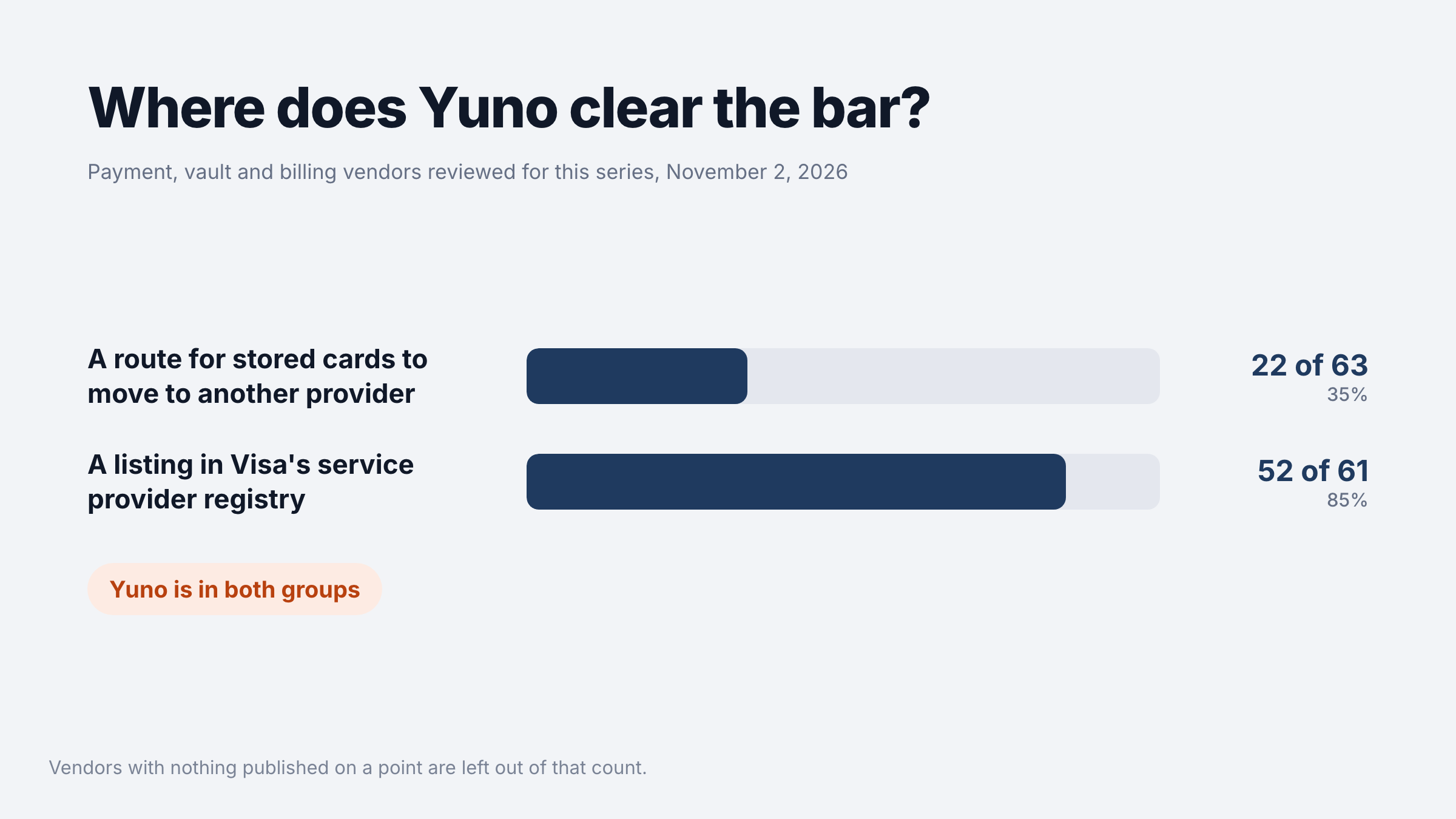
The registry is the less exclusive group, at 52 of the 61 we searched for. Akurateco, MoneyHash and Praxis are also listed, and Ikajo’s name isn’t. On price, Yuno counts as unpublished, since its add-on list leaves out the platform fee. These counts date from November 2, 2026.
What to verify before you sign
A list of rails tells you what’s connected, not what’s live for you. Test any of these vendors on your own markets and your own risk category.
| Decision area | Question to ask | Evidence to request | Red flag |
|---|---|---|---|
| Local rails | Which methods are live in our countries today? | Live connections by country | A directory that mixes planned and live |
| Data location | Where does our data sit, and can we choose? | The region and sub-processor list | One answer for every market |
| Stablecoins | Which provider holds the license for our flows? | The named partner and its authorization | Stablecoin support with no named entity |
| Risk category | Will our vertical be accepted, and on what terms? | The restricted list that applies to us | Approval only after integration |
| Exit | What must the receiver hold before tokens move? | The written export request process | No named contact for exports |
Run the first row for your two largest planned markets, which is usually enough to separate a live rail from a logo.
The bottom line
Choose by the market you’re entering next. Yuno claims the widest reach here and has the funding to keep adding to it. MoneyHash suits the Gulf and Africa, Praxis or Ikajo suit regulated and high-risk business, and Hyperswitch suits teams with engineers to spare.
Akurateco fits a bank or PSP that wants its own branded system. With any of these Yuno competitors, ask for live connections by country.
Questions about Yuno competitors
Does Yuno offer a white label?
Yes. Banks and payment providers white-label its technology, a white-label dashboard controls the providers offered, and its hosted payment link can run on your own domain without Yuno branding.
Who are Yuno’s main competitors?
Akurateco, MoneyHash, Hyperswitch and Praxis all sell orchestration, with different strengths in hosting, region and vertical. Ikajo competes where the merchant account matters most.
How much does Yuno cost?
Add-on unit prices are published, such as $0.0101 for smart routing, but the Monthly Platform Fee is set in each order form. Ikajo’s 1.2% gives you something firmer to compare in advance.
Which Yuno alternatives work for gambling?
Praxis lists the gaming licenses it accepts, and Ikajo opens gambling accounts at a 3% starting rate. Yuno’s gaming page is mainly about video games, so ask directly if you run a casino or sportsbook.
Are there open-source Yuno alternatives?
Yes. Hyperswitch has a free Self-Host Community Edition, though the merchant takes on PCI DSS and the running of the system.