Starbucks and Alipay together launched an AI-powered “Coffee Alarm Clock” in China. The new service allows consumers to schedule recurring Starbucks orders through Alipay’s AI agent, Ah Bao.
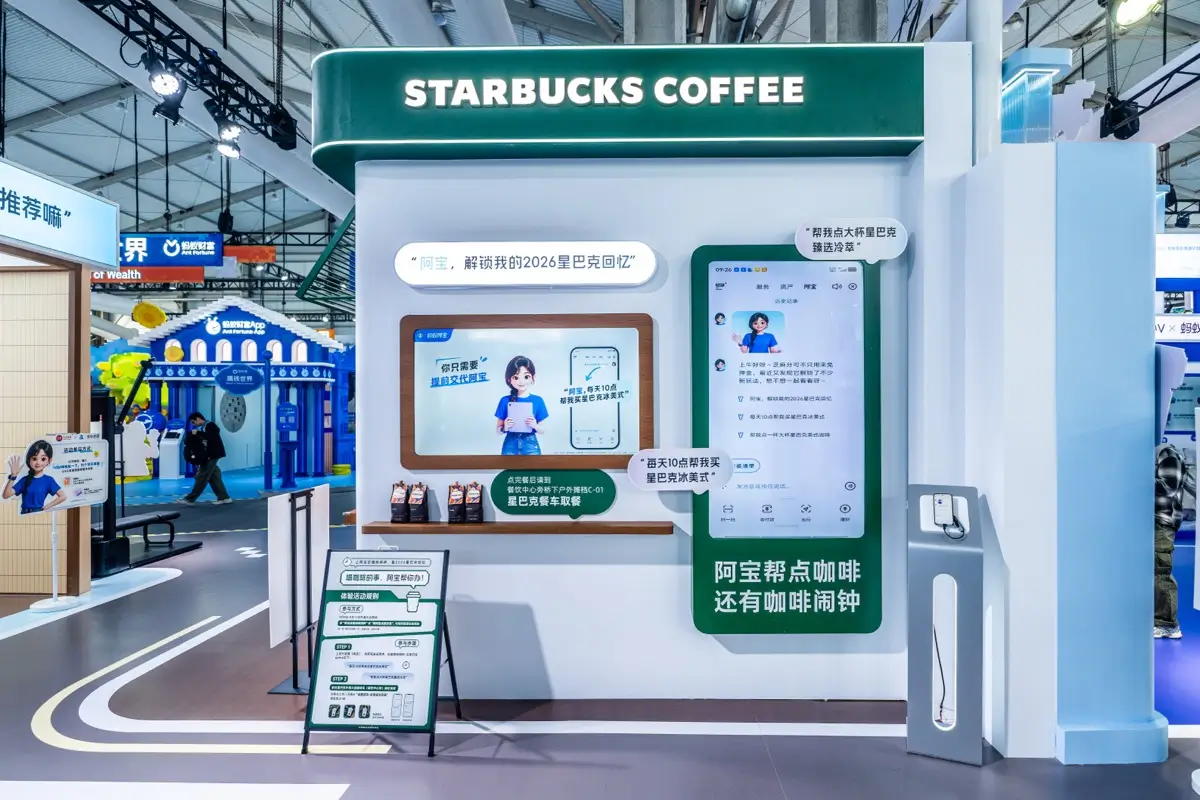
The service, unveiled on September 10 at the 2026 Inclusion · Conference on the Bund in Shanghai, helps cope with recurring tasks like ordering coffee. These are routines that would otherwise need to be initiated each day manually. Instead, users can give Ah Bao a voice instruction, e.g. ask it to order a Starbucks iced Americano at a specified time every day.
In the Alipay app, users can open Ah Bao, describe the service they want, give the alarm a name and enable Alipay notifications. Ah Bao then retains the instruction and initiates the service at the scheduled time.
At the same time, the agent does not automatically complete payment without user involvement. When the scheduled task is initiated, Ah Bao prompts the user to review the order and confirm and authorise payment. If the original instruction is incomplete, the agent can ask follow-up questions to clarify details. Users can also cancel a recurring task at any time.
This makes the agentic commerce feature relevant to services that users need repeatedly rather than for one-off purchases. In addition to recurring coffee orders, Alipay says Ah Bao can handle other scheduled daily tasks, including arranging rides in advance. A new “Service” module at the top of Ah Bao’s main page allows users to view and manage their active services.
Ah Bao was launched in June 2026. According to Alipay, it now provides more than 10,000 AI-powered everyday services across more than a dozen categories, including dining, hospitality, travel and pet care. These include paying utility bills, booking pet services, locating EV charging stations and hailing a self-driving car.
Several major retail brands have also integrated their services with Ah Bao. Alipay names McDonald’s, KFC, Mixue Bingcheng, Luckin Coffee and Haidilao among the companies whose services can be accessed through the AI agent for ordering and payments.
The service is also designed to work beyond the Alipay app. Ah Bao uses Alipay’s AHA protocol, which is intended to support interoperability between AI agents and devices. This includes smartphones, AI glasses and cars.
For Xiaomi smartphone users, for example, a request can be given to Xiaomi’s Xiao AI agent. Xiao AI can then work with Ah Bao to access supported services. Alipay says Ah Bao is currently integrated with five leading smartphone brands, collectively representing more than 70% of the market, as well as 16 automakers.
This cross-device setup means that access to services supported by Ah Bao does not have to depend on opening the Alipay app directly. A user could interact through a compatible smartphone, AI glasses or vehicle interface, depending on the device and service available.
Alipay also announced an annual investment of RMB 10 million in an Emerging AI Agent Award. The programme is intended to support developers, merchants and independent software vendors creating AI-powered consumer services.
Developers can use Alipay’s Qmuse programming tools to create AI agents using natural-language instructions without writing code. Selected services may have an opportunity to be commercialised through Ah Bao, while consumers with ideas for AI agents can also participate for cash prizes.