Choosing a white label payment gateway is no longer just a technical shortcut. For many payment service providers, fintech companies, acquiring banks, ISOs, PayFacs, SaaS platforms, and enterprise merchants, it is a strategic decision that shapes how they enter the payment market, manage merchants, control payment flows, and scale internationally.
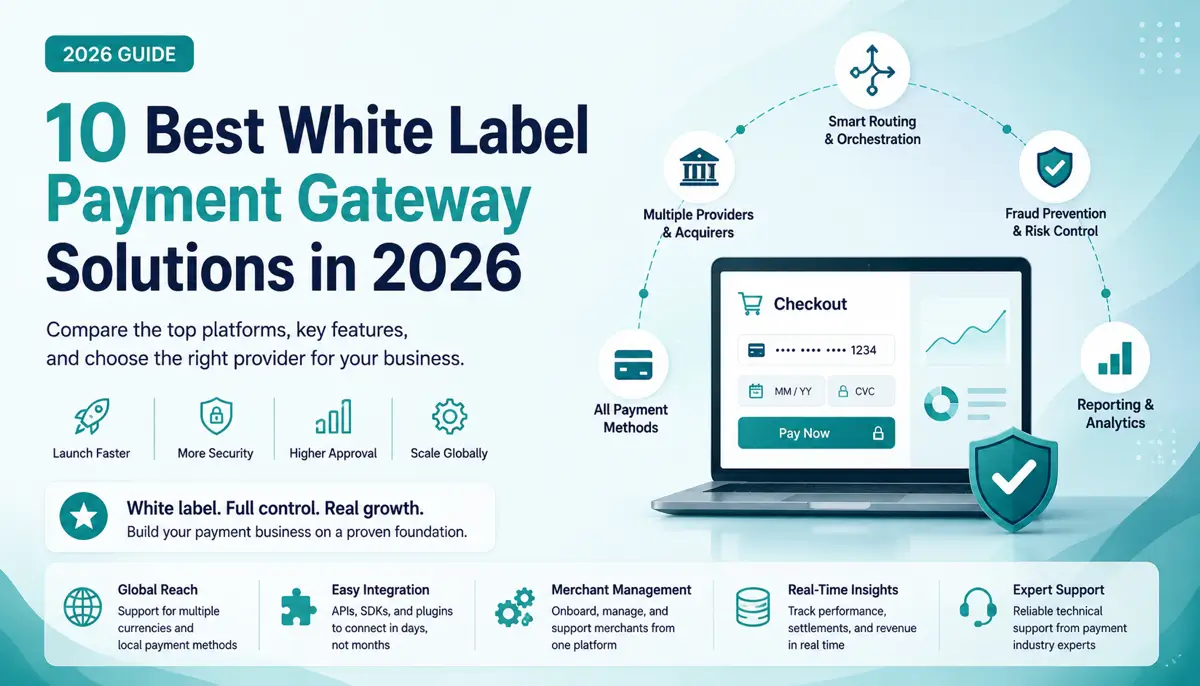
A few years ago, a white label gateway was often understood as a ready-made payment page with custom branding. In 2026, the expectations are much higher. Businesses now look for payment infrastructure that can support merchant onboarding, provider connectivity, smart routing, cascading, fraud management, tokenization, reporting, reconciliation, recurring payments, settlement visibility, and operational control.
The right provider can help a company launch payment services faster without building the whole infrastructure from scratch. The wrong provider can create dependency, technical limitations, weak routing logic, poor reporting, and high operational friction later.
This guide explains what a white label payment gateway is, how it works, what to consider before choosing one, and which providers are worth evaluating in 2026.
What Is a White Label Payment Gateway?
A white label payment gateway is ready-made payment software that a company can brand and operate under its own name. Instead of building a payment gateway internally, the company uses an existing technology platform and customizes it with its logo, colors, domain, interface, payment flows, and merchant-facing experience.
For the end customer or merchant, the platform appears to belong to the company offering the service. Behind the scenes, the technical infrastructure is provided by a specialized payment technology vendor.
This model is especially attractive for companies that want to enter or expand in the payment market but do not want to spend years building gateway infrastructure, maintaining PCI-related systems, developing integrations one by one, and hiring a large payment engineering team.
White label payment gateways are commonly used by payment service providers, acquiring banks, fintech startups, ISOs, payment facilitators, SaaS platforms, marketplaces, and enterprise merchants that want more control over payment processing.
How a White Label Payment Gateway Works
A white label payment gateway gives a business access to a pre-built payment infrastructure. The vendor provides the core technology, while the client configures the system around its own business model.
The process usually starts with defining the target markets, merchant segments, currencies, payment methods, provider connections, risk settings, branding requirements, and reporting needs. After that, the system is configured and customized. The client may connect existing acquirers, PSPs, banks, or alternative payment methods, or request new integrations from the vendor.
Once the platform is ready, the business can onboard merchants, process transactions, manage payment flows, monitor provider performance, and operate under its own brand. Depending on the provider, the client may also get tools for smart routing, cascading, fraud prevention, tokenization, subscriptions, invoicing, merchant billing, and analytics.
The main advantage is that the business does not need to reinvent the entire payment infrastructure. It can focus on commercial strategy, merchant acquisition, risk policy, customer relationships, and market expansion.
Why Businesses Choose White Label Payment Gateway Solutions
The main reason is speed. Building a payment gateway from scratch can take a long time and requires deep payment expertise. A white label model makes it possible to launch faster because the foundation is already developed.
The second major reason is cost efficiency. Instead of investing heavily in engineering, compliance, infrastructure, maintenance, and integrations, a business can use a ready-made system and pay for access, customization, support, and additional development when needed.
Another important reason is flexibility. Modern payment businesses rarely rely on one payment provider only. They need access to multiple acquirers, PSPs, local payment methods, card schemes, digital wallets, fraud tools, and reporting systems. A strong white label gateway makes this easier to manage from one place.
For PSPs and PayFacs, white label infrastructure can also create a faster path to market. They can build their own branded payment offering, onboard merchants, manage transactions, and develop a commercial model without owning every technical layer internally.
For enterprise merchants, the value is slightly different. They may not want to become a PSP, but they may want more control over routing, payment performance, reporting, and provider dependency. In this case, a white label or orchestration-based platform can become a way to control payment operations more strategically.
Key Benefits of a White Label Payment Gateway
A white label payment gateway can bring several practical advantages, but the real value depends on the depth of the platform.
The first benefit is faster time to market. Companies can launch payment services in weeks or months instead of spending years on internal development.
The second benefit is reduced technical workload. The vendor usually handles the core infrastructure, updates, maintenance, and platform development, while the client focuses on operations and business growth.
The third benefit is branding. A company can offer payment services under its own name, build trust with merchants, and create a more consistent customer experience.
The fourth benefit is payment provider diversification. Businesses can connect several acquirers, PSPs, and payment methods through one platform instead of building every integration separately.
The fifth benefit is payment performance optimization. Features such as routing, cascading, retries, provider monitoring, and transaction analytics can help businesses reduce failed payments and improve approval rates.
Finally, a strong white label platform gives operational visibility. Teams can see how transactions perform, where declines happen, which providers work better, how merchants behave, and where payment operations need improvement.
Possible Disadvantages to Consider
White label payment gateways are useful, but they are not risk-free. The biggest concern is provider dependency. Since the core infrastructure belongs to the vendor, the client depends on the vendor’s uptime, roadmap, support quality, security practices, and ability to add new functionality.
Another limitation is customization depth. Most white label platforms offer branding and configuration, but not every system allows deep changes to the underlying infrastructure. This may become an issue for businesses with very specific technical, compliance, or product requirements.
Pricing can also become complex. Some providers charge setup fees, monthly fees, transaction fees, support fees, custom development fees, or integration fees. Before choosing a vendor, businesses should understand the full commercial model, not only the advertised starting cost.
There is also the question of differentiation. If many companies use similar white label infrastructure, the business needs to create differentiation through service quality, pricing, merchant support, risk expertise, market focus, payment methods, and value-added features.
What to Look for When Choosing a White Label Payment Gateway
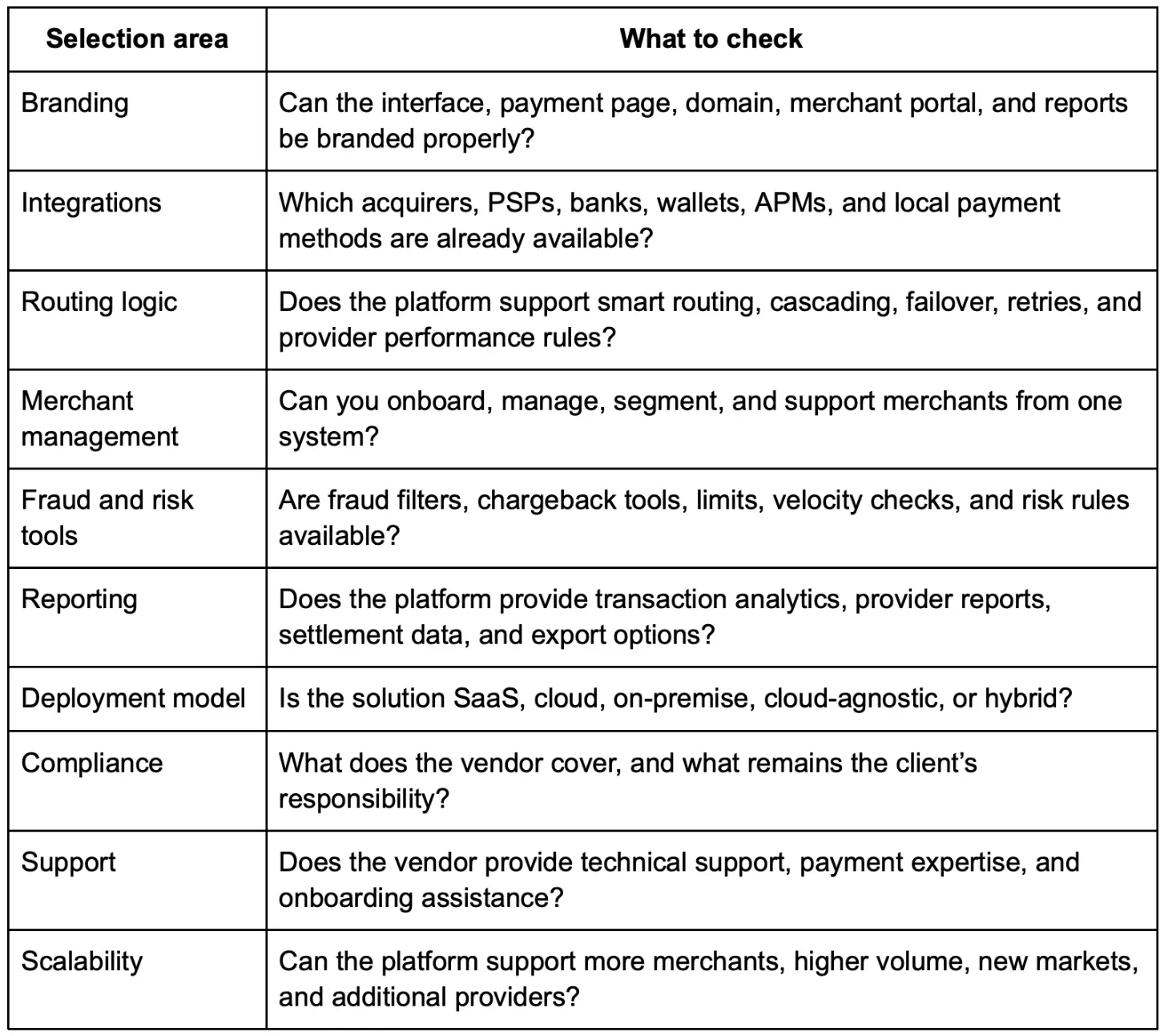
Before comparing providers, businesses should understand what they actually need. A startup PSP, an acquiring bank, an enterprise merchant, and a SaaS platform may all look for white label infrastructure, but their priorities will not be the same.
Quick Comparison of White Label Payment Gateway Providers
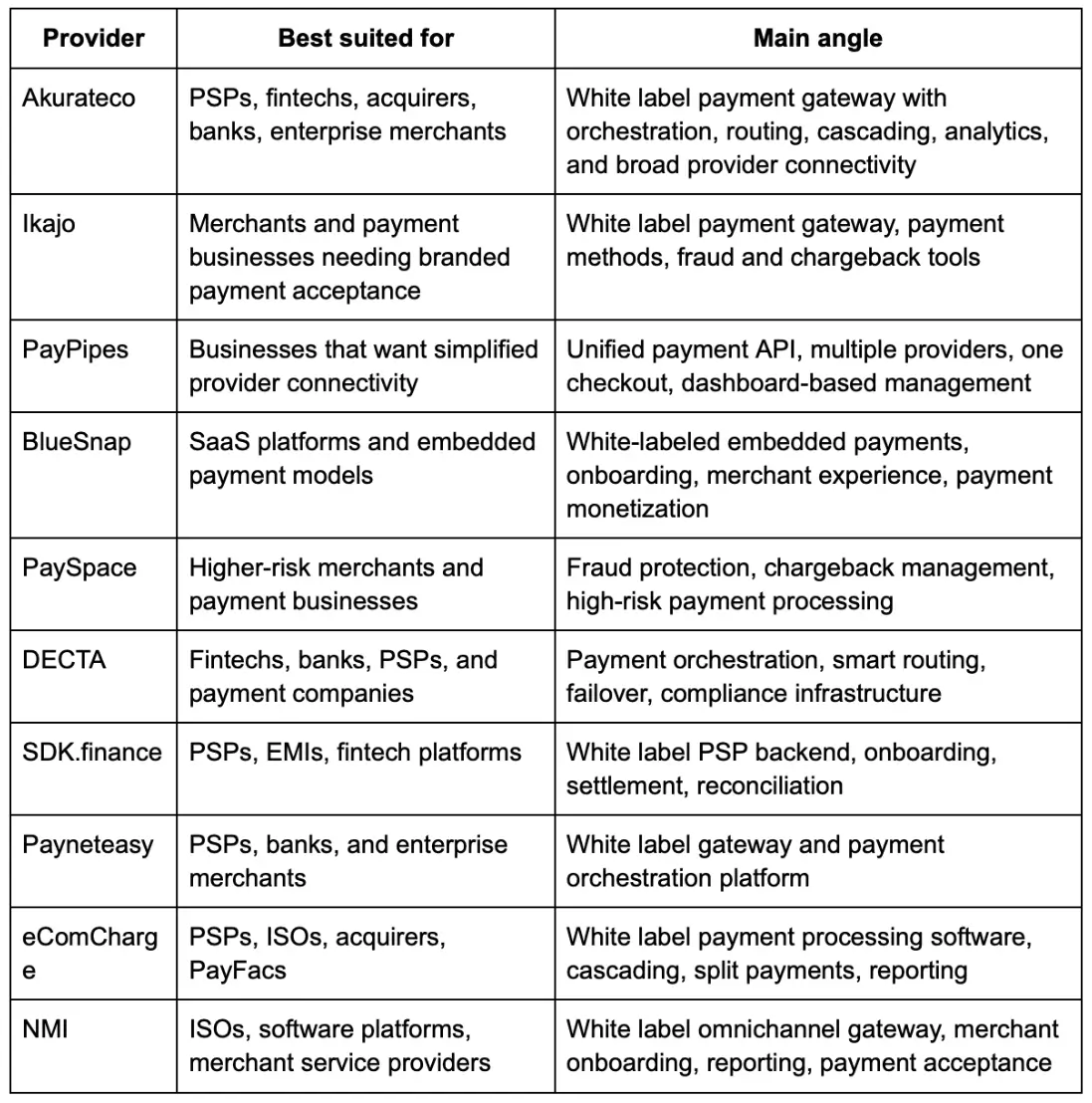
This comparison is not meant to say that one provider is universally better than the others. The right choice depends on the company’s business model, target merchants, regions, payment methods, compliance needs, and internal technical resources.
1. Akurateco
Akurateco is one of the strongest options for companies that need more than a branded payment page. The platform combines white label payment gateway functionality with payment orchestration capabilities, which makes it suitable for PSPs, fintech companies, banks, acquirers, and enterprise merchants that need a more flexible payment infrastructure.
The platform focuses on areas such as smart routing, cascading, fraud prevention, tokenization, billing, payment analytics, merchant data, and consolidated reporting. Akurateco’s public materials describe the solution as PCI DSS-compliant white label payment software with tools for transaction routing, fraud detection, tokenization, billing automation, mobile SDKs, and real-time insights. (Akurateco)
Akurateco is especially relevant when the business wants to manage multiple payment providers (over 650, according to the company) from one infrastructure layer. Its orchestration materials also highlight access to advanced routing, cascading, and hundreds of integrations. (Akurateco)
The main strength of Akurateco is that it fits both launch and expansion scenarios. A new PSP can use it to enter the market faster, while an established payment company or enterprise merchant can use it to improve routing, provider management, reporting, and operational control.
Best for: PSPs, fintechs, acquirers, banks, and enterprise merchants that need white label infrastructure with strong payment orchestration capabilities.
2. Ikajo
Ikajo offers a white label payment gateway solution for businesses that want to process payments under their own brand. It is positioned around payment page branding, merchant onboarding, payment acceptance, alternative payment methods, fraud protection, and chargeback prevention.
Its public materials mention white label setup, payment page branding, required documentation, and merchant onboarding as part of the launch process. (Ikajo – global payment provider) Ikajo also highlights support for main card payment types, alternative options, multiple currencies, customization, statistics, accounting, and anti-fraud and chargeback prevention tools. (Ikajo – global payment provider)
Ikajo can be a relevant option for companies that need a branded gateway and want payment acceptance with risk tools included. It may be especially useful for merchants and payment businesses that care about payment method coverage, currency support, and fraud protection.
Best for: Businesses that need a branded payment gateway with payment acceptance, fraud prevention, and chargeback management tools.
3. PayPipes
PayPipes positions itself as a unified payment API for global businesses. Instead of focusing only on the branding layer, it emphasizes the ability to connect multiple payment providers through one integration, optimize transactions, unify payment methods into one checkout, and manage payments from a single dashboard. (Paypipes)
This makes PayPipes a useful option for businesses that want to reduce technical fragmentation. Instead of maintaining separate integrations with every provider, a company can use PayPipes as a connection layer.
Its documentation also describes payment management through one API, a merchant back office for transaction visibility, customizable payment pages, and PCI DSS-compliant card payment handling. (docs.paypipes.com)
PayPipes may be a good fit for businesses that care less about building a full PSP operation and more about simplifying provider connectivity and checkout management.
Best for: Businesses that need one API to manage multiple payment providers and payment methods.
4. BlueSnap
BlueSnap is a strong option for platforms that want to embed payments into their own product experience. Its white label and embedded payment materials focus on helping platforms control the merchant experience, from branding and onboarding to communication flows. (BlueSnap)
BlueSnap also explains that embedded payments allow payment functionality to be built directly into a software platform, so customers do not need to integrate with a separate payment service. The company offers white-labeled embedded payment options for platforms. (BlueSnap)
This makes BlueSnap particularly relevant for SaaS companies, marketplaces, and software platforms that want to monetize payments without becoming a full payment infrastructure company themselves.
Its strength is not only gateway branding, but also the ability to support embedded payment experiences for platforms that want to add payments as part of their own product.
Best for: SaaS platforms, marketplaces, and software companies that want white-labeled embedded payments.
5. PaySpace
PaySpace focuses strongly on fraud protection, chargeback management, and payment processing for higher-risk merchants. Its white label materials describe an integrated anti-fraud system and chargeback management tools designed to protect businesses from fraudulent activity and friendly chargebacks. (PaySpace)
Its broader service pages also highlight fraud and chargeback prevention tools, dispute management, third-party signals, and payment methods geared toward high-risk verticals. (PaySpace)
This makes PaySpace a relevant option for businesses where risk management is a central part of payment operations. For example, companies working with higher-risk verticals may need more attention to fraud patterns, chargebacks, disputes, and payment acceptance stability.
PaySpace may not be the broadest orchestration-first platform in the list, but it can be useful for companies that need a white label gateway with a strong focus on risk-heavy payment environments.
Best for: Higher-risk merchants and payment businesses that need fraud protection and chargeback management.
6. DECTA
DECTA offers payment orchestration and broader payment infrastructure for fintechs, banks, PSPs, and payment companies. Its orchestration materials highlight smart routing based on cost, success rates, geography, and transaction type, as well as automatic failover to backup providers. (DECTA)
DECTA also highlights PCI DSS Level 1 compliance and advanced security across its processing services. (DECTA)
This makes DECTA relevant for businesses that need a more infrastructure-oriented solution. It may be a good fit for companies that want payment orchestration, acquiring-related infrastructure, security, and provider routing under one broader payment technology partner.
DECTA is especially suitable for organizations that see payments as a regulated infrastructure layer, not only as a checkout function.
Best for: Fintechs, banks, PSPs, and payment businesses that need orchestration and secure payment infrastructure.
7. SDK.finance
SDK.finance is different from many gateway-first providers because it focuses on white label PSP and fintech backend software. Its white label PSP solution is described as a backend for merchant onboarding, payment processing, settlement, and reconciliation. (sdk.finance)
This makes SDK.finance relevant for companies that want to build a broader payment or fintech product, not just add gateway branding. It can be useful for PSPs, EMIs, fintech startups, wallet products, and payment-heavy businesses that need operational backend components.
The platform may be especially interesting when the business needs merchant onboarding, ledger logic, settlement workflows, reconciliation, and other backend capabilities as part of the payment operation.
SDK.finance is not necessarily the first choice for a company that only needs a simple branded checkout. It is more relevant for businesses that need a foundation for a larger payment or fintech ecosystem.
Best for: PSPs, EMIs, and fintech companies building broader payment operations.
8. Payneteasy
Payneteasy offers a white label payment gateway and payment orchestration platform for PSPs, banks, and merchants. Its public website highlights PCI DSS Level 1 certification, payment orchestration, and a large integration network. (payneteasy.com)
Its gateway page describes a PCI-DSS-compliant white label gateway with branded checkout, fraud protection, and scalable infrastructure. It also mentions features such as verified uptime, payment integrations, and fraud prevention filters. (payneteasy.com)
Payneteasy can be a good fit for payment companies that need a more mature gateway and orchestration setup. It is particularly relevant for businesses that want provider connectivity, fraud tooling, gateway branding, and infrastructure designed for larger-scale payment operations.
Its main advantage is the combination of white label gateway functionality and payment orchestration positioning.
Best for: PSPs, banks, and enterprise merchants that need a white label gateway with orchestration capabilities.
9. eComCharge
eComCharge provides white label payment processing software for PSPs, ISOs, acquirers, and payment facilitators. Its public materials describe merchant payment management, split payments, cascading, fraud prevention, risk management, multiple currencies, Apple Pay, Google Pay, custom reporting, analytics, recurring payments, and subscription management. (ecomcharge.com)
The company also positions its white label payment gateway as a way to start a payment gateway business and set up payment processing software faster than building from scratch. (ecomcharge.com)
eComCharge may be a practical option for businesses that want a white label system with tools for merchant management, payment acceptance, reporting, commissions, and operational control.
It can be especially relevant for PSPs, ISOs, acquirers, and PayFacs that need to launch or expand payment processing services under their own brand.
Best for: PSPs, ISOs, acquirers, and PayFacs that need white label payment processing software.
10. NMI
NMI offers a white label payment gateway solution with a strong focus on omnichannel payment acceptance. Its public materials describe online, in-store, self-service, mobile, EMV, and contactless payments from a single white label gateway platform. (NMI)
NMI also highlights merchant lifecycle management, CRM and underwriting tools, merchant onboarding, reporting, and white label gateway infrastructure. (NMI)
This makes NMI relevant for ISOs, software platforms, and merchant service providers that need to support merchants across multiple payment environments. It is less about only online checkout and more about flexible payment acceptance across channels.
NMI can be a strong option for companies that already work with merchants and need a reliable gateway layer to support payment acceptance, reporting, and merchant management under their own brand.
Best for: ISOs, software platforms, and merchant service providers that need white label omnichannel payment acceptance.
How to Choose the Right Provider
The best white label payment gateway depends on what kind of payment business you want to build.
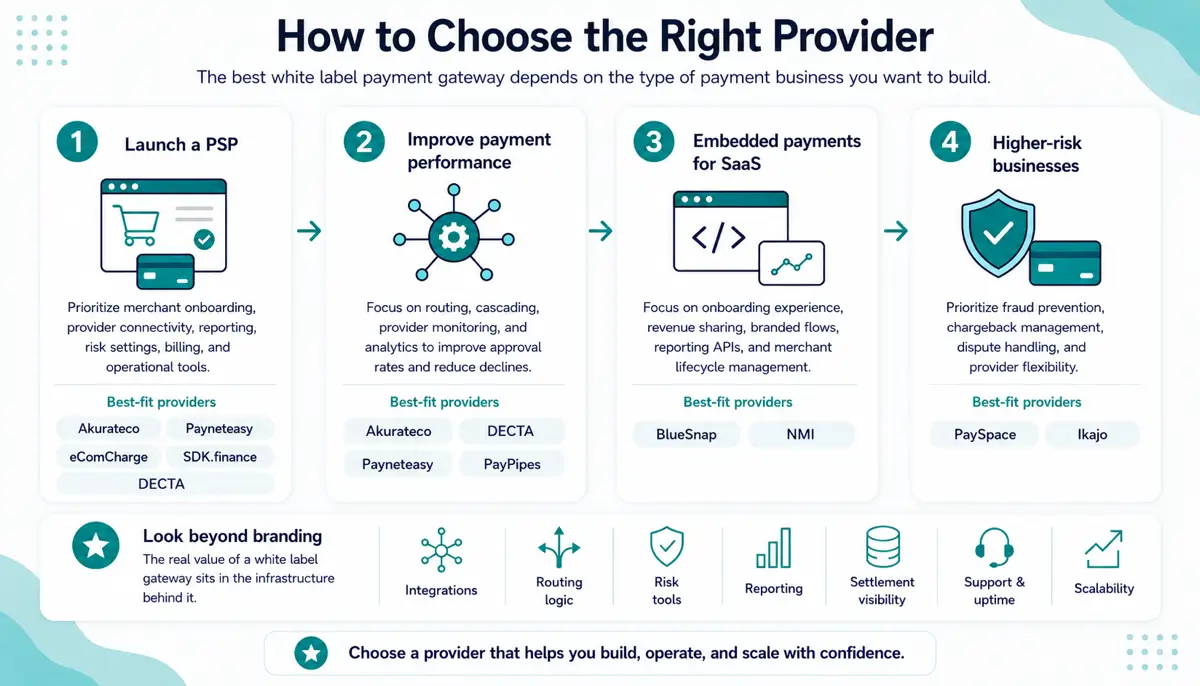
The most important point is not to choose based only on branding. A branded interface is useful, but the real value of a white label gateway sits deeper: integrations, routing logic, risk tools, reporting, settlement visibility, support, uptime, and the vendor’s ability to scale with your business.
Final Thoughts
A white label payment gateway can help businesses enter the payment market faster, reduce development costs, and offer payment services under their own brand. But in 2026, choosing a white label provider should be treated as an infrastructure decision, not just a design or checkout decision.
The strongest platforms do more than process payments. They help businesses manage merchants, connect providers, improve transaction performance, reduce manual work, monitor risks, analyze payment data, and scale into new markets.
For companies that need a combination of white label infrastructure and payment orchestration, Akurateco is one of the most complete options to evaluate. It brings together branding, routing, cascading, analytics, fraud tools, and provider connectivity in one platform, which makes it relevant for PSPs, fintechs, acquirers, banks, and enterprise merchants.
Still, the right choice depends on your business model. Before signing with any provider, define your target merchants, markets, payment methods, risk profile, compliance needs, technical capacity, and growth plan. Then compare platforms based on how much operational complexity they remove from your business.
The best white label payment gateway is not simply the one that lets you put your logo on a payment page. It is the one that gives you the infrastructure to build, manage, and scale a payment business with confidence.
Read more on this topic