Explore the 2026 stablecoin showdown between Apple Wallet and PayPal. Compare fees, usability, and global reach as PayPal expands PYUSD to 70 markets and Apple enables USDC payments via Apple Pay merchant integrations.

The world of digital payments is rapidly evolving, and stablecoins have emerged as a key bridge between traditional finance and the crypto economy. In 2026, two major players are at the center of the conversation: Apple Wallet and PayPal.
While independent crypto or stablecoin wallets can implement USDC tap‑to‑pay on iPhone, Apple Wallet has not integrated native USDC stablecoin support as a built‑in payment option, which makes the crypto everyday usability level much lower than fiat payments. Meanwhile, PayPal continues to expand its stablecoin offerings with PYUSD, giving users a true account-level experience.
What’s better: exploring second-largest stablecoin payments with third-party tools and potential friction or leveraging less-used stablecoin asset but seamlessly and through a popular trusted platform?
This comparative analysis examines the current capabilities, limitations, and opportunities of both platforms, helping consumers and merchants understand who truly leads the stablecoin money race in 2026.
Apple Wallet and USDC: Strategic but Indirect Integration
Apple Pay is a top digital wallet platform, handling roughly $10 trillion in transactions each year, with about 60–66 million users in the U.S. and approximately 550-640 million users worldwide as of 2025.
However, contrary to some 2026 reports and speculations, Apple Wallet does not currently support native USDC storage or transfers. There is no verified announcement from the tech giant that users can hold or send stablecoins directly within Apple Wallet.
Apple’s engagement with stablecoins has primarily been through Apple Pay at the merchant level, leveraging partnerships with platforms like Circle. In November 2022, Circle announced that merchants using Circle payments could accept Apple Pay and settle transactions in USDC. This integration allowed businesses to bridge traditional mobile payments with crypto rails, creating a seamless checkout experience for customers.
Key point of Apple’s stablecoin involvement is that it’s largely merchant-focused. The integration is primarily designed for merchants who want to accept USDC via Apple Pay. However, it does not have any universal character. Not any person owning USDC can use Apple Wallet to pay for goods with their stablecoin assets everywhere.
Backend crypto settlement is also in the spotlight, since USDC is handled through Circle’s platform, not directly in the Apple Wallet. While customers use Apple Pay to pay, the USDC aspect is invisible at the device level, and no peer-to-peer stablecoin transactions exist natively.
In short, Apple Wallet and Apple Pay enable crypto-enabled payments, but do not offer a fully native stablecoin wallet experience like PayPal’s PYUSD.
PayPal PYUSD: Native Stablecoin in Action
By contrast, PayPal, which commands approximately 25% of the Europe’s digital wallet market share, has positioned itself as a mainstream stablecoin platform. On March 17, 2026, PayPal announced that its PYUSD stablecoin is available to users and merchants in 70 markets worldwide. This rollout allows PayPal account holders to store, send, and receive PYUSD directly, making it one of the few mainstream financial platforms offering true account-level stablecoin functionality.
PayPal’s key advantages include:
- Native wallet experience: Users can hold PYUSD directly within their PayPal accounts.
- Peer-to-peer transfers: Account holders can send PYUSD to friends, family, or merchants globally.
- Global reach: PYUSD is accessible in 70 countries, giving it a broader geographic footprint than Apple’s merchant-focused integration.
- Seamless settlement: Merchants can accept PYUSD payments directly, simplifying crypto-to-fiat operations.
PayPal’s approach reflects a full-stack stablecoin strategy, contrasting with Apple’s more cautious, merchant-focused model.
Head-to-Head Comparison: Apple Wallet vs. PayPal
Here’s a side-by-side comparison of Apple Wallet (with USDC via Circle merchant integrations) and PayPal’s PYUSD:
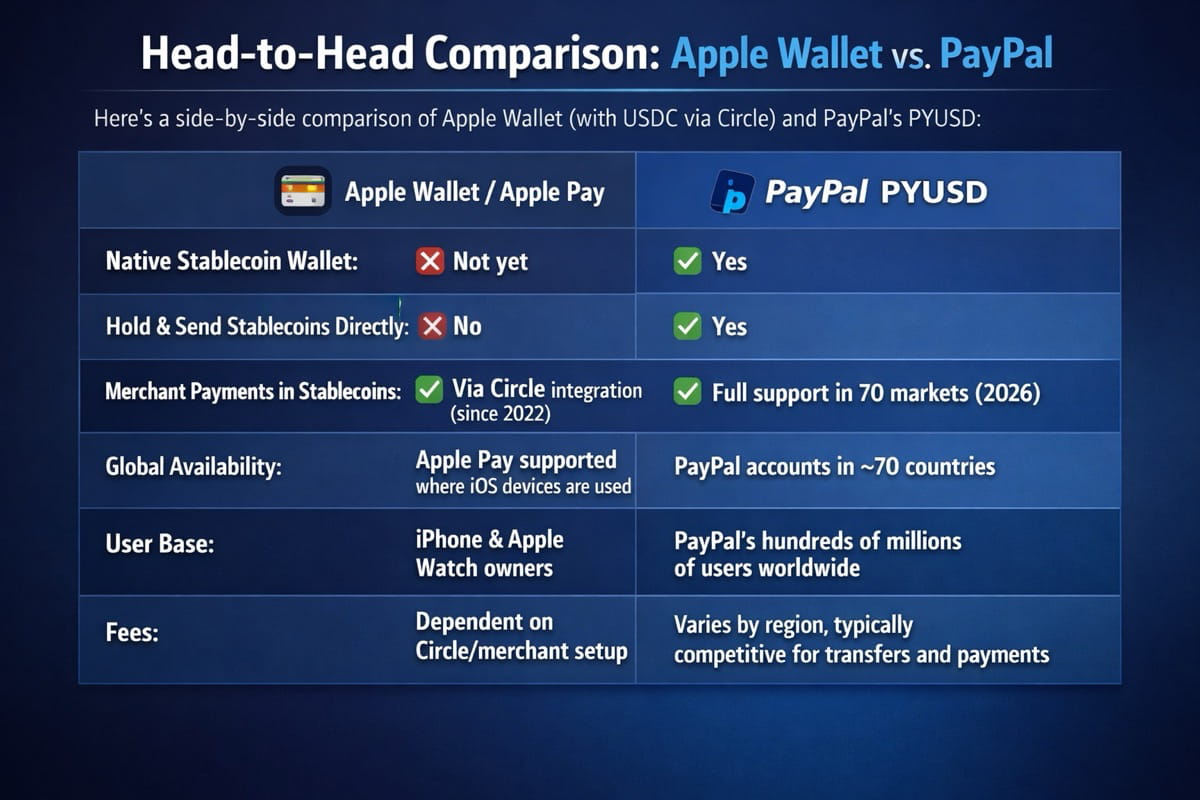
Image created via ChatGPT
Fees, Limits, and Usability
While Apple Wallet enables USDC acceptance at checkout, fees are determined by merchants and Circle, and consumer-level transactions are limited to Apple Pay purchases. Native USDC transfers between individuals are not possible.
PayPal, in contrast, offers account-level transfers with clearly defined limits and often lower fees compared to traditional banking or remittance rails. PYUSD transfers can settle instantly within PayPal’s ecosystem, making cross-border payments far more cost-effective and convenient.
Why it matters:
- For merchants: Lower fees and simplified settlement encourage more businesses to adopt stablecoins.
- For consumers: Instant, low-cost transfers could accelerate stablecoin adoption for everyday payments.
Ecosystem Considerations: Device vs. Platform
Apple Wallet’s advantage:
- Seamless iOS integration with Apple Pay.
- Highly trusted platform for digital transactions.
- Supports crypto indirectly, offering a smooth checkout experience.
PayPal’s advantage:
- Works across devices — iOS, Android, and web.
- Provides true stablecoin control at the account level.
- Offers a larger, global network of merchants and users for PYUSD payments.
Apple’s approach is ecosystem-first: stablecoins exist behind the scenes for merchants but aren’t exposed to users natively. PayPal’s approach, in turn, is crypto-first: users have direct control over their stablecoin holdings and transactions.
Market Implications
The stablecoin strategies of Apple and PayPal carry significant implications for adoption, innovation, and the future of remittances. In terms of mass adoption, Apple has the potential to reach hundreds of millions of iPhone users through its merchant checkout integrations, offering a seamless way to use USDC via Apple Pay. PayPal, on the other hand, provides real, peer-to-peer stablecoin usability on a global scale, giving users direct control over PYUSD transactions.
Competition and innovation are also intensifying. Apple may eventually follow PayPal’s lead by enabling more direct stablecoin functionality for consumers, while PayPal’s recent expansions position it as a frontrunner in everyday stablecoin transactions, setting industry standards for usability and reach.
Looking at the future of remittances, both platforms are challenging traditional bank systems. PayPal, in particular, offers a practical alternative to SWIFT and ACH payments, enabling faster, lower-cost transfers across borders and highlighting the potential of stablecoins to reshape global payments.
Who leads the 2026 stablecoin race? For everyday users and merchants seeking direct stablecoin use, PayPal currently has the edge. Apple demonstrates strategic crypto engagement, but its approach remains merchant-focused and indirect.
Conclusion
2026 is shaping up as a pivotal year for stablecoins in mainstream finance. Apple Wallet and PayPal represent two distinct strategies:
- Apple focuses on crypto-enabled payments at checkout, leveraging iOS device dominance.
- PayPal offers native stablecoin accounts with broad geographic and functional access.
While Apple’s USDC involvement shows promise, PayPal’s PYUSD demonstrates true account-level stablecoin usability, making it the current frontrunner in the stablecoin money race.
For consumers, merchants, and fintech observers, understanding these differences is critical as stablecoins shift from niche crypto assets to everyday payment tools.