The UK government has unveiled its most significant shake-up to special educational needs support in England in a decade. The headline that Education, Health and Care Plans will eventually be reserved for the most complex cases has alarmed many families. But the picture is considerably more complicated than that.

On 23 February 2026, Education Secretary Bridget Phillipson published Every Child Achieving and Thriving, a schools’ white paper that sets out the most sweeping proposed changes to the SEND (Special Educational Needs and Disabilities) system since the Children and Families Act 2014 introduced Education, Health and Care Plans. The announcement has been welcomed in parts, met with deep anxiety in others, and complicated by the fact that most of it will not take legal effect until 2030 at the earliest.
Despite the long term to wait for the actual changes, Bridget Phillipson noted that investing in the reform starts coming in already this year and told BBC, “I’m confident parents will see that change, but we want to do it carefully.”
The system being reformed is, by most accounts, broken. Local authorities in England are projected to carry £6 billion in high needs deficits by March 2026. One in 14 children waited more than a year to receive an EHCP in 2024. Tribunal appeals are rising. And over a million children with identified SEND have no legally enforceable rights at all. The question is whether the reforms will fix this — or, as critics argue, simply redistribute the pain.
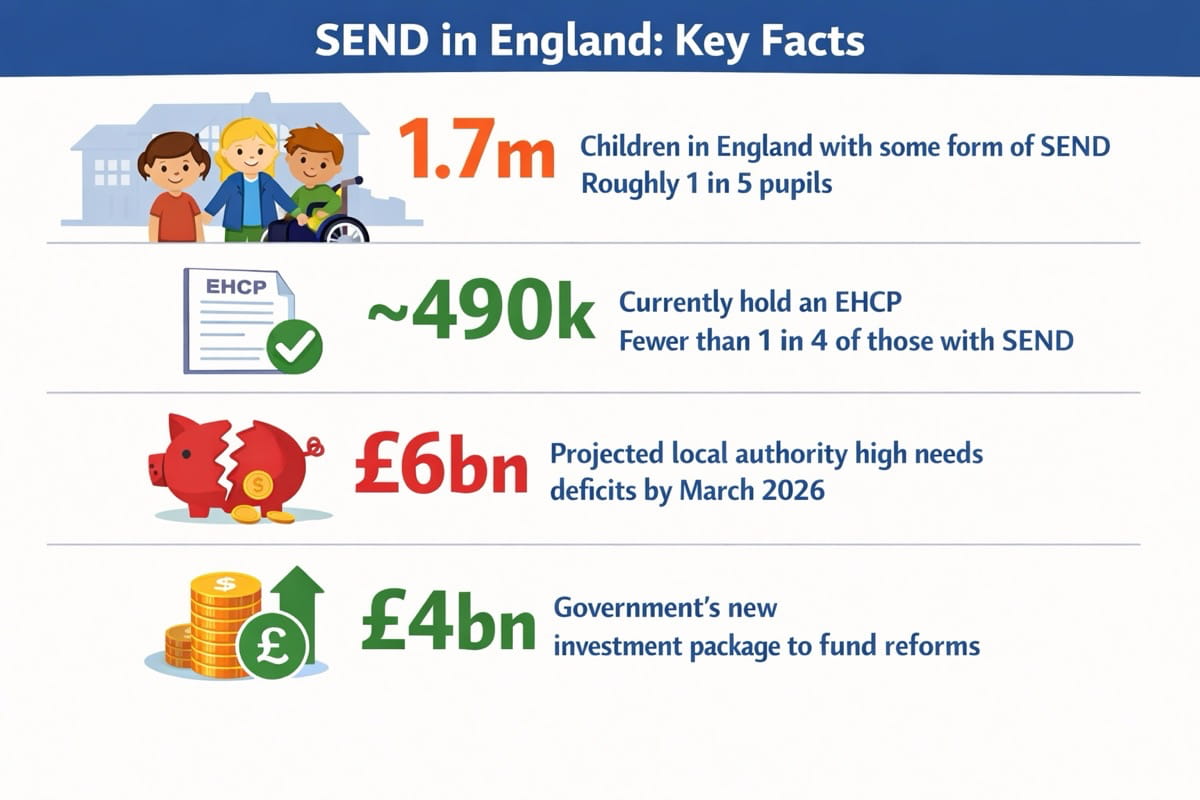
What Is Actually Changing in SEND
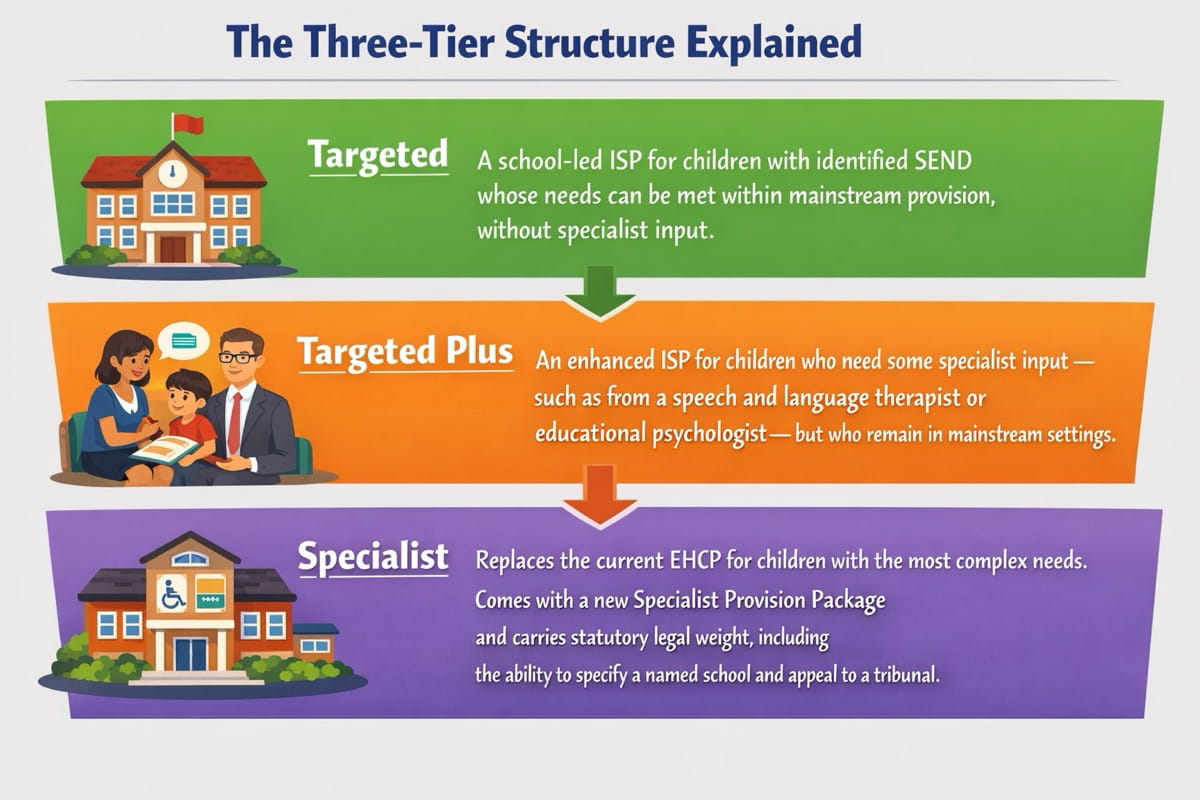
The core structural change is the introduction of Individual Support Plans (ISPs) — a new legal requirement that schools produce a written, tailored support plan for every child identified with SEND. Currently, over 70% of children with SEND have no legally enforceable plan of any kind. ISPs would change that for the first time.
The plans would operate across two tiers: “Targeted” and “Targeted Plus,” based on the intensity of need. Children will not need a formal diagnosis to access them. ISPs sit below the EHCP threshold, meaning they are the school’s own statutory responsibility rather than involving a local authority assessment.
EHCPs, meanwhile, are not being abolished. They will be retained and, under the new framework, sit within a “Specialist” tier reserved for children whose needs cannot be met through mainstream schooling. By 2035, the government estimates the proportion of pupils with EHCPs will fall from around 5.8% to approximately 4.7% — meaning around one in eight of those currently on an EHCP would, over that period, transition to an ISP instead.
The Money Behind It
The reforms are backed by a £4 billion investment package, broken down across three main areas:
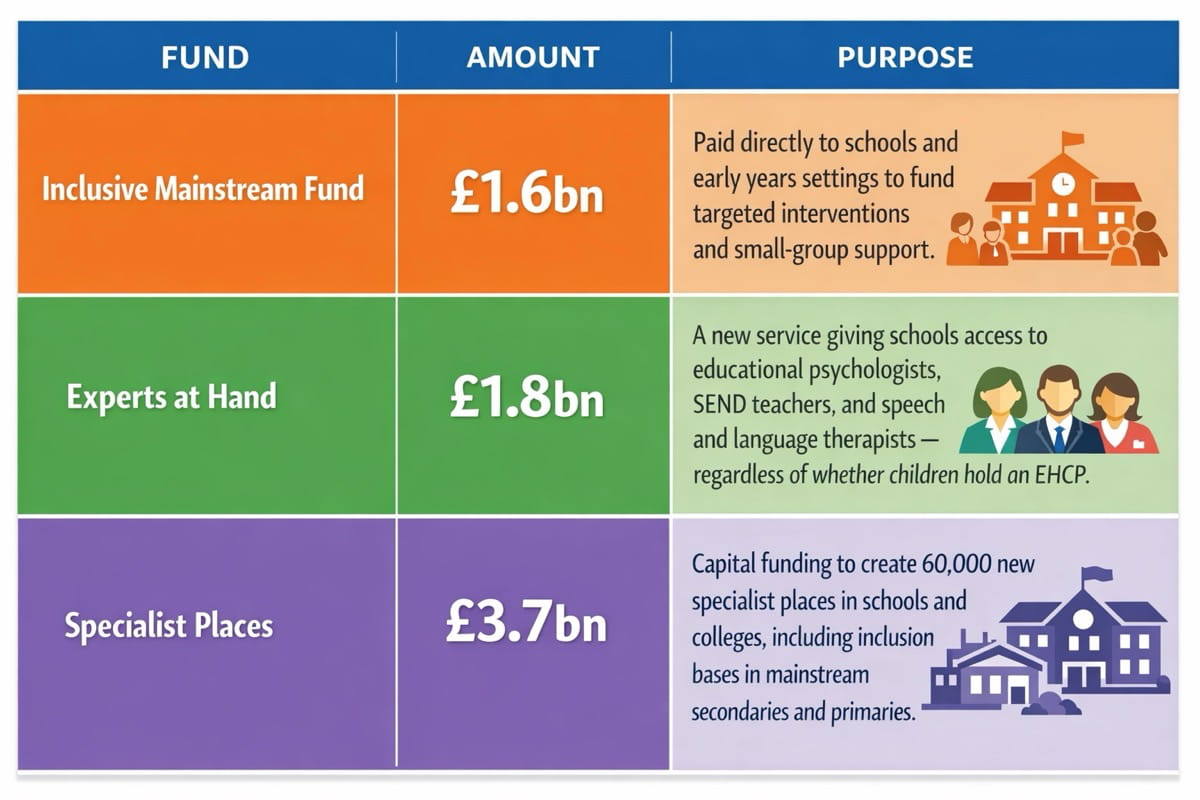
The inclusion bases are described as flexible in-school spaces that can be used for small group work, adapted curriculum delivery, or personal care, depending on individual need.
The Timeline: When Does Any of This Happen?
A 12-week public consultation runs until 18 May 2026. Families, schools, charities, and practitioners can respond before proposals are turned into draft legislation.
The current EHCP system remains in place. No child loses existing support during this period. Legislation is expected to pass through Parliament.
Assessments for the new ISP and Specialist tier system begin. Children currently in Year 3 or above will not be moved onto an ISP before finishing secondary school unless they choose to.
The new system begins operating. Transitions from EHCP to ISP will only happen at natural phase changes — such as moving from primary to secondary — and only for eligible children.
EHCPs are expected to be fully reserved for Specialist-tier children only. The government projects this will apply to around 4.7% of pupils, down from 5.8% today.
The “Triple Lock” and What It Actually Guarantees
The government has tried to pre-empt the most acute parental anxiety that children will be removed from specialist schools or lose hard-won support overnight with what it calls a “triple lock” of transitional protections.
Under this, every child who has a special school place in 2029 will keep it if they want it, for the duration of their education. Transitions from EHCP to ISP will only begin in 2030, and only at natural phase boundaries. And ISPs will be in place before any EHCP transitions begin, so there is no gap in legally enforceable support. The SEND Tribunal will remain as a legal backstop for families challenging decisions about the new Specialist tier.
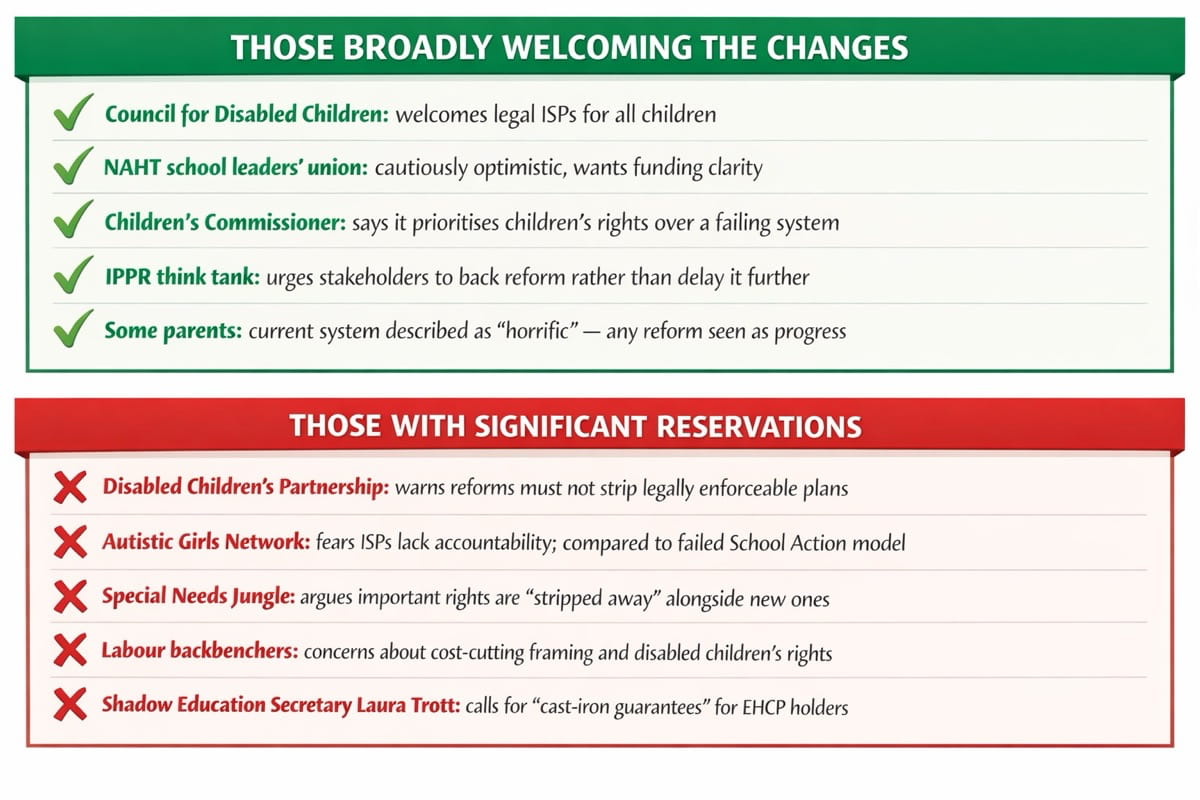
However, critics have noted a significant omission: ISP decisions cannot be appealed to the tribunal. If a school’s ISP is inadequate, a family’s only route is through the school’s own complaints process. This has led disability advocates to argue that the new system reduces parents’ ability to hold provision to account for the majority of SEND children.
“An EHCP is a legal contract with the Local Authority. An ISP, as described, places the burden of appeal on the school itself. If the school is the provider, the assessor, and the first point of appeal, the “checks and balances” that parents currently rely on at the Tribunal are effectively dismantled. Given that LAs lose 99% of Tribunal cases, we have zero confidence that moving the “decision gate” closer to the budget-holders will help our kids.”
said Cathy Wassell, CEO & Founder, Autistic Girls Network & The Haven in her “The 2026 SEND Reform: A “Watershed Moment” or Just More Invisible Children?” article
Who Supports the Reforms and Why
The Financial Pressure Underneath It All
It is hard to discuss the SEND reforms without acknowledging the financial context that, in part, is driving them. Demand for EHCPs has grown sharply over the past decade, with the proportion of pupils holding one rising from around 2.8% to 5.8% of the school population. The cost of placing children in independent specialist schools, sometimes hundreds of miles from home, has ballooned in tandem.
Phillipson has acknowledged the government wants to reduce these costs, particularly on out-of-area specialist placements. Critics argue this means the reforms, whatever their stated intentions, will in practice reduce provision for some children. The Autistic Girls Network noted that removing around 270,000 EHCPs and replacing them with ISPs raises an immediate workforce question: who will write and assess all the additional ISPs that would be needed?
While acknowledging positive aspects of changes in the long-dysfunctional educational SEND system, Dr Mark Carew, London School of Hygiene & Tropical Medicine, an Assistant Professor at the International Centre for Evidence in Disability, noted that:
“The decisive question is whether these commitments are matched by effective accountability and delivery mechanisms, sustainable funding, and a robust framework for research and independent evaluation. All these are needed for this new policy package to become transformational rather than aspirational for England’s 1.7 million pupils with SEN.”
What Happens Next
The immediate next step is the consultation, which runs until 18 May 2026. Families, practitioners, and organisations can submit responses at consult.education.gov.uk. The government has indicated that draft legislation will follow, with an implementation timetable built around the 2029 start date.
Independent oversight will be provided by the Children’s Commissioner. The Education Select Committee, chaired by Helen Hayes MP, has signalled it will scrutinise the legislation closely, noting that while the system is “not beyond repair,” meaningful change will require more than structural reorganisation.
For the families currently navigating the system, waiting months for assessments, fighting tribunals, or watching their children struggle in mainstream classrooms without adequate support, the reforms offer a promise of change, but one that will not arrive for several years. The gap between aspiration and delivery is precisely what has eroded trust in the system to begin with. That may prove the hardest thing to rebuild.