The AI company’s new “Frontier Alliances” are an acknowledgement that selling to large corporations requires far more than a good model, and also a quiet escalation of the battle against Anthropic, Google, and the SaaS platforms already embedded in every major business.

OpenAI has announced multi-year partnerships with four of the world’s largest consulting firms: McKinsey & Company, Boston Consulting Group, Accenture, and Capgemini, to help sell and deploy its new enterprise AI platform, Frontier. The initiative, called Frontier Alliances, marks the most structured attempt yet by OpenAI to convert corporate interest in AI into widespread, operational adoption at scale.
The announcement lands as OpenAI enters what its own CFO, Sarah Friar, called the company’s most important period for enterprise growth. In a January blog post, Friar identified large corporations as a primary revenue target for 2026. The Frontier Alliances represent the clearest signal yet of what that push actually looks like in practice.
Frontier is OpenAI’s enterprise platform, launched in early February 2026. It functions as a no-code system that allows businesses to build, deploy, supervise, and govern AI agents — essentially AI workers that can navigate corporate software, execute workflows, and make decisions across a company’s entire technology stack, from CRM systems to HR platforms to internal ticketing tools. These AI solutions are projected by Capgemini to generate up to $450 billion in economic value by 2028 and are a vital business opportunity to catch up on.
OpenAI describes the new platform as a “semantic layer for the enterprise” — a unified control plane that connects AI agents to the data and systems businesses already use, without requiring deep technical rebuilds. The platform supports agents built on OpenAI’s own models as well as those running on other underlying systems.
Why OpenAI Needs the Consultants
The short answer is: access and trust. The four consulting firms named in the Frontier Alliances have spent decades embedded inside the same corporations OpenAI is now trying to reach. They have relationships at board level, knowledge of existing IT architecture, and experience managing the organisational change that technology deployments require. OpenAI, regardless of how good its models are, does not have any of those things at scale.
There is also a harder structural problem. Enterprise AI adoption has been slower than almost everyone predicted. Most large companies have run pilots, some have deployed narrow use cases, but relatively few have achieved genuine operational transformation. Several recent McKinsey surveys show that while over 50% of organizations employ open source AI tools for data management, AI models, and developer workflows, only 23% are scaling at least one most innovative type of AI applications – agentic system somewhere in their enterprise.
The barrier, it turns out, is rarely the technology itself — it is the process of redesigning workflows, aligning incentives, integrating data, and convincing employees and managers to change how they work.
“If it was a walk in the park, OpenAI would have done it by themselves. It’s a recognition that it takes a village,” said Fernando Alvarez, Chief Strategy and Development Officer of Capgemini in an interview to CNBC.
OpenAI’s chief revenue officer Denise Dresser, the former Slack CEO hired in December 2025, has been candid about this initiative. She said OpenAI does not want a model where it is doing the implementation work indefinitely. The goal is for enterprises to become self-sufficient over time, with consulting firms bridging the gap between launch and operational maturity.
“We’re excited to deepen our work with OpenAI as a Frontier Alliance partner to help clients turn AI into real outcomes. Business transformation requires more than great models – it requires end-to-end execution across technology, data, security, and change management. Together, we’ll help organizations operationalize AI across the enterprise – responsibly and at scale.”
Julie Sweet, Chair and CEO, Accenture
The four partners are not interchangeable. Each brings a different capability to the alliance, and OpenAI has been deliberate about how they are positioned.
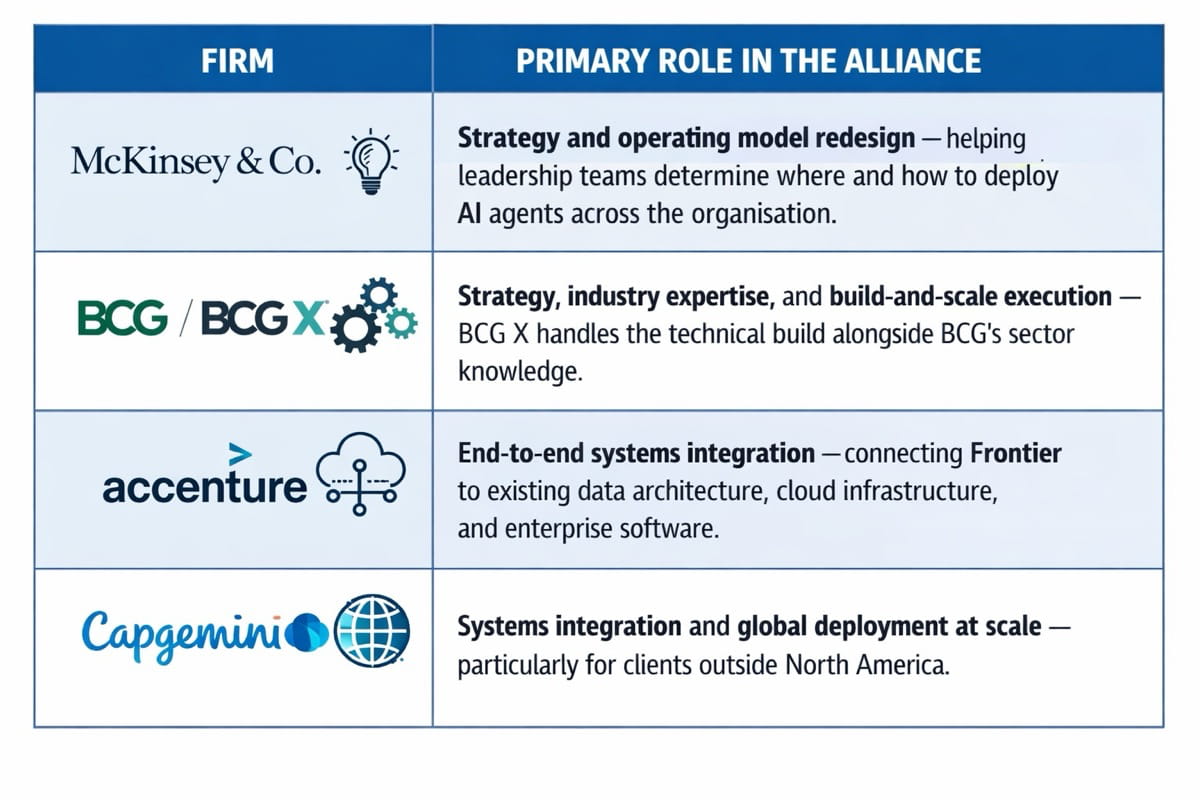
Each firm is also building dedicated internal practice groups certified on OpenAI technology, and will work alongside OpenAI’s own Forward Deployed Engineers — specialists embedded directly within client organisations during implementation.
Buried inside this partnership announcement is a significant challenge to the established enterprise software market. Frontier is designed to let AI agents operate across an organisation’s entire technology stack, including the CRM, HR, and workflow tools made by Salesforce, Microsoft, Workday, ServiceNow, and others. If it succeeds, enterprises may find they need to buy fewer seats of traditional SaaS software as AI agents absorb more of the underlying work.
That threat has become more concrete with the Frontier Alliances. McKinsey and BCG are the same firms that help Fortune 500 boards decide which software platforms to invest in. Having them actively introduce and implement an alternative to established SaaS platforms is not a development Salesforce or Microsoft will welcome and it represents a notable shift in the consulting firms’ own positioning, given how embedded they are with exactly those vendors.
OpenAI is not the first AI company to use this playbook. Anthropic, OpenAI’s most direct rival, has already signed enterprise consulting deals with Deloitte and Accenture in recent months, and has made significant inroads with its Claude models in corporate settings, particularly through Claude Code and its recently launched Claude Cowork platform. The Frontier Alliances are, in part, a structured response to that momentum.
Google, meanwhile, has its own consulting partnerships through Google Cloud and the broader Alphabet ecosystem. The race is now less about whose model performs better on benchmarks, and more about whose go-to-market infrastructure can reach and retain the largest enterprises fastest.