A new deal between Pesalink and PAPSS will let Kenyans send money across African borders in local currencies, cutting out the correspondent banking chains that have long made such transfers slow and expensive.
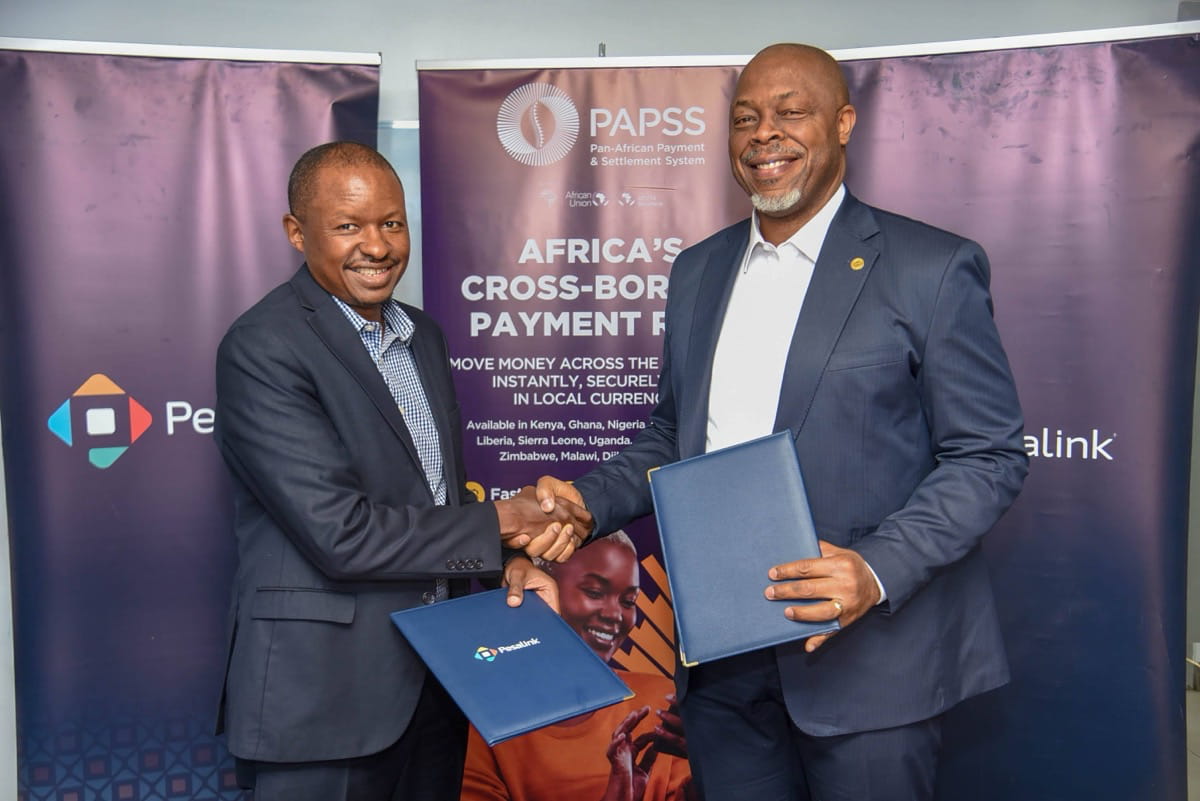
Image by Afreximbank: Pesalink CEO, Gituku Kirika (left), with PAPSS CEO Mike Ogbalu III (right), exchange the agreements following the signing of the partnership in Nairobi, Kenya
Pesalink, the instant payment network used by Kenyan banks, has signed a technical integration agreement with the Pan-African Payment and Settlement System (PAPSS), linking Kenya’s domestic banking infrastructure directly to a growing network of African financial institutions for the first time. The partnership signing took place at Pesalink’s offices in Nairobi.
Under the arrangement, payments can flow instantly between banks and mobile money operators on the Pesalink network and the 160-plus commercial banks and fintechs, including the 5 largest continent’s companies, connected to PAPSS across Africa. PAPSS has links in 20 out of 54 African countries. Transactions settle in local currencies rather than through a third-country reserve currency like the US dollar, which is how most African cross-border payments currently work.
Cross-border payments within Africa are among the most expensive in the world. According to a 2023 World Bank report on remittance prices, sending money between African countries costs on average 7-8,5% of the amount transferred — above the global average of 6 to 7%. Besides, intra-African money transfer corridors often hit 7-14% fees via banks, driving informal routes that undercount official stats. Another hurdle is that settlement times can stretch to between three and seven business days, a significant barrier for small businesses that need to move money quickly.
Much of this cost and extra time comes from the way transactions are currently routed: funds typically pass through correspondent banks in the US or Europe before reaching another African country, with each intermediary taking a fee and adding time. For instance, as of 2021, about one-third of all purchase volume in the Middle East & Africa region was routed via domestic network cards, while roughly 67% were facilitated via global schemes like Visa and Mastercard. The Pesalink-PAPSS transaction model bypasses this chain by establishing a direct link between domestic payment systems.
“For PAPSS to deliver true impact, collaboration with national and private switches like Pesalink is essential. Pesalink is the first switch we’ve piloted for transaction termination in Kenya, and we are already seeing greater adoption by opening more channels for seamless, local-currency cross-border payments across Africa.”
Mike Ogbalu III, PAPSS CEO
PAPSS, an initiative developed by the African Export-Import Bank (Afreximbank) in partnership with the African Union and the AfCFTA Secretariat in 2022 and expanding ever since, functions as a continental settlement layer. It connects 15 national payment switches and numerous commercial banks so that payments can be authorised, cleared, and settled between countries without leaving the African financial system.
Pesalink’s role in the arrangement is as a Technical Connectivity Provider, effectively a payment gateway through which PAPSS transactions can reach any of the 80-plus institutions on Kenya’s domestic network, including banks, fintechs, SACCOs, and mobile money operators.
“Kenyan banks will now be able to offer faster, cheaper cross-border payments. They will be helping their customers grow more regional trading relationships and thrive in a more integrated digital economy.”
Gituku Kirika, Pesalink CEO
For individuals sending remittances to family in another African country, or SMEs paying suppliers across the border, the change could meaningfully reduce the cost and wait time involved. Rather than converting into a foreign currency and paying conversion fees at both ends, transactions will stay in the currencies of the sending and receiving countries.
The deal also has implications for Kenya’s role in regional trade. As more African countries connect to PAPSS, Kenyan businesses will have a smoother path to settling invoices across borders — an increasingly important consideration as the African Continental Free Trade Area (AfCFTA) gradually reduces barriers to intra-African commerce.