Colombia’s instant payment system Bre-B has reached 83% of the country’s adult population in its first year, exceeding the adoption rate recorded by Brazil’s Pix at the same stage, according to an analysis by EBANX.
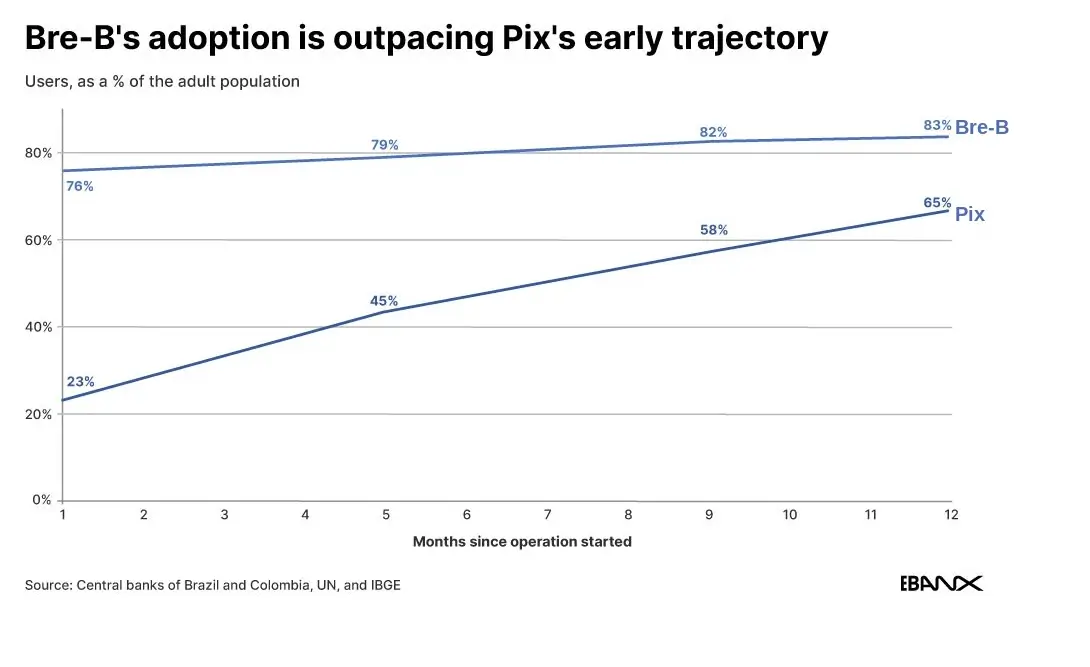
Image source: EBANX
Bre-B launched in October 2025 and now has 36 million active users, including 32 million individuals. By comparison, Pix had reached 65% of Brazilian adults after its first year. Bre-B therefore reached the same level of penetration that took Pix almost three times as long to achieve.
The figures come from EBANX, a global payments technology company focused on emerging markets. The analysis combines data from the central banks of Colombia and Brazil with population figures from the United Nations and Brazil’s IBGE.
Bre-B is processing more than 8 million transactions a day, three times its daily volume during its first month. The system has processed nearly $80 billion in total value since its launch.
“Adoption moves fast when a system is built to its users’ needs, and that is exactly what happened in Colombia. Bre-B connects payment methods and digital financial solutions that used to work in isolation, solving a real problem for Colombian consumers and businesses,” said Sebastian Fantini, Director of Product at EBANX.
Bre-B takes a different route from Pix
Colombia used Pix as a reference when developing Bre-B but chose a different approach. Rather than creating a completely new payment infrastructure, the country connected existing payment systems into a single national network.
Interoperability for instant transfers was made mandatory for financial institutions. EBANX was one of two fintechs invited to participate in Colombia’s Interdisciplinary Committee for Interoperable Payments, which advised authorities during the development of the system.
“Bre-B took inspiration from Pix and adopted from the start what had already worked in Brazil. That head start, in a country that is smaller and less banked, pushed adoption and public trust further than its neighbour managed at the same stage,” Fantini said.
The rapid adoption could also give Bre-B an important role in Colombia’s e-commerce market.
Only 24% of Colombian adults have a credit card, according to the Financial Superintendence of Colombia. That compares with Bre-B’s 83% penetration, creating a much larger potential customer base for merchants that accept the instant payment method.
“When a merchant moves from a credit-card-only checkout to offering Bre-B, its potential customer base in Colombia more than triples. All it takes is a single integration to get there. There is no marketing budget that produces that kind of reach,” Fantini added.
Bre-B brings new consumers to online merchants
Early results from a global online retail brand show how the payment system can affect e-commerce. The retailer enabled Bre-B for 5% of its customers during an initial rollout through EBANX. In three weeks, the company recorded a 5% incremental revenue increase and $300,000 in additional TPV. Checkout conversion increased from 20% to 50%, while the payment success rate among consumers who initiated a transaction reached 98.2%.
Bre-B also brought new customers to the retailer. Some 45% of consumers who selected Bre-B had never previously purchased from the company through EBANX, despite cards and other local payment methods already being available.
“Instant payment systems like Bre-B drive a kind of financial inclusion that benefits local e-commerce directly, because they bring in consumers who were not buying online at all,” Fantini noted.
Colombia is Latin America’s third-largest digital commerce market, behind Brazil and Mexico. The market is estimated at $59 billion and is expected to reach $73 billion by 2028, according to Payments and Commerce Market Intelligence data cited by EBANX.
Business payments could be the next step
The next phase of Bre-B is expected to expand beyond person-to-person transfers and retail payments.
“The next chapter basically covers all the use cases around business payments,” said Ana María Prieto, Payment System Director at Banco de la República, in an August interview with EBANX Insights.
Prieto also said upcoming regulation is expected to address utilities, recurring payments and payroll. The final regulation is expected by the end of 2026.
“We are very aware that to gain adoption and drive massive usage of Bre-B, we need to complete the other use cases and add the value-added or overlay services we have seen in other jurisdictions,” she added.
Banco de la República is also working on common protocols for refunds, disputes and outages across the payment systems connected to Bre-B.
“Banco de la República’s move is strategic, because every use case added to Bre-B makes the rail stronger for everyone on it. We watched this movie in Brazil, with an extremely positive impact for global merchants that localised their payment strategy to match how consumers in the country pay. Colombia is on the same path, and it is getting there faster,” Fantini said.