The former HP boss, Spanish-American business executive Enrique Lores is now running one of fintech’s biggest names – PayPal. But Spain has its own digital payments superstar, Bizum, and it’s not backing down. Here’s what’s really at stake.
ARTICLE AT A GLANCE
- PayPal named Enrique Lores, former HP Inc. CEO, as its new chief executive in February 2026.
- The board pushed for faster execution after weak Q4 results and cautious profit guidance.
- PayPal’s stated ambition: transform from a payments tool into a full commerce platform.
- In Spain, Bizum dominates with ~30 million users and is now going contactless in-store from May 2026.
- The Spanish digital payments market is forecast to hit $158 billion by 2031 at 21% CAGR.
Who Is Enrique Lores and Why Is His Appointment a Big Deal?
Enrique Lores isn’t a typical Silicon Valley fintech hire. He spent his entire career at HP, eventually becoming its CEO, guiding the PC and printer giant through a grinding reinvention in a shrinking hardware market. Now, the PayPal board has bet that exactly that kind of “large company transformation experience” is what the payment platform desperately needs.
The appointment came in February 2026, replacing Alex Chriss after just over two years in the role. The timing wasn’t subtle: PayPal had just posted weaker-than-expected Q4 results and offered cautious 2026 profit guidance. According to media reporting, the board wanted faster execution and tighter operational discipline — code for “we’re not moving fast enough.”
Lores had been serving as PayPal’s board chair before taking the top job, so he wasn’t walking in blind. He knew the company’s challenges: a branded checkout button under pressure from Apple Pay and Google Pay, a Venmo unit that’s beloved but hard to monetise, and a strategic ambition to become something far bigger than a payments widget.
Is PayPal Really Going to Become a Super-App?
The “super-app” label gets thrown around a lot in fintech. But PayPal’s own strategy documents, filed with the SEC, lay out something that sounds remarkably close to it. The company’s four strategic pillars for 2025–2026 are:
- winning branded checkout,
- scaling omnichannel (“PayPal Everywhere”),
- growing Venmo as a youth-focused money-moving app,
- and building what it calls a “commerce platform.”
That last phrase is key. PayPal no longer wants to be the thing you click at checkout. It wants to be where you discover deals, earn rewards, pay in-store via NFC, manage buy-now-pay-later, and handle peer-to-peer transfers — all in one place. The September 2024 launch of PayPal Everywhere already pushed debit card adoption strongly upward and opened new in-store spending categories.
“It’s a pivotal moment for PayPal and its customers and a significant first step as we bring the power of PayPal to everywhere they shop,” said Alex Chriss, former President and CEO, PayPal
Whether Lores will accelerate or pivot this vision remains to be seen. His HP playbook was built on operational efficiency and disciplined product focus, not sprawling platform ambitions. Investors and analysts will be closely watching his first concrete moves: product roadmaps, branded checkout updates, and any cost structure changes.
For Spain specifically, the key question is whether PayPal commits to localising its super-app strategy around Spanish consumer habits, or treats the country as a generic European market. That choice will determine everything.
Bizum: Spain’s Homegrown Payment Giant That’s Getting Stronger
To understand why PayPal’s super-app pivot is complicated in Spain, you need to understand Bizum. This is not your ordinary payment app from a private entity. It’s a bank-consortium product backed by over 30 Spanish financial institutions, embedded directly into users’ existing banking apps without any separate downloads, new accounts, or registration friction.
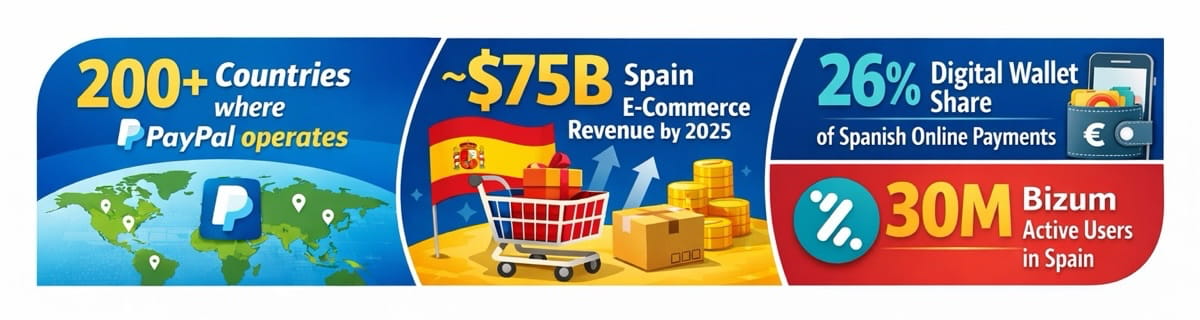
The numbers are staggering. Bizum now has close to 30 million active users, processed over 105 million online transactions in 2025 alone, and holds nearly 90% of Spain’s instant peer-to-peer payment traffic. In April 2025, it expanded cross-border to Portugal, Italy, and Andorra via the EuroPA network, linking 50 million users across 186 institutions, and later commited to realizing a unified, sovereign pan‑European payments ecosystem in partnership with other EU’s major regional industry players.
And already in May 2026, Bizum is going contactless in physical stores, meaning customers will be able to tap their phone at any shop counter just like Apple Pay or a bank card. This is the moment Bizum stops being a “transfer app” and becomes a genuine full-stack payments competitor.
PayPal vs. Bizum in Spain: A Clear-Eyed Comparison
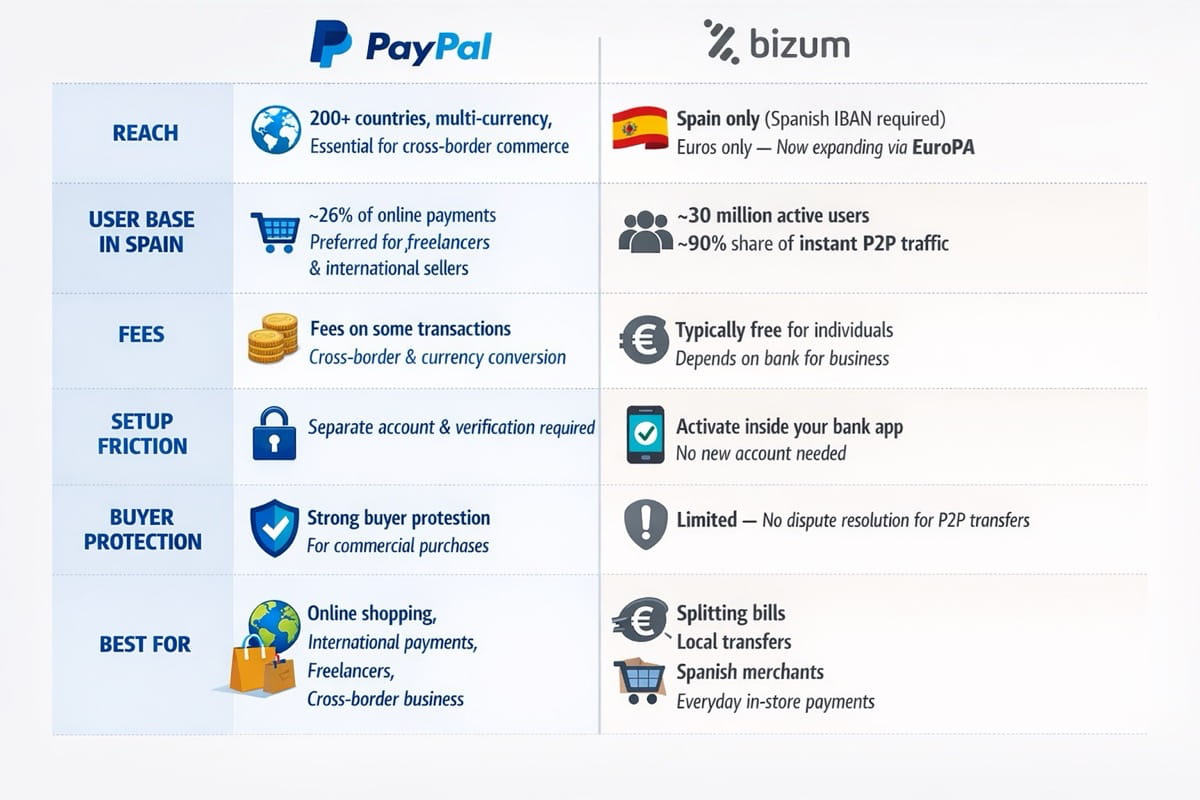
The honest conclusion: these two products serve different primary use cases. However, the battleground still exists and it lies in the middle: Spanish e-commerce, in-store mobile payments, and the growing BNPL segment. That’s exactly where Lores will need PayPal to win.
What the Spanish Market Actually Looks Like Right Now
Spain’s digital payments landscape is in genuine transition. Cards still dominate at over 50% of online transactions, but digital wallets are growing fast, already accounting for roughly 26% of online payments and rising. Mobile payment usage jumped from 29.7% of Spaniards in 2022 to 50% in 2023, a trajectory that shows no signs of slowing.
The market is projected to grow from $50 billion in 2025 to over $60 billion in 2026, and could reach $158 billion by 2031 at a 21% compound annual growth rate. Notably, the EU Instant Payments Regulation, effective from January 2025, now mandates sub-10-second euro transfers at no extra cost. That levels the playing field considerably, removing one of PayPal’s few structural advantages over bank-based systems like Bizum.
Meanwhile, competition isn’t just PayPal and Bizum. Apple Pay and Google Pay are accelerating, especially in cities. Revolut has installed 50 large-format ATMs in Madrid and Barcelona as a physical acquisition strategy as well. And Silbo Money is integrating payments directly into WhatsApp for Spain’s 35 million users on that platform.
Three Scenarios for PayPal Under Lores in Spain
Scenario 1: The operational efficiency play
Lores doubles down on what PayPal does well — protecting its dominant position in cross-border e-commerce and freelancer payments, while cutting costs and improving branded checkout conversion. Bizum keeps the domestic P2P market; PayPal owns international commerce. Verdict: most likely in the short term.
Scenario 2: The super-app push
PayPal accelerates its commerce platform vision, investing in Spanish-language loyalty programmes, local merchant integrations, and aggressive BNPL expansion. It positions itself as the rewards-rich alternative to Bizum’s no-frills bank transfer experience. Possible if Lores commits to localisation.
Scenario 3: Strategic partnership or acquisition
Rather than fighting Bizum head-on, PayPal seeks interoperability or forms alliances with Spanish banks or retailers. HP’s Lores was known for ecosystem plays, not just standalone product battles. A partnership with a major Spanish bank is not unthinkable. Speculative, but worth watching.
Frequently Asked Questions
Why did PayPal replace its CEO so suddenly?
The PayPal board had concerns about the pace of execution and the company’s ability to compete with Apple Pay and Google Pay in branded checkout. After weaker-than-expected Q4 2025 results and cautious profit guidance for 2026, the board turned to Enrique Lores, already serving as board chair, to drive faster operational discipline.
Can PayPal compete with Bizum in Spain?
In peer-to-peer transfers and everyday in-store payments, Bizum’s structural advantage built into existing banking apps with no friction is very hard to beat. However, PayPal has clear advantages in international commerce, buyer protection, and multi-currency support. The realistic battleground is e-commerce and BNPL, not daily transfers.
What is Bizum doing in 2026 that changes things?
From May 2026, Bizum is launching contactless in-store payments across Spain, directly competing with Apple Pay, Google Pay, and bank cards at physical checkout. Combined with its 2025 cross-border expansion to Portugal, Italy, and Andorra, Bizum is evolving from a simple transfer tool into a comprehensive payments ecosystem.
What is PayPal’s super-app strategy exactly?
PayPal wants to move beyond the checkout button and become a full commerce platform: integrating shopping discovery, loyalty rewards, peer-to-peer transfers (via Venmo in the US), BNPL, and in-store payments. The PayPal Everywhere launch in late 2024 was the first major step, driving debit card adoption and expanding into physical retail categories.
Which should I use in Spain — PayPal or Bizum?
Use Bizum for splitting bills with friends, sending money to Spanish contacts, and paying at local businesses — it’s free, instant, and requires no extra setup. Use PayPal for online shopping with buyer protection, international payments, receiving payments as a freelancer, or anything involving foreign currencies or sellers outside Spain.
Bottom Line
Enrique Lores inherits a PayPal at a crossroads: strong brand, slowing execution, and an increasingly crowded market. In Spain specifically, the challenge is acute: Bizum’s structural embeddedness in Spanish banking makes it almost untouchable in P2P and everyday payments.
For PayPal to genuinely compete, Lores will need to:
- Invest in Spanish localisation , e.g. rewards, language, local merchant tie-ins
- Sharpen the BNPL proposition, where Spain’s 11.6% annual growth rate is a clear opportunity
- Protect and improve the branded checkout experience against Apple Pay and Google Pay
- Consider ecosystem partnerships rather than outright platform competition with Bizum
The Spanish digital payments market will be worth over $158 billion by 2031. There’s room for more than one winner, but the definition of “winning” for PayPal in Spain may need to be rewritten under its new CEO.