At a time when geopolitical tensions are escalating and oil prices are surging, gold prices are doing something unexpected: they’re falling. Investors tracking the gold price today in India, global benchmarks, or even data from platforms like Kitco are seeing a rare divergence — one where crisis is not lifting the price of gold, but pushing it lower.
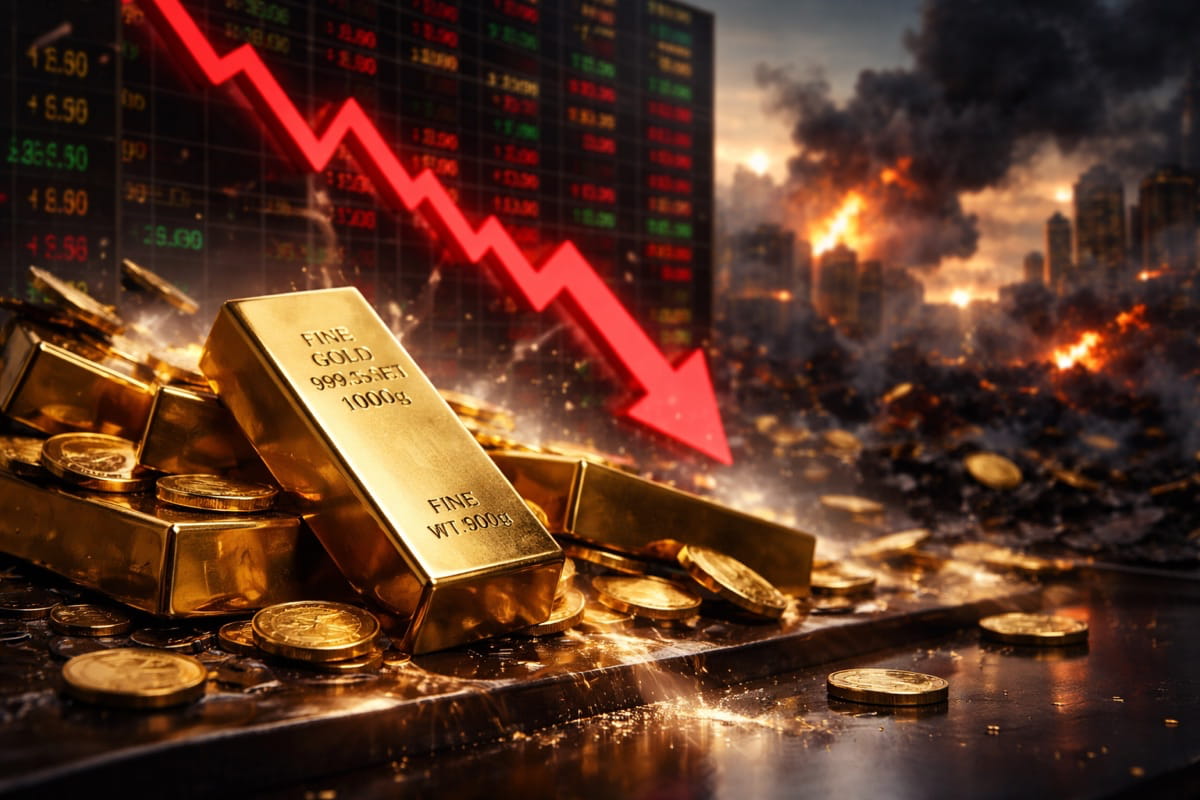
A sharp and fast decline in gold prices
The scale of the recent drop is significant. Gold has fallen roughly 15–18% in just a few weeks, slipping more than 20% from its January 2026 peak near $5,600 per ounce. That officially places the metal in bear market territory. For those following the gold price chart, the move is striking: a steep downward trend rarely seen in such a short period.
In absolute terms, the price of gold has dropped by approximately $1,200–$1,500 per ounce, with recent trading hovering in the $4,100–$4,400 range. Short-term moves have been equally dramatic, with nearly 4% single-day declines and multiple consecutive losing sessions.
The selloff has also hit silver prices hard. Investors checking the silver price today or regional benchmarks like the chandi rate today have seen even sharper volatility, with silver falling up to 8–19% from recent highs.
The paradox: why gold is falling during a crisis
Traditionally, gold and silver act as safe-haven assets. During wars or financial instability, demand rises, pushing gold prices higher. But this time, another force is dominating: interest rates.
The ongoing geopolitical tensions involving Iran have driven oil prices above $100 per barrel, raising fears of prolonged supply disruptions. This has fueled global inflation concerns — a key factor influencing both gold futures and broader commodity markets.
However, instead of supporting gold, rising inflation is leading investors to expect higher interest rates for longer. This is critical because:
- Gold does not generate yield
- Higher interest rates increase the opportunity cost of holding gold
- A stronger U.S. dollar makes gold more expensive globally
As a result, even as uncertainty rises, gold prices are under pressure, showing that monetary policy is outweighing safe-haven demand.
Not unprecedented — but unusual
While surprising, this situation is not entirely without precedent. A similar pattern occurred during the 2022 Russia–Ukraine conflict, when gold initially rose but later declined as central banks tightened policy.
A closer historical parallel can be found in the early 1980s. During that period, aggressive rate hikes to combat inflation caused a sharp drop in the price of gold, despite economic uncertainty.
What makes the current situation stand out is the timing and speed. For investors watching the gold price chart, it’s rare to see such a steep decline during an active geopolitical crisis.
What experts expect next for gold and silver
Forecasts are now divided, with analysts offering different scenarios for gold prices and silver prices depending on how macro conditions evolve.
Short-term outlook: downside risks remain
In the near term, many analysts expect continued volatility. Technical levels suggest gold could test $4,275 or even fall toward $4,000.
For investors tracking the gold price today in India or global spot markets, the key risks include:
- Persistent inflation driven by energy prices
- Delayed expectations for rate cuts
- Continued strength in the U.S. dollar
Silver is expected to remain even more volatile, meaning fluctuations in the silver price today and chandi rate today could be sharper than gold.
Base-case forecasts: stabilization
Despite the recent drop, many forecasts still place average gold prices for 2026 in the $4,200–$4,800 range. This aligns with longer-term expectations reflected in gold futures markets.
However, these projections may shift if current macro pressures persist.
Bullish scenarios: potential rebound
Longer-term, many analysts remain bullish on gold. If conditions change, prices could rebound toward $5,500 or higher, with some forecasts even pointing to $6,000 in more extreme scenarios.
Triggers for a rebound include:
- Escalation of geopolitical tensions
- A reversal in interest rate policy
- Weakening of the U.S. dollar
- Sustained inflation supporting hard assets
In such a scenario, both gold prices and silver prices could recover strongly.
The bigger picture
For investors following gold price charts, gold futures, or regional benchmarks like the gold price today in India, the current market represents a shift in dynamics.
Instead of reacting primarily to geopolitical risk, markets are being driven by monetary policy expectations. This has created a rare situation where rising oil prices and inflation are not boosting gold, but weighing on it.
“The conventional wisdom says wars are supposed to be bullish for precious metals, but the Iran conflict is doing something the textbooks don’t cover – it is pricing in inflation and pricing out rate cuts simultaneously,” Tracy Shuchart, senior economist at NinjaTrader, told The New York Post. “That repricing is what matters for gold, because gold doesn’t just trade on fear. It trades on the opportunity cost of holding a zero-yield asset, and that cost just spiked. Silver, which carries the same rate sensitivity plus industrial demand that gets crushed under stagflation conditions, is getting hammered even harder. The safe haven bid from Iran lasted about 48 hours. The rate repricing will last as long as crude stays elevated.”
Bottom line
Gold’s recent decline is steep, rapid, and unusual. The price of gold has fallen more than 20% from its peak, entering a bear market despite ongoing geopolitical tensions.
For now, the direction of gold prices and, to some extent, silver prices depends less on conflict and more on central bank policy. Investors watching the gold price today or tracking movements via platforms like Kitco are seeing a clear pattern emerge.
Interest rates are currently more powerful than fear. If rates remain high, gold may continue to struggle. But if monetary policy shifts, the metal could quickly regain its traditional role and its upward momentum.