A patient is cleared for discharge at 10 AM. By 4 PM, they’re still in the bed — not because of medicine, but because the billing desk is waiting on a TPA to confirm a final number. Multiply that by every bed in a mid-size hospital, every single day, and you start to see why “billing software” for a hospital is really a patient-experience problem wearing an accounting hat.
The technology question underneath it is interoperability. A hospital bill is assembled from systems that were never designed to talk to each other: registration, pharmacy, pathology, radiology, the ward, and the billing counter. Cloud platforms such as myBillBook’s hospital billing software approach this from the GST-compliant billing and inventory side, giving smaller facilities a single connected record of what was dispensed and what was charged, accessible from any device on the premises. Larger multi-specialty hospitals with heavy claim volumes will layer additional systems on top of that foundation. Either way the principle holds: a charge should reach the patient’s account the moment it is incurred, not whenever someone remembers to key it in.
Why Hospital Billing Isn’t Just “Bigger Retail Billing”
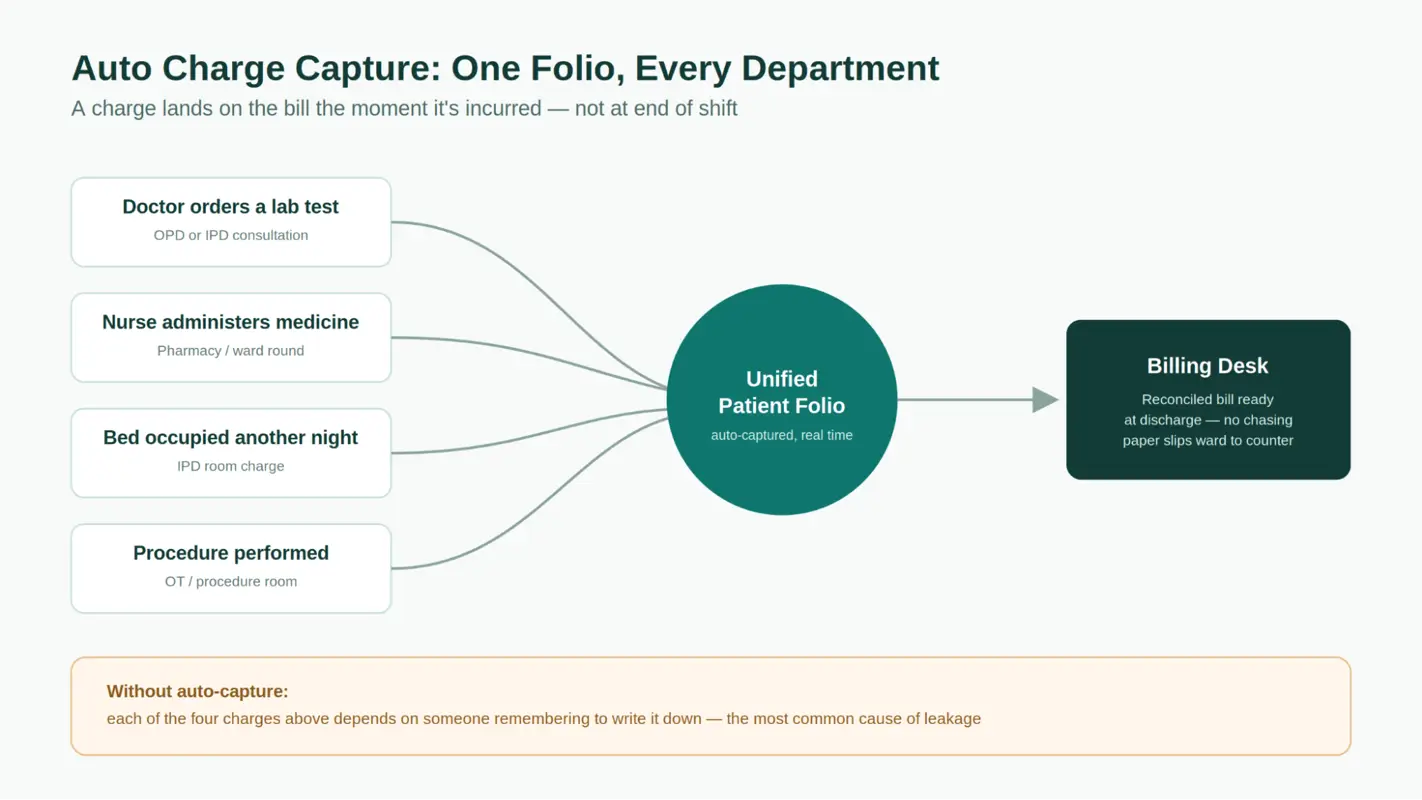
A retail shop bills one transaction at a time. A hospital bills the same patient across departments, days, and sometimes weeks — a consultation on day one, a lab test on day two, a procedure on day four, a room charge that accrues daily, and a pharmacy bill that gets added in the middle of it all. Every one of those charges has to land on a single, reconciled patient folio by the time of discharge, without anyone chasing a paper slip from ward to counter.
That’s the structural difference. Retail billing software closes a transaction and moves on. Hospital billing has to hold open an account across an entire care journey, pull in charges from departments that don’t naturally talk to each other, and still produce an invoice that satisfies GST rules, insurance documentation standards, and the hospital’s own audit trail — all before the patient walks out the door.
The Real Cost of Disconnected Billing
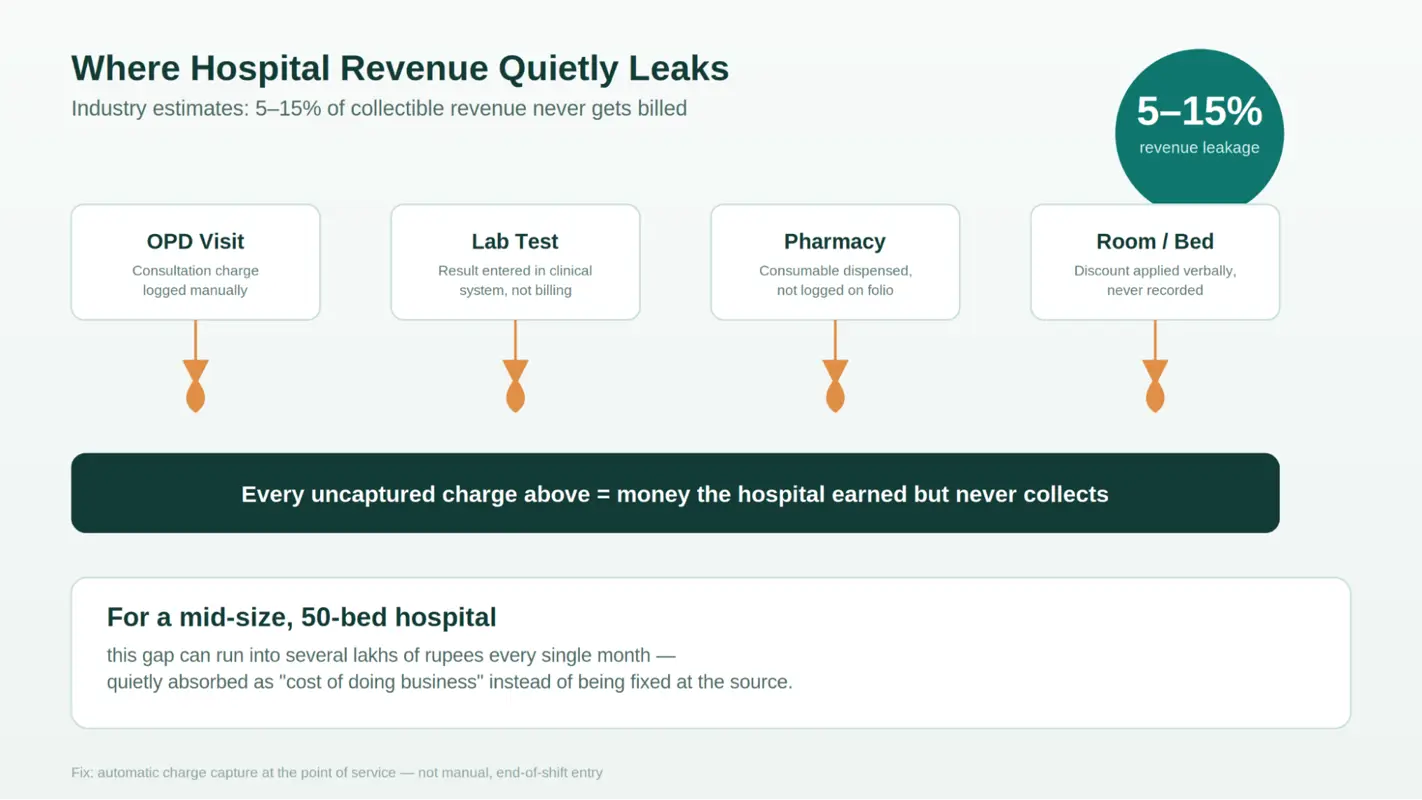
Revenue leakage in hospitals is rarely one dramatic error. It’s dozens of small ones: a nurse forgets to log a consumable, a lab result gets entered into the clinical system but never crosses over to billing, a discount is applied verbally and never recorded. For a mid-size, 50-bed facility, that gap can run into lakhs every month, quietly absorbed into “cost of doing business” instead of being treated as the fixable operational problem it actually is.
For a mid-size, 50-bed facility, that gap can run into lakhs every month, quietly absorbed into “cost of doing business” instead of being treated as the fixable operational problem it actually is.
The fix isn’t a stricter billing clerk. It’s a system where a charge, the moment it’s incurred — a test ordered, a medicine dispensed, a bed occupied for another night — is captured automatically instead of relying on someone remembering to write it down.
The IRDAI Discharge Clock Most Hospitals Aren’t Ready For
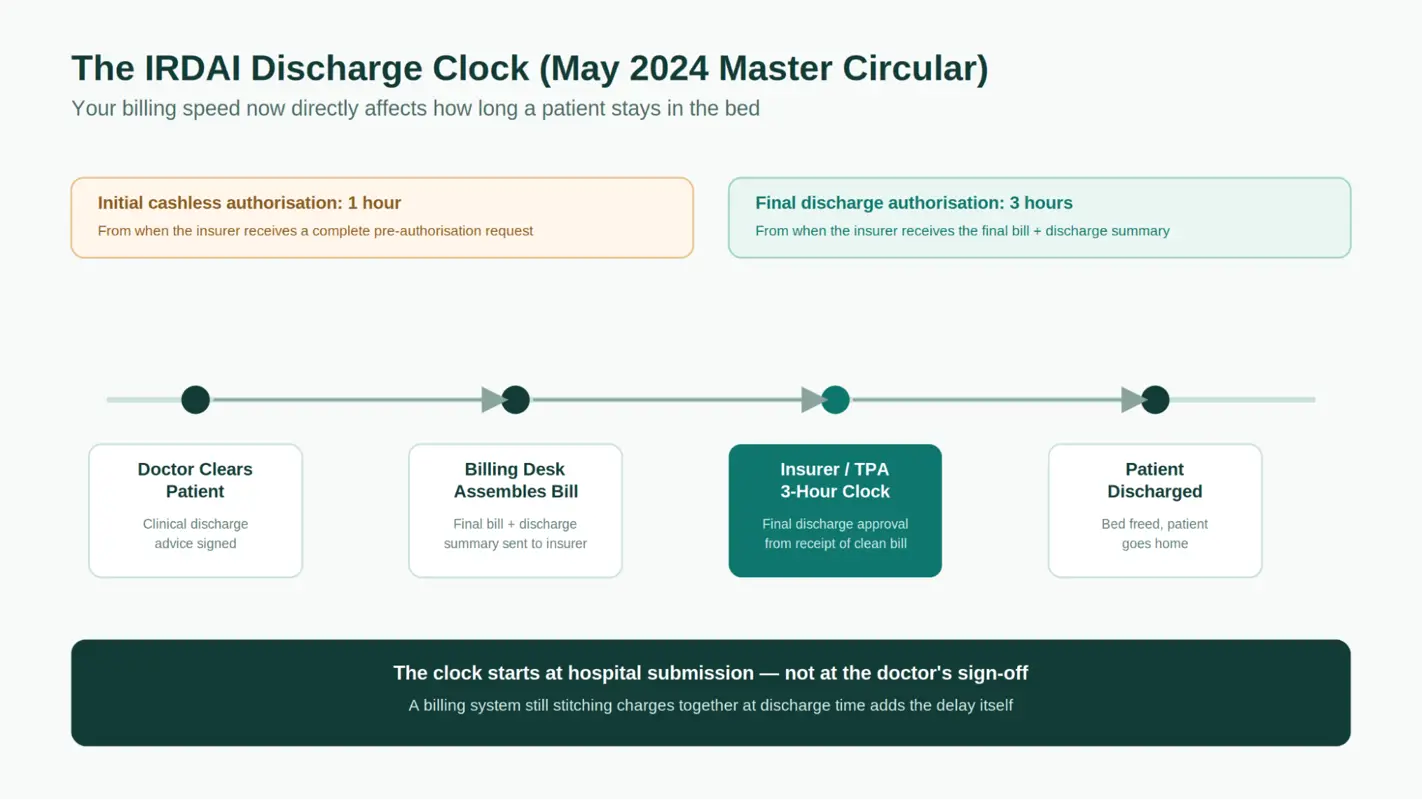
Here’s what most “top 10 hospital billing software” listicles skip entirely, and it’s arguably the strongest reason to take your billing stack seriously right now. IRDAI’s Master Circular on Health Insurance Business dated 29 May 2024 (IRDAI/HLT/CIR/PRO/84/5/2024) put a hard clock on cashless approvals. Insurers must decide on a cashless authorisation request within one hour, and must grant final authorisation at discharge within three hours of receiving the hospital’s request.
The circular also attaches a financial consequence in the other direction: where insurer delay past the three-hour mark results in additional hospital charges, the insurer bears that cost from its shareholders’ funds rather than passing it to the policyholder. Read the operational implication carefully, because it runs toward the hospital. The three-hour clock does not start when the doctor signs off. It starts when the hospital transmits a complete, query-free bill and discharge summary. Every minute the billing desk spends assembling charges from five different registers happens before the clock starts, which means it is time the hospital owns outright and cannot recover from anyone.
What Hospital Billing Software Actually Needs to Do
1. Unify OPD and IPD Billing on One Screen
Outpatient and inpatient billing shouldn’t live in separate tools. A single patient may move from an OPD consultation into an IPD admission within the same visit, and the billing system needs to carry that history forward without re-entry.
2. Auto-Capture Charges From Every Department
The biggest single fix for revenue leakage is removing the human middle step. When a doctor orders a test, a nurse administers medication, or a bed is occupied for another night, that charge should land on the patient’s folio automatically — not after someone remembers to key it in at the end of the shift.
3. Treat Claims as a Workflow, Not a Formality
Pre-authorisation requests, document assembly, submission tracking, and reimbursement follow-up all need somewhere to live, with visibility into exactly where a claim is stuck: hospital-side documentation, or insurer-side review. Given the IRDAI timelines above, this is now a discharge-speed question rather than a finance-team convenience.
This is also where buyers should be most careful. Claim workflow depth varies enormously between products. Some billing platforms handle it natively, others expect it to sit in a separate system alongside them. Ask any vendor to demonstrate a live claim moving through its stages rather than accepting a feature-list checkmark.
4. Get GST Right for Mixed Services
Core healthcare services are largely GST-exempt in India, but hospitals routinely bill items that aren’t — certain non-essential procedures, pharmacy sales to outpatients, or room rents above specified thresholds. A billing system needs to apply the correct treatment per line item automatically, rather than leaving it to whoever’s at the counter that day.
5. Produce an Audit-Ready Trail
If the billing platform cannot exchange data with your clinical systems, someone is retyping it. Ask specifically what integration surface exists, whether that is a documented API, a standards-based interface such as HL7 or FHIR, or a structured import. Ask which direction data flows and how often. This is the most under-examined item on most hospital software shortlists, and it decides whether automated charge capture is achievable at all.
What to Test Before You Buy
A demo will show you a clean, empty system. What you actually need to test is how it behaves on a messy, real day:
- Feed it a real multi-department patient journey — OPD visit, admission, a lab order, a pharmacy charge — and time how long it takes to produce one reconciled bill.
- Ask the vendor to show a claim moving through its actual stages in the live product, and confirm whether status tracking is native or requires a separate system.
- Check whether GST treatment is applied per line item automatically, not as a single blanket rate for the whole invoice.
- Ask for integration documentation in writing. A vendor that cannot name its integration method has not built one.
- Get a straight answer on support: when a claim is stuck at 2 AM, who do you actually call?
The vendors who pass this test are the ones willing to run it on your actual data before you sign anything — not just walk you through a polished sandbox demo.
Where the Market Is Moving
Indian hospitals are steadily moving away from spreadsheets and standalone billing counters toward connected systems that tie registration, pharmacy, lab, and the billing desk together. Smaller nursing homes and clinics tend to prioritise ease of use and GST compliance out of the box. Larger multi-specialty hospitals lean toward deeper claim-workflow automation and standards-based clinical integration, usually assembled from more than one system.
FAQs
Does hospital billing software replace a full Hospital Management System (HMS)?
Not necessarily. Some hospitals run billing as a module within a larger HMS; others run a dedicated billing and inventory system alongside a separate clinical EMR. What matters is that charges flow between the two without manual re-entry.
Is GST applicable on hospital bills in India?
Core healthcare services are generally exempt, but specific items certain non-essential procedures, pharmacy sales to outpatients, and room rents above defined thresholds can attract GST. A billing system should apply this per line item, not as a blanket rule.
How long can an insurer take to approve a cashless claim?
Under IRDAI’s Master Circular of 29 May 2024, insurers must decide on cashless authorisation within one hour and grant final authorisation at discharge within three hours of the hospital’s request. Where insurer delay beyond three hours causes additional hospital charges, the insurer bears that cost rather than the policyholder.
What’s the single biggest cause of hospital revenue leakage?
Uncaptured charges services rendered but never logged against the patient’s bill, usually because they depend on someone remembering to write them down instead of a system capturing them automatically.