Brazil’s instant‑pay system Pix has revolutionized domestic payments. In March 2026, Banco do Brasil and Banco Patagonia launched the first confirmed cross‑border Pix service in Argentina. Now analysts ask: what if Uruguay (and others) join the network?

Image created via Sora
In this projection, we explore how extending Pix beyond Brazil’s borders could alter Latin America’s payment infrastructure. We discuss the confirmed Argentina rollout, clarify why Uruguay’s role remains speculative, outline the technical flow of a Pix cross‑border payment, compare it to legacy SWIFT transfers, and assess the impact on crypto/stablecoins and regional fintech strategy. We conclude with recommendations for banks and payment firms preparing for an interoperable future.
Pix origins and Argentina pilot
Pix was launched by Brazil’s central bank in late 2020 as a real-time, 24/7 payment rail. It quickly became ubiquitous: by 2026 over 170 million Brazilians use Pix for instant, free money transfers. Its success attracted regional attention. In March 2026 Banco do Brasil (with Banco Patagonia) enabled Brazilians in Argentina to pay Argentine merchants via Pix. Customers scan a QR code with their Brazilian banking app; the merchant in Argentina is credited in pesos while the consumer’s Brazilian account is debited in reais. Banco do Brasil handles the peso-real conversion and fees, displaying taxes and rates at checkout. This first international deployment explicitly aims at “regional integration” and is being evaluated for expansion to other markets.
Uruguay: much interest, no formal launch
Uruguay is often mentioned as the “next step” in cross‑border Pix integration, but clarity is needed. Industry reports note that Brazilian tourists in Uruguay (as in Argentina) could use Pix via fintech solutions. For example, payment platforms like PagBrasil (partnered with Uruguay’s Plexo) and KamiPay in Argentina have enabled QR‑based Pix payments for Brazilians abroad.
In mid-2023, commercial solutions also allowed Brazilians in Uruguay to pay in reais (with merchants receiving pesos or “digital dollars”). However, no official central-bank agreement has been announced for Uruguay akin to the Argentina deal. The Banco Central do Brasil has not formalized a Uruguay integration, and Uruguayan authorities have not issued a reciprocal rule. In short, Argentina is confirmed Pix‑on‑the-ground, whereas Uruguay’s involvement remains a projected scenario based on tourism use cases.
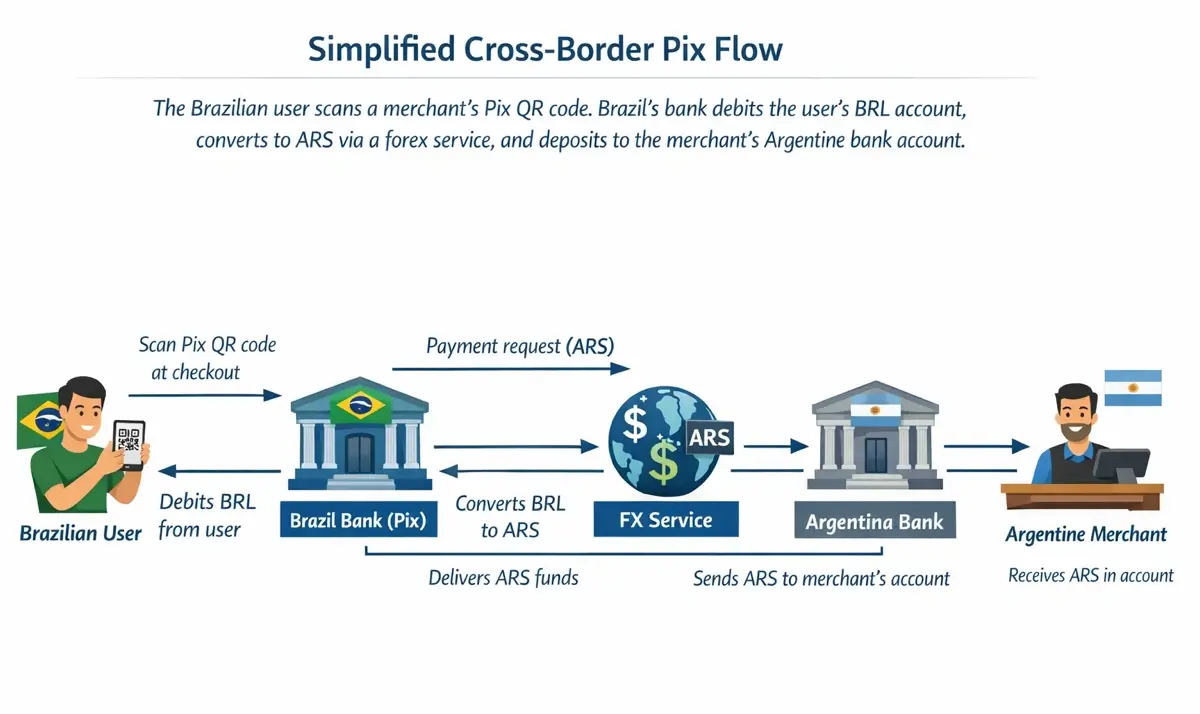
Simplified cross-border Pix flow. The Brazilian user scans a merchant’s Pix QR code. Brazil’s bank debits the user’s BRL account, converts to ARS via a forex service, and deposits the merchant’s Argentine bank account in local currency.
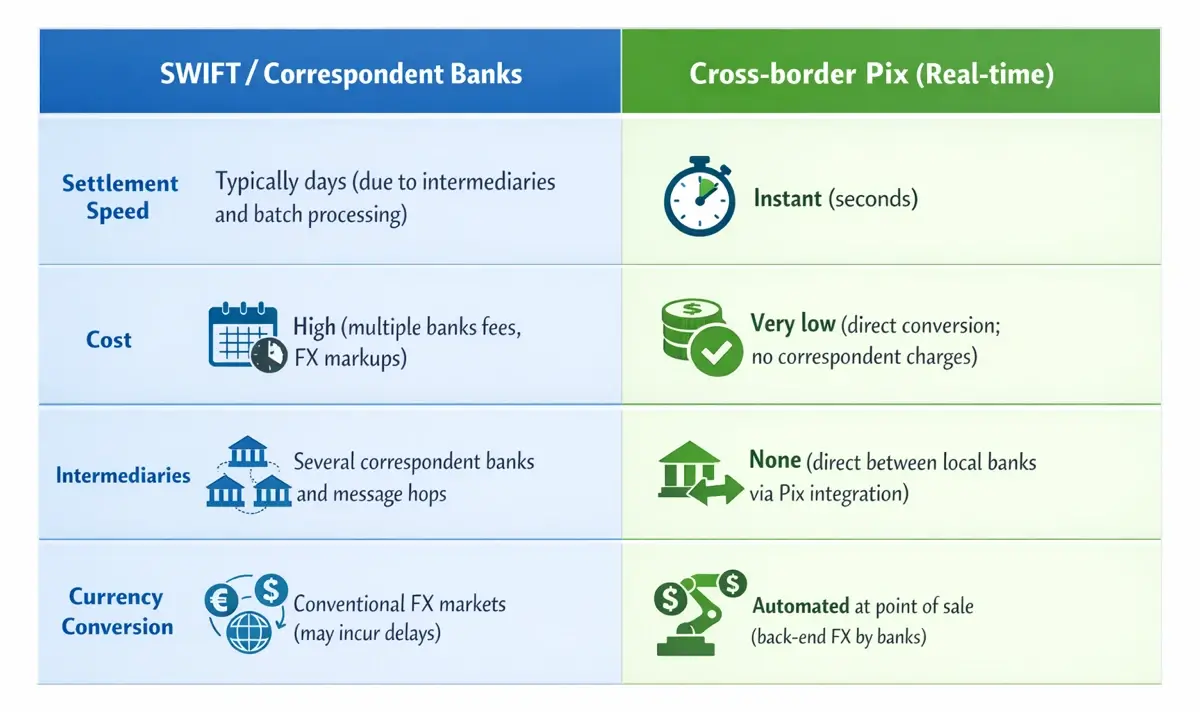
Pix vs. SWIFT (cross-border payment comparison)
Pix-style rails could “route around” SWIFT for regional flows: payments finalize in seconds rather than days, and fees drop sharply.
Stablecoins, crypto and payment rails
Cross-border Pix and similar instant rails pose a strategic challenge to crypto-based payments. Stablecoins grew partly to speed up remittances and FX settlement. But real-time rails offer many of the same benefits without crypto volatility. For retail cross-border spending, a local-currency Pix transfer can now replace what Brazilians might have done with USDC or other stablecoins.
As Banco Central do Brasil’s pilot shows, Pix payments can even settle in USD or digital currencies for merchants. This may eventually push stablecoins to focus on infrastructure use-cases letting Pix and domestic rails handle retail payments and FX. Since Pix-enabled RTP lowers the cross-border friction that stablecoins aimed to solve, banks and fintechs should consider new roles for crypto (e.g. FX ladders, DeFi on-ramps) instead of crowding out instant rails.
Next frontiers in LatAm
Looking beyond Uruguay, which countries are ripe for Pix integration? Key candidates share three traits:
- an active instant‑pay system,
- high Brazillian travel/remittance ties,
- and supportive regulators.
Chile, Colombia and Peru already have national RTP networks and significant tourist inflows. Mexico has SPEI (real-time domestic transfers) and huge remittances. Paraguay and Bolivia could also join via partners. (Indeed, PagBrasil’s expansion roadmap mentions Argentina, Chile, Mexico, and Portugal.)
Brazil’s own strategy is to focus “on areas with large Brazilian communities,” including other Americas, Europe and Asia. For B2B readers, this implies watching regional central banks: new bilateral agreements (e.g. Pix-Chilean system) could emerge soon, and fintech partnerships (like PagBrasil or Fiserv) may pre-empt them.
Recommendations for banks & fintechs
1. Build interop expertise: Begin integrating your payment APIs with Pix and other local rails. Banks and processors should establish Pix-compatible on-ramps (for example, support multi-currency QR payments and real-time FX settlement). This may involve implementing open API standards or hiring Pix-knowledgeable staff.
2. Forge regional partnerships: Collaborate with foreign banks or payment platforms in target countries (e.g. local acquirers in Argentina/Uruguay). Joint pilots like Banco do Brasil did with Banco Patagonia can shorten time‑to‑market. Monitor central bank working groups (e.g. Pix Forum) to align with emerging frameworks.
3. Enhance compliance and liquidity management: Instant cross-border rails still require KYC/AML adherence and FX liquidity. Invest in real-time monitoring tools and dynamic FX hedging systems. Payment processors should ready solutions for automatic currency conversion and tax handling (as in the Banco do Brasil pilot).
By preparing on these fronts, B2B players can leverage the coming real-time corridor. Whether Pix becomes a LatAm counterpart to Europe’s SEPA Instant or remains a niche, cross-border instant rails are still on track to reshape regional commerce.