Péter Magyar’s landslide victory over Viktor Orbán ends 16 years of Fidesz rule. For Hungary’s financial sector and its nascent fintech ecosystem, the shift could be transformative, but the path forward is far from simple.
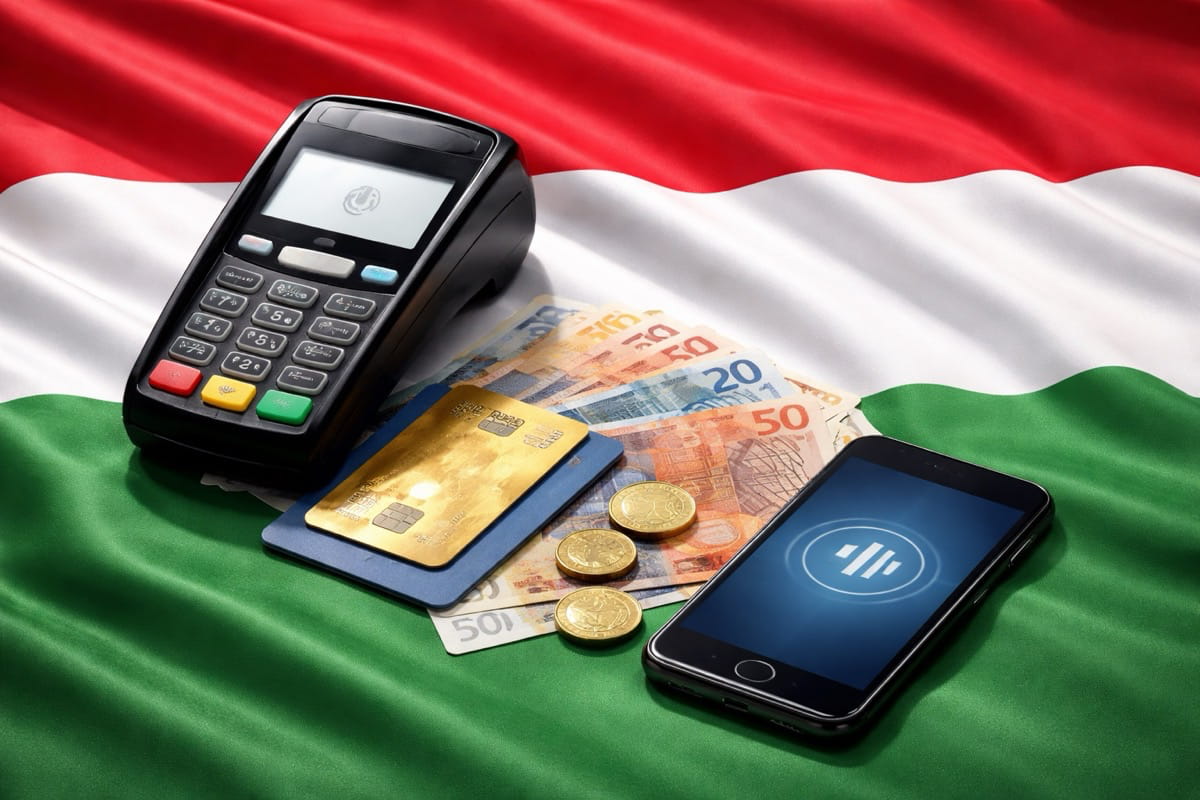
Image created via Sora
Hungary woke up on Monday to its most consequential political shift since 1990. With Péter Magyar’s Tisza Party securing a commanding two-thirds supermajority in parliament, the country has definitively closed the Orbán era and opened a new chapter whose implications for banking, payments, and financial technology are only beginning to come into focus.
Some stats to bear in mind:
- 138 Tisza seats won
- €18b EU funds frozen
- +2% Forint surge vs. Euro
The EU Funds Unlock: Capital Meets Infrastructure
The most immediate financial consequence of the election is the prospect of unlocking approximately €18 billion in EU funds that Brussels suspended over Hungary’s rule-of-law violations. Magyar has pledged to travel to Brussels as one of his first acts in office, with restoring Hungary’s access to frozen cohesion and recovery funds at the top of his agenda.
These funds, earmarked for infrastructure, digitisation, and SME support, are directly relevant to the payments ecosystem. Digital infrastructure upgrades, cross-border connectivity projects, and business modernisation grants all drive card and electronic payment adoption. A material release of these funds before the August 31 deadline would be a structural accelerant for Hungary’s transaction economy.
The forint jumped to near four-year highs and local shares saw significant surge as markets priced in a more cooperative Budapest–Brussels relationship and what that means for billions in previously inaccessible capital.
Currency Stability: Good News for Cross-Border Commerce
Markets moved fast. The forint surged roughly 2% against the euro in overnight trading, reaching levels not seen in nearly three years. For Hungary’s payment landscape, a stronger and more stable forint matters considerably. First of all, it reduces FX conversion costs on cross-border transactions. That, in turn, improves the competitiveness of Hungarian e-commerce merchants serving EU markets. Furthermore, strong and competitive fiat currency makes Hungary a more attractive destination for European payment providers eyeing Central and Eastern European expansion. Under Orbán, currency volatility and political risk created much of unwanted friction for international players — friction that a pro-EU government has the credibility to meaningfully reduce.
Regulatory Realignment with the EU
One of the quieter but more consequential shifts will be in regulatory culture. The Orbán government may have maintained formally compliant transpositions of EU payment directives, e.g. PSD2, AML frameworks, instant payment regulations, and other crucial legislative initiatives. Nevertheless, unfortunately, it was widely known that the judiciary and regulatory bodies overseeing enforcement were politically stirred and effectively captured.
At this point, the election winner, Magyar has explicitly pledged to join the European Public Prosecutor’s Office and restore judicial independence. For payments and financial services, this matters not less than for common citizens. It signals that enforcement will potentially become more predictable, appeals processes more credible, and licensing decisions more insulated from political pressure. Although everyone understands such big systemic shifts don’t come overnight, even a glimps of hope for regulatory transparence and predictability is a good sign for investors. That predictability is a precondition for serious institutional investment in the Hungarian market.
What It Means for Local Fintech Startups
Hungary has produced capable fintech talent — developers, product managers, and payment engineers who have largely been absorbed by Western European companies or emigrated due to constrained domestic opportunity. After Orbán’s long rule, more promising regulatory environment, combined with unlocked EU innovation grants potential and stronger rule-of-law guarantees, entirely changes the calculus.
Startups building in open banking, embedded finance, and B2B payments stand to benefit most directly. The anticipated flow of EU structural funds into SMEs, a stated Tisza priority, will increase demand for digital invoicing, expense management, and working capital tools precisely where Hungarian fintechs are already building. As an additional advantage, access to EU programmes like the European Innovation Council and Horizon Europe, previously difficult to leverage due to Hungary’s governance risk classification, may now open more readily.
Perhaps most critically: talent retention. Hungary’s fintech sector has suffered a slow brain drain under Orbán, as uncertainty over EU membership alignment and the rule of law pushed ambitious founders westward. A credible pro-EU government removes a key psychological barrier to building and staying local. Early-stage venture capital entities, whether they are domestic or regional, has been watching this election closely. A Magyar administration is likely to see renewed VC interest in Budapest as a founding hub, particularly for CEE-focused payment infrastructure and compliance-tech companies navigating the post-PSD3 landscape.
The Honest Caveat
Please don’t think that any of this possible fintech landscape change will be automatic or simple, for that matter. Magyar inherits a difficult-to-restore economy. In Hungary, GDP grew just 0.4% in 2025, inflation remains elevated, and the budget deficit is projected to surge above 5% through 2027. Just let that sink in. Unlocking EU funds requires meeting strict technical and governance conditions under a hard deadline. Institutional reforms such as judiciary, media, anti-corruption bodies, might take years to credibly embed. The payments landscape will not transform overnight. But the direction of travel has unambiguously shifted, and for an industry as sensitive to regulatory trust and macroeconomic stability as financial services, direction matters enormously.
Hungary’s fintech moment may finally be arriving — not with a single announcement, but with the steady compounding of better institutions, more stable currency, and reopened European capital flows. The election result is the starting gun, not the finish line.