Hyperswitch’s version 1.128.0, dated October 15, 2026, lists fraud-management flows among its features, and its release notes page now counts 37 weekly releases and 724 merged pull requests. In July, Juspay also tied it to Recurly for subscription businesses. Open source moves quickly, and anyone can see it moving, but you’ll want to know what running it costs you before you compare it with vendors who run the platform for you.
Key takeaways:
- Hyperswitch is the only entry here whose core you can download for free, under Apache 2.0, and its docs rate the operational overhead of self-hosting as high.
- Gr4vy is the closest managed swap for a merchant who wants an isolated environment without a platform team.
- Akurateco, at #2, also offers self-hosting, with a vendor SLA and a white-label gateway for PSPs and banks.
Do you have engineers who want to own payments, or do you want the control without the pager? The five Hyperswitch competitors below are ranked for that decision, by merchants and payment businesses buying a payment orchestration platform. Every vendor number here came off that vendor’s site or paperwork, in October or November 2026.
Hyperswitch in 2026
Juspay open-sourced Hyperswitch in 2022, and the project now ships on a weekly rhythm.
What it sells
Hyperswitch calls itself the world’s first open-source payment orchestration platform, and there are three ways to buy, or not buy, it. The community code in the core GitHub repository is free under Apache 2.0, while a separate routing repository, decision-engine, carries the stricter AGPL v3. Paying for Self-Host Enterprise Edition gets you SLA-driven support and a dedicated account manager. Hyperswitch Cloud is fully managed, with a stated 99.999% uptime SLA.
Self-hosting asks a lot. The checklist wants a cloud account, an active processing account with an acquirer, and skills in Kubernetes, Rust, Postgres, Redis, Prometheus and S3. The enterprise sizing guide works from 25 million transactions a month. Its blog estimates infrastructure twice on one page, up to USD 1,000 a month in a table and up to 1,500 in the FAQ, from a floor of USD 100, and engineering time comes on top.
What changed
Release dates tell you more here than press does. Version 1.125.0 is dated July 9 and 1.128.0 October 15, so that’s three version numbers in about three months for anyone planning upgrades on a self-hosted build. On July 22 Juspay announced the Recurly partnership, giving subscription businesses access to over 300 PSPs through Hyperswitch.
That number needs care, since the pricing page says 90+ for self-hosted editions and 210+ for Cloud. Ask which connectors your edition actually gets. If terms like routing and cascading are new to your team, PaySpace Magazine’s payment orchestration explainer covers what the layer does before you size the work.
What users say
Review sites say little. Hyperswitch has 5.0 out of 5 from 1 review on SourceForge and 4.9 from 9 on Product Hunt, and Trustpilot shows none (checked October 29, 2026). OpenTechHub gives self-hosting 5 out of 5 for complexity and tells merchants without a platform team to be careful. GitHub’s issue tracker will tell you more than any of them.
Hyperswitch competitors at a glance
Only Akurateco also offers self-hosting, so that’s the first filter.
| # | Competitor | Best for versus Hyperswitch | Deployment | Pricing | Standout |
|---|---|---|---|---|---|
| 1 | Gr4vy | Isolation without the operations | Single-tenant cloud | No public price | 400+ payment methods |
| 2 | Akurateco | Self-hosting with a vendor SLA | SaaS, own servers or cloud | Quote | 99.95% uptime SLA |
| 3 | Payrails | Finance teams on one stack | Vendor-operated vault | No public price | US Merchant of Record option |
| 4 | BridgerPay | No-code routing | Google Cloud | Book a demo | 1,000+ PSPs claimed |
| 5 | IXOPAY | Tokens plus white label | Vendor-hosted | Tokens from $1,000 a month | Published SLA and terms |
None of these has a price you can compare with free code, so weigh engineering hours against each quote.
How the competitors compare
Hyperswitch’s strength is transparency, and its weakness is the workload that comes with it. Read each rival for what it takes off your team.
1. Gr4vy: your own environment, run by someone else
If your reason for choosing Hyperswitch was not sharing servers, Gr4vy answers it without the staffing. You get a dedicated single-tenant cloud instance, with separate sandbox and production, and regional data residency. Swapping in a PSP or anti-fraud tool needs no checkout work, and the 90 days to October 23, 2026 passed with no incident on its status page.
Tokens import and export, and cards in its vault work across PSPs. In May 2026 it added Pix Automatico through dLocal.
Best for: an enterprise merchant or platform that wanted isolation rather than source code.
Watch out for: you can’t read the code or move it to your own account, and no price is public.
2. Akurateco: self-hosting with a vendor behind it
Akurateco and Hyperswitch both put the platform in your environment, but the deal differs. Here you get a vendor on the hook, a 99.95% uptime SLA and a stated timeline, about 30 days on your cloud account across AWS, Oracle Cloud, Azure or Google Cloud, and about 60 days on dedicated infrastructure. It also runs as SaaS, in about 5 business days on average.
Both of its products, the orchestration platform and the white-label gateway, carry 150 built-in configurable fraud filters and 700+ ready connectors. A new integration takes about 14 days.
Best for: a PSP or bank that must self-host but won’t staff a Rust and Kubernetes team.
Watch out for: you can’t inspect the source as you can with Apache 2.0 code, and self-hosting still leaves PCI DSS scope with you.
3. Payrails: when finance is the real buyer
Hyperswitch handles the payment switch. Payrails extends into reconciliation, chargebacks, fee monitoring and payouts, with 100+ integrations including SAP, and it launched a Merchant of Record on October 7, 2026 that’s limited to the United States in its docs. Its vault can take a merchant from SAQ-D down to SAQ-A, a shorter compliance load than a self-hosted build.
Best for: a large merchant whose finance team wants one system.
The trade-off: it operates the vault, publishes no price list, and has no public reviews we could read.
4. BridgerPay: routing without engineers
A team that looked at Hyperswitch’s checklist and winced may prefer the opposite approach. BridgerPay lets staff drag and drop routing rules by location, expense or type, and its retry tool sends eligible declines to other PSPs. It runs entirely in the cloud on Google Cloud, with 1,000+ PSPs claimed across 185 countries and a free catalog you can browse with no account. On October 20, 2026 it expanded into retail, travel and hospitality.
Best for: a merchant in high-risk or fast-moving markets with no developers to spare.
Watch out for: developer docs sit behind a password, standard terms run 12 months and renew yearly, and fees are set in each service order.
5. IXOPAY: enterprise depth with contracts in print
Hyperswitch’s terms are simple, 30 days’ notice for convenience. IXOPAY’s go the other way, with no termination for convenience during a term and a published SLA of 99.90%. In return you get 500+ pre-built adapters, universal and network tokens, and a white-label edition, and the May 2026 agreement makes token transfer a defined, paid process.
ATOM, HDFC CCAvenue, UPI and Paytm all have IXOPAY adapter pages, which matters if you chose Hyperswitch for its Juspay roots.
Best for: a large enterprise or PSP that prefers a signed vendor over community support.
The trade-off: expect a long contract and a demo before any orchestration price.
Where Hyperswitch sits among 70 payment platforms
The checks in this series covered 70 vendors, a count that takes in vaults and billing tools. Stored cards come out well for Hyperswitch. It belongs with the 22 of 63 vendors documenting a way out, sending a PGP-encrypted CSV over SFTP to a PCI DSS compliant processor once you share that processor’s attestation and Hyperswitch’s security team approves.
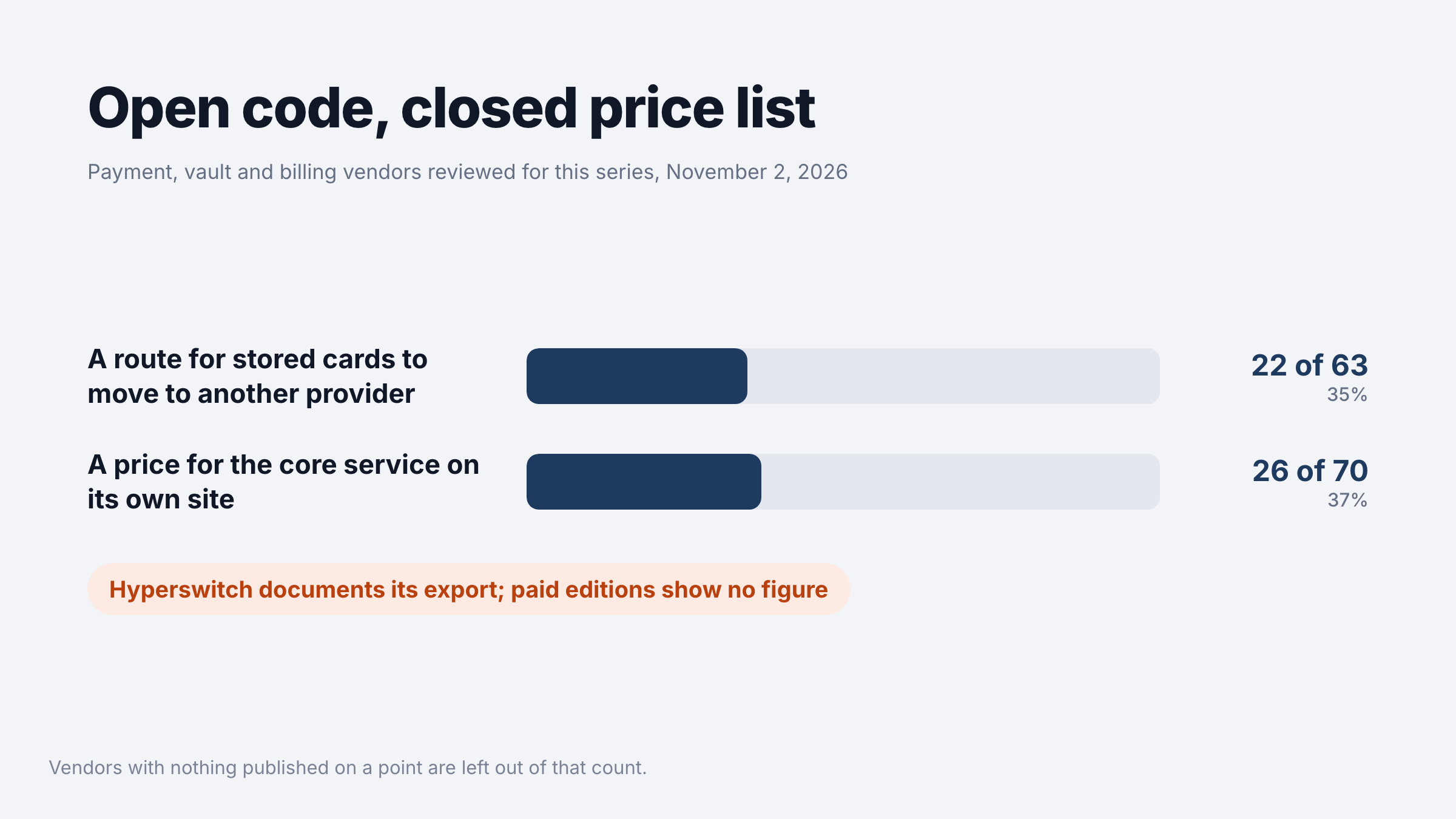
Price is harder to place. The community code is free, but the paid editions say Contact Us, so the 26 of 70 count for core prices leaves Hyperswitch out. Its infrastructure ranges cover hosting only, and they differ on one page. We took those counts on November 2, 2026, and Hyperswitch wasn’t part of our Visa registry search.
What to verify before you sign
Self-hosting a card environment means taking on rules that are still tightening. Of the 64 new requirements in PCI DSS v4, 51 were future-dated and took effect on March 31, 2025. Local rails add their own load too, with NPCI’s figures showing UPI at 25.47 billion transactions in October 2026, so a build serving India has to size for that traffic.
| Decision area | Question to ask | Evidence to request | Red flag |
|---|---|---|---|
| PCI workload | Who owns the audit at our transaction count? | The responsibility matrix | “Compliant” with no split of duties |
| Staffing | Which skills, and how many people, for on-call? | A named runbook and sizing guide | Hours quoted without an on-call plan |
| Upgrades | How often must we patch, and what breaks? | Release notes and a rollback path | Weekly changes with no support window |
| Connectors | Which connectors does our edition include? | The list for that edition | A headline count from another edition |
| Licensing | Which components sit under which license? | A license inventory | Copyleft found after the build starts |
Run that table past your security lead first, because most of its answers land on their desk once the contract is signed.
The bottom line
Stay with Hyperswitch if you have a platform team that wants the code, and budget for audits and upgrades as well as servers. For isolation without the staffing, look at Gr4vy. To self-host with a vendor behind it, or to sell a gateway under your own brand, look at Akurateco. Among these Hyperswitch competitors, the other three suit narrower cases, so pick by who’d be awake at 3 a.m. when a connector fails.
Questions about Hyperswitch competitors
Is Hyperswitch really free?
The core repository is under Apache 2.0, so the code costs nothing. You still pay for infrastructure, engineers and PCI DSS work, and the enterprise and cloud editions are quoted.
Who are Hyperswitch’s main competitors?
Gr4vy, Akurateco, Payrails, BridgerPay and IXOPAY are the closest here. Only Akurateco also offers deployment in your own environment.
How much do Hyperswitch alternatives cost?
Among Hyperswitch alternatives here, $1,000 a month gets IXOPAY’s token plan, while Gr4vy, Payrails and BridgerPay give prices only through sales.
Who is responsible for PCI DSS on a self-hosted Hyperswitch?
You are. The docs require a QSA Report on Compliance above 1 million card transactions a year, a self-assessment questionnaire below that, and quarterly network scans by an Approved Scanning Vendor.
Is Hyperswitch owned by Juspay?
Yes. Juspay open-sourced it in 2022, and the agreement for its hosted services is with Juspay Technologies Private Limited.