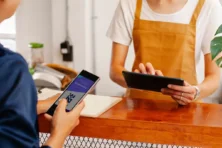
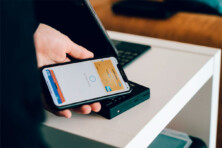
Throughout the last few years, the emergence of NFC wearables has revolutionized mobile payments and added more security and flexibility to some types of m-commerce
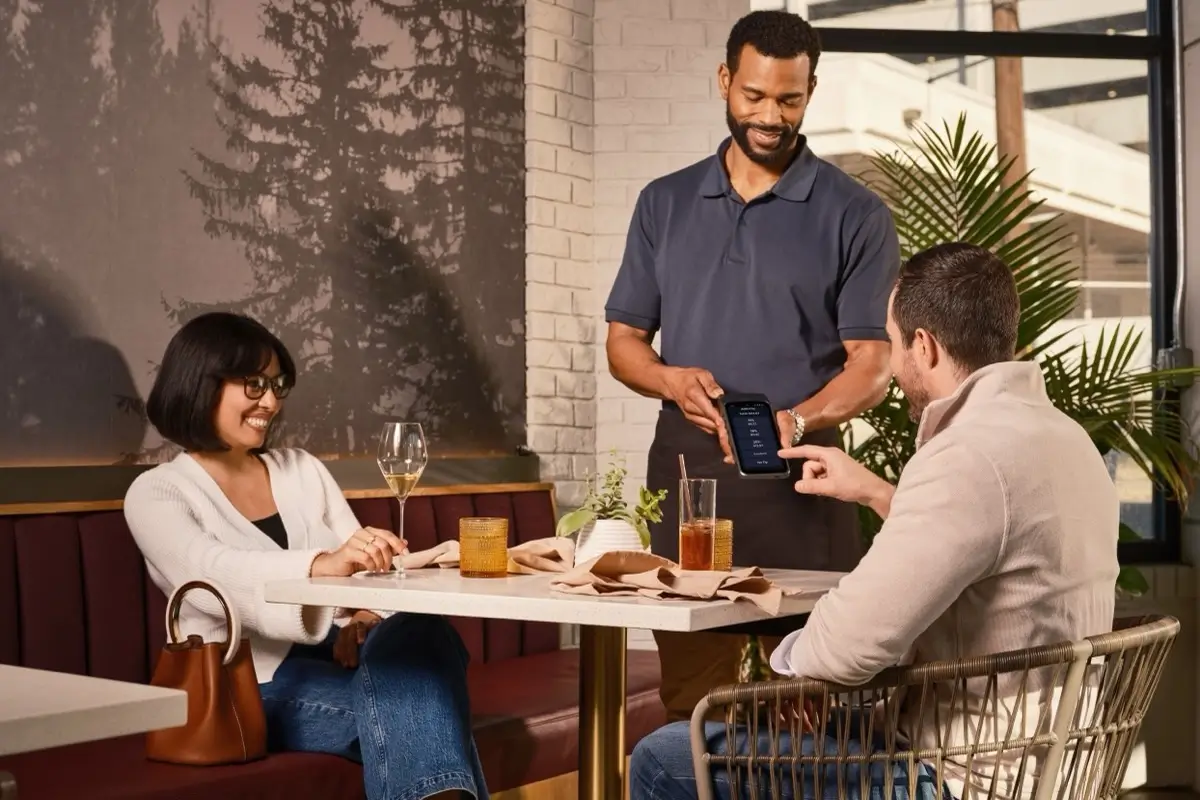
Mobile commerce, or in short m-commerce, is a retail or wholesale trade that takes place online by means of mobile applications on wireless handheld devices e.g. cellphones and tablets. It also includes the mobile sale of services, banking activities, mobile payments of household running costs, etc. Considering its convenience, it is no surprise m-commerce popularity is on the rise.
Statistics
As of 2025, m-commerce sales volume comprised 59% of all e-commerce deals, and in 2026 the share is estimated at 60%. The numbers are growing every year. Market experts predict mobile sales to reach 63% in 2028.
Allied Market Research has estimated that the global mobile-payments market will grow by about 8% annually until 2034. They predict the total transaction sum to reach $16,142 billion.
As m-commerce is enabled via the use of mobile wallets such as Apple Pay, PayPal, or Google Wallet, their use is also expected to rise by about 35% from 2025 to 2030, according to Juniper Research. By then, the number of digital wallet users is predicted to grow from 4.4 billion to over 6 billion.
Considering these tendencies, most e-commerce businesses are striving to facilitate mobile shopping as well. For instance, they have designed simplified website interfaces which are easy to navigate on a mobile phone or tablet. They have created separate shopping apps. Finally, they have added mobile wallets as a valid payment option to their main webpage.
Nevertheless, mobile conversion rates still lag behind those of ordinary e-commerce. During the Black Friday and Cyber Monday sales in 2025, desktop online shoppers converted at a rate of 3.61%, while those shopping via smartphones converted only at 2.59%. At the same time, smartphones brought about 74% of the traffic and over 67% of the orders.
What do these numbers signify? To begin with, it means that traditional online shopping is still more convenient for many users than mobile transactions. Perhaps, the apps are not optimized enough for buyers’ preferences. For instance, they may not be able to examine the item properly in all details on a smartphone screen, etc. Or else, mobile apps may be missing a lure such as Alibaba’s small discounts for mobile users only. That smart move allowed the platform to raise mobile conversion rates from 0.44% to 2.8% within the 2012-2016 period.
However, the main public concern is still the security of mobile transactions. It is registered all over the fintech sector and across the globe. Whether it’s paying with a mobile wallet at a local store or completing a transaction via a mobile shopping app, people are still afraid to store their card details in a portable device that’s easy to steal or be lost. According to Experian’s 2025 Identity and Fraud Report, identity theft (68%) and stolen card information (61%) remain the top fraud concerns among consumers, while 76% say physical biometrics make them feel the most secure. Therefore, improving security measures is the main challenge for m-commerce growth.
Nevertheless, it has all the chances of overcoming these limitations, considering the fast pace of transformations m-commerce has adopted since its very beginning.
History of m-commerce
 Kevin Duffey coined the term m-commerce during the Global Mobile Conference Forum. At the time, it was limited to buying ringtones and services through text messages.
Later that year, Finland installed two Coca-Cola vending machines that allowed buying beverages via SMS. Merita Bank of Finland used SMS to develop the first mobile banking system.
 The first browsing-like mobile application was introduced in Japan. The i-Mode Internet service was provided by NTT DoCoMo. It allowed customers to purchase items through their phones.
 Different countries in Europe developed opportunities to pay for parking and buy train and airline tickets through mobiles. Finnair allowed mobile check-ins.

A Dutch department store chain launched a sales campaign through text messages. Customers registered online and connected their bank accounts. They received SMS with special offers. By replying “yes,” they confirmed a purchase. The payment was made via bank transfer from the connected account.
The same year, Apple launched the iTunes store.
 The iPhone was launched. It popularised the use of smartphones. Developers began working on apps.
 Amazon launched TextBuyIt that allowed users to check prices and purchase items using SMS. One of the world’s first mobile wallets, GCash was created.
During the last decade, m-commerce was quickly evolving. It acquired a familiar form that modern consumers are used to. 3G and 4G networks sped up transactions and made m-commerce more attractive to buyers.
 The launch of Apple Pay and Android Pay made mobile shopping more secure and convenient.
Throughout the last few years, the emergence of NFC wearables has revolutionized mobile payments and added more security and flexibility to some types of m-commerce. However up-to-date, they remain not as popular as standard smartphone payments among users.
In 2016, India launched the Unified Payments Interface (UPI), while super apps like Alipay and WeChat Pay turned mobile payments into a part of everyday life in China. QR codes became the most popular digital wallet transaction type, with 380 billion transactions forecast for 2026.
In 2024, Apple began opening access to NFC capabilities on the iPhone. It allowed banks and other companies to build their own contactless wallet features into their apps on iOS.
Pros & Cons
|
Pros |
Cons |
| You can buy on the go. Transactions are instant. | Some mobile screens are too small to properly examine the item details. |
| You can store all your credit and debit cards information in one place and use the mobile wallet from multiple portable devices. | Portable wireless devices can get lost or stolen. |
| Apps can automate regular payments. | Digital accounts are always under a threat of hacking. |
| Some shopping apps have additional benefits for users. |