Spreedly introduced Composer on October 21, 2026, a no-code canvas for fraud checks, authentication, routing and execution built on its newly acquired Dodgeball logic engine. In March it had already made agentic commerce a live channel. A company that started in 2007 storing cards now sells far more than storage, which widens who it competes with.
Key takeaways:
- Spreedly’s vault prints a price, from $750 a month, but routing, retries and network tokens sit on a tier priced through sales.
- Akurateco is the competitor here that you can host yourself, and Hellgate gives you dedicated infrastructure.
- Hellgate and VGS also publish starting prices, €1,000 and $1,000 a month, while IXOPAY and BridgerPay quote privately.
Are you buying a vault, a router or the whole payment layer? The five Spreedly competitors below are ranked for merchants and platforms sizing up a payment orchestration platform. Figures are as published by each vendor when we checked in October and November 2026.
Spreedly in 2026
Few vendors in this space publish as much about their terms, so Spreedly makes a useful yardstick.
What it sells
Spreedly calls itself a global payments orchestration platform, with pillars called Connect, Vault, Optimize, Protect, Agentic and Composer. It lists 150+ gateway connections, 60+ payment methods and 32+ fraud and risk solutions on a multi-tenant architecture, with white-label options and automated merchant onboarding.
The Independent Vault starts at $750 a month with unlimited storage. The Performance Optimization tier, priced through sales, adds routing, retries, network tokens and 3DS.
Its Terms of Service (October 1, 2026) set a 30-day initial term unless an ordering document says otherwise, renewing for equal terms. Notice is at least 15 days, or 30 where the term is 12 months or longer.
Cards can go automatically to supported gateways, or by encrypted file to other PCI-compliant destinations, generally within 2 weeks. Its Terms charge for each manual export, while its help center makes the first one free for each third-party service per merchant.
What changed
Spreedly’s 2026 has been about AI agents and one acquisition:
- On March 4 agentic commerce went live as a channel, with agent-initiated transactions running over a merchant’s existing PSP relationships.
- The April 1 spring release introduced Composer 2.0, combining Dodgeball’s logic engine with Spreedly’s connectivity.
- An October 1 summer roundup covered support for AI shopping agents.
- On October 21 it formally introduced Composer.
Card networks are moving as well. Visa announced Agent Scoring and an Agentic Registry on June 10, and Mastercard launched Agent Connect on September 9. Spreedly’s reach into Brazil via Pix and EBANX is older news and may matter more to your revenue this year.
What users say
Scores are spread thinly. Software Advice shows 4.5 from 13 reviews, TrustRadius 7 out of 10 from 2 and Gartner Peer Insights 3.0 from 1, with no reviews on Trustpilot (as of October 29, 2026). The status page offers firmer data, with 3 incidents in the 90 days to October 23 and 99.98% uptime for the Core Transactional API.
Spreedly competitors at a glance
The market has split into vaults, routers and platforms that do both, and this table shows where each vendor falls.
| # | Competitor | Best for versus Spreedly | Deployment | Pricing | Standout |
|---|---|---|---|---|---|
| 1 | Akurateco | Hosting and branding the platform yourself | SaaS, own servers or cloud | Quote | 700+ ready connectors |
| 2 | IXOPAY | Enterprise-scale tokens and routing | Vendor-hosted | Demo request | 500+ pre-built adapters |
| 3 | Hellgate | Dedicated infrastructure at a listed price | Dedicated, with one shared service | Guardian from €1,000 a month | Vault built to cut PCI scope |
| 4 | BridgerPay | Wide connector choice with a free catalog | Google Cloud | Book a demo | 1,000+ PSPs across 185 countries |
| 5 | VGS | Vault only, routing built by you | Vendor-hosted, three regions | Starter from $1,000 a month | 10 billion tokens |
Spreedly, Hellgate and VGS let you price a vault before a call, which is rare enough in this market to be worth noting.
How the competitors compare
Spreedly’s terms set a high bar for openness, so each profile of these Spreedly alternatives also says how much its rival discloses.
1. Akurateco: the platform on your own terms
Spreedly runs as multi-tenant SaaS. Akurateco offers SaaS as well, plus deployment on your own servers or in an Azure, Google Cloud, Oracle Cloud or AWS account, keeping data residency and PCI DSS scope in-house. Cloud deployments take about 30 days and dedicated infrastructure about 60. It sells a white-label payment gateway to PSPs and banks, whose brand then appears on portals and domains, alongside its payment orchestration platform.
Acquirer contracts stay yours, and 700+ ready connectors link them up, with tokenization and network tokenization available. Service levels include a 99.95% uptime SLA, 150 built-in configurable fraud filters, about 14 days for a new integration and a 5-business-day average to begin processing.
Best for: a PSP, bank or regulated merchant that wants to run its own branded stack.
Watch out for: there’s no processing of funds or opening of merchant accounts here. Its card export route also isn’t documented the way Spreedly’s is.
2. IXOPAY: the enterprise token platform
IXOPAY’s roots go back to Vienna in 2001, and mergers with TokenEx and Aperia Compliance in 2024 put tokens and compliance in one group. Adapters number 500+, with 250+ acquirers among them. TokenEx Core bundles Universal Tokens, Network Tokens and the Transparent Gateway API.
Moving out is documented through TokenEx Batch, which detokenizes stored data into a file and can encrypt it for another provider.
Best for: a global enterprise that wants universal tokens from a specialist.
The trade-off: no rate card exists. Spreedly’s 30-day default looks short beside IXOPAY GmbH’s General Terms, which renew fixed terms for 18 months and say it isn’t obliged to return data after a SaaS termination.
3. Hellgate: dedicated infrastructure with list prices
Hellgate, a product of Germany’s Starfish GmbH & Co. KG, sells two main things. Guardian is a token vault on dedicated infrastructure, built to move a merchant from SAQ D to SAQ A or A-EP, and Commerce is a ready-made service for routing, retries and provider abstraction.
Guardian’s list prices are €1,000 a month (up to 2.5 million credentials), €5,800 (up to 15 million) and €12,500 (up to 25 million), with no setup or onboarding fees. Commerce imports tokens, including from third-party vaults such as Stripe, with reconciliation reports.
Best for: a merchant that wants its own vault infrastructure and a price it can budget against.
Watch out for: its site gives no total connector count, so check your PSPs by name, and Visa’s registry shows no row for it under the names we tried.
4. BridgerPay: wide choice of connections
BridgerPay says it connects 1,000+ PSPs across 185 countries, and you can browse its Connections catalog free with no account. That’s a good way to check your providers before talking to anyone. It adds independent Bridger 3DS, Bridger Retry for rerouting eligible declines and settlement reconciliation across providers. It serves retail, travel, SaaS, financial institutions and gaming.
Best for: a merchant that values connector breadth and wants to check coverage first.
Watch out for: no price list exists, and developer documentation sits behind a password. Standard Subscription Terms let it delete your data after termination with no obligation to retain it, so plan your export before you give notice. Its pages show no self-hosted edition.
5. VGS: the vault without the router
VGS answers the question on its own page. Asked whether it’s an orchestration platform, it says it provides the data layer on which you build your own strategy. It holds 10 billion tokens and offers network tokens, account updater and card attributes through one API, with direct connections to all four card networks by its own claim. Starter is from $1,000 a month and Growth is quoted.
Vaults can sit in North America, Europe or Asia Pacific for residency.
Best for: an engineering team that wants to own routing and buy only the vault.
The trade-off: Spreedly’s comparison page says routing on VGS requires custom development, and that’s a rival’s claim worth testing. VGS’s docs cover moving cards in, with no page on exporting them out.
Where Spreedly sits among 70 payment platforms
Spreedly is one of only 8 vendors in this competitor series that clear all three of these measures: a price for the core service (26 of 70), a listing in Visa’s provider registry (52 of 61) and a documented route for stored cards to move (22 of 63). VGS is another.
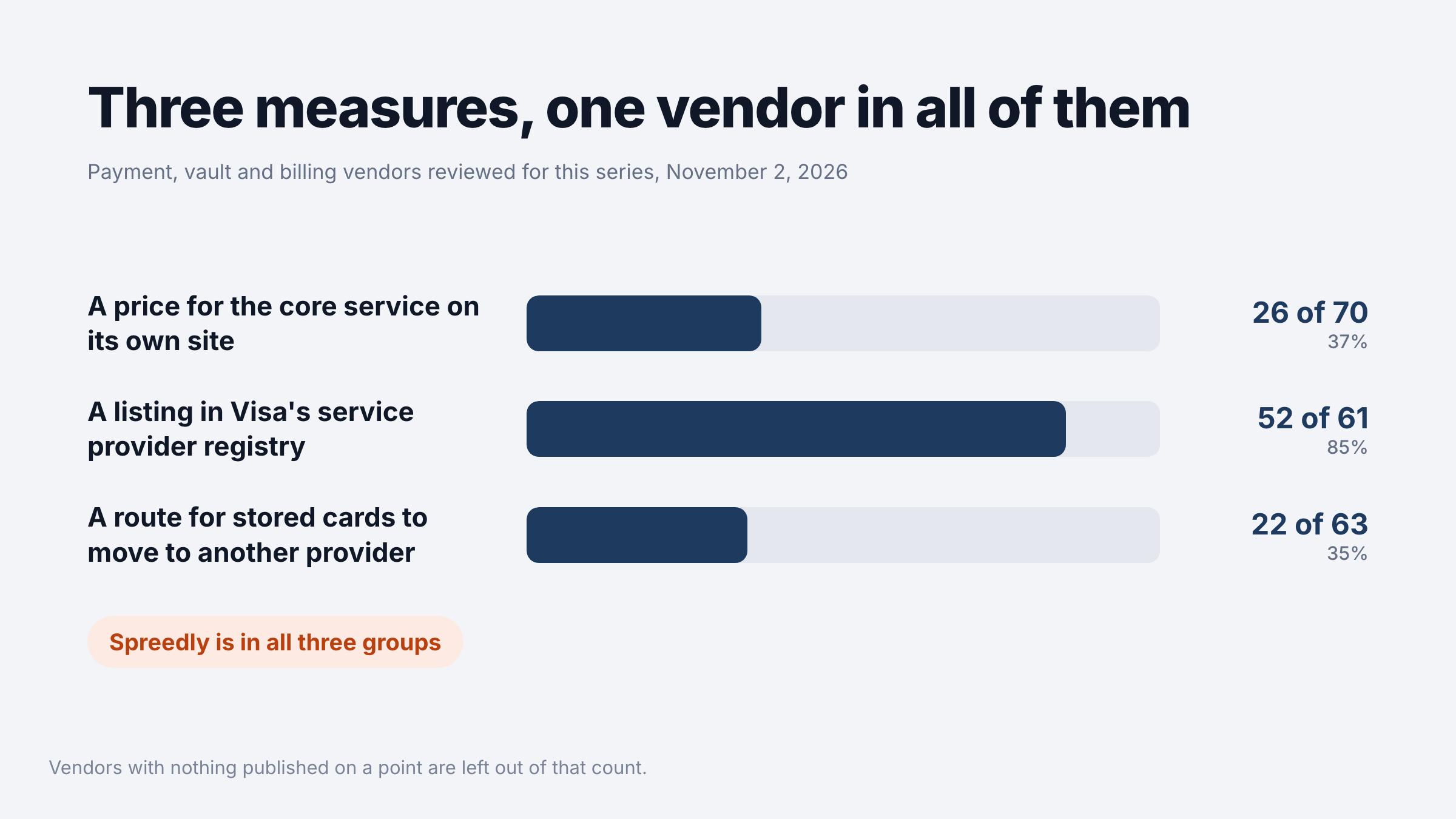
Spreedly, Inc. has been registered since 2014. Hellgate shows a price and an export route without a registry row, IXOPAY and BridgerPay are listed but print no price, and Akurateco is listed too. Counts are from November 2, 2026, and vendors with no public position on a point drop out of that figure.
What to verify before you sign
Spreedly publishes more than most, so use its terms as a checklist for the others.
| Decision area | Question to ask | Evidence to request | Red flag |
|---|---|---|---|
| Term and notice | What are the initial term and the notice period? | The renewal clause | Long auto-renewal in older terms |
| Card export | What does an export cost, and how long does it take? | The fee and typical timing | Fees set only in a later statement of work |
| AI agents | How do you identify agent-initiated transactions? | Support for Visa and Mastercard’s agent programs | A demo with no live merchant |
| Dedicated or shared | Who else runs on our infrastructure? | The architecture summary | “Dedicated” with a shared service underneath |
| Status history | What did the past 90 days look like? | The public status page | No incident history at all |
Agent commerce is still young, so weight the first two rows more heavily for now.
The bottom line
Stay close to Spreedly if a neutral vault with open terms is what you value most. Move to Akurateco if you want the stack branded and hosted your way, IXOPAY for enterprise tokens, Hellgate for dedicated infrastructure at a list price, BridgerPay for connector breadth and VGS if your engineers will build the routing. Among Spreedly competitors, plan your exit first, because the terms differ widely.
Questions about Spreedly competitors
Is Spreedly a payment orchestration platform?
Yes. Its homepage title is “Global Payments Orchestration Platform”, and it also sells an Independent Vault.
How much does Spreedly cost?
The Independent Vault starts at $750 a month. The Performance Optimization tier, with routing and network tokens, is priced through sales.
Which Spreedly alternatives publish prices?
Hellgate Guardian starts at €1,000 a month and VGS Starter from $1,000 a month. IXOPAY and BridgerPay don’t publish prices.
Can you export cards from Spreedly?
Yes, automatically to supported gateways through its store API, or by encrypted file to other PCI-compliant destinations, generally within 2 weeks. The Terms charge for manual exports, though the help center says the first to each third-party service is free.
Is VGS a Spreedly competitor?
Partly. VGS sells the vault and data layer and says you build the orchestration yourself, while Spreedly sells both vault and routing.