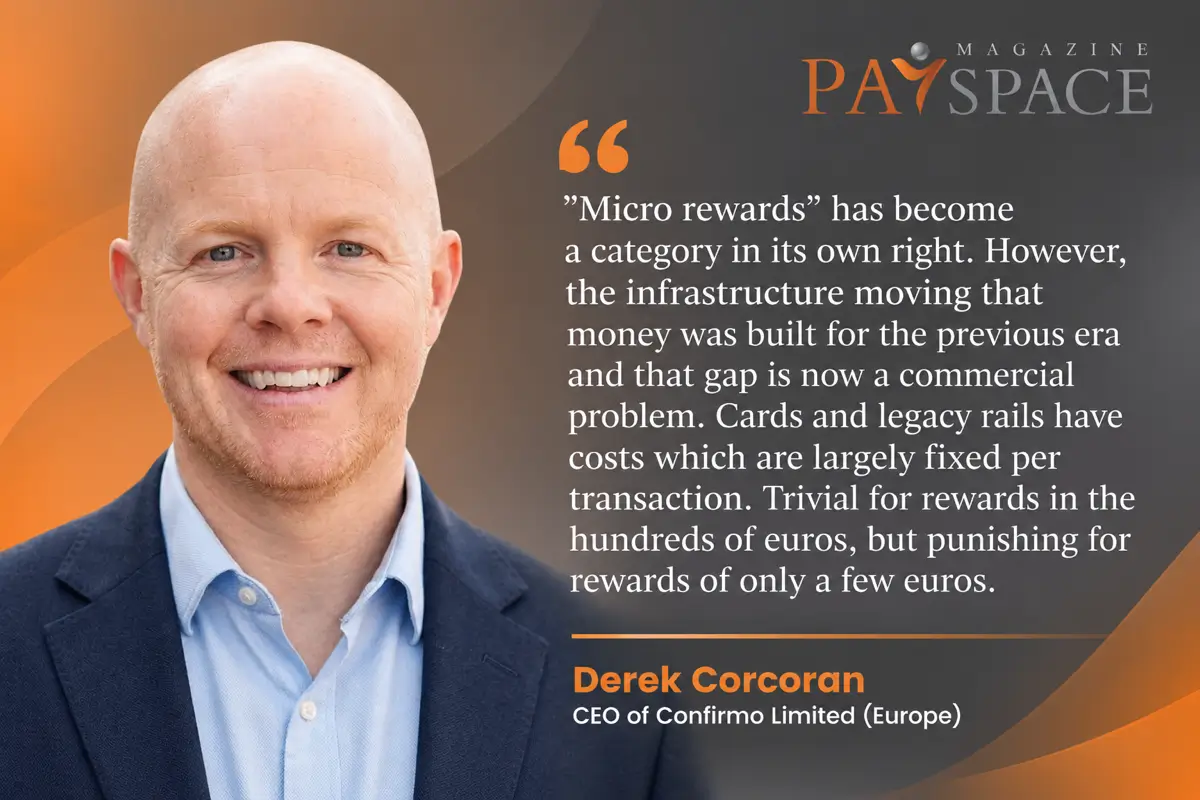
“The rewards industry has built impressive infrastructure at the catalogue, delivery and programme-design layers. But the weak link is the settlement layer underneath, and the shift to micro rewards has exposed it,” claims Derek Corcoran, CEO of Confirmo Limited (Europe)
In this article, the stablecoin firm executive explores one of the payment use cases rarely discussed in the context of crypto transactions, but highly relevant for modern retail businesses: loyalty program payouts and incentives.
Below is the analysis fully attributed to Derek Corcoran, CEO of Confirmo Limited (Europe).
The gift card, rewards and incentives industry used to mainly involve bulk buying and selling. New technology is changing that, opening up business models around smaller, instant and sometimes cross-border payouts. Now, survey panels, cashback, and affiliate schemes pay sums as small as pennies and cents to huge, globally distributed audiences. “Micro rewards” has become a category in its own right.
What is changing isn’t just what recipients want, but what businesses need to do to stay competitive. Companies are rethinking how they reward their customers and employees, moving towards more frequent and more memorable incentives across the B2B2C chain. But the limit hasn’t been the idea – it is the fact that micropayments are not viable on traditional card rails or banking networks, so the strategy has been nearly impossible to deliver.
However, the infrastructure moving that money was built for the previous era and that gap is now a commercial problem. Cards and legacy rails have costs which are largely fixed per transaction. Trivial for rewards in the hundreds of euros, but punishing for rewards of only a few euros.
The problem isn’t just cost related. Card networks can move money, but only across their own closed networks, which limits reach and means the processing fees are high enough that sending a small reward or incentive often isn’t viable. When sending money to thousands of recipients at once, across both borders and currencies at high frequency, this then means platforms have to manage delay, conversion and far more checking behind the scenes on exactly the payments that are growing fastest.
The rewards industry has built impressive infrastructure at the catalogue, delivery and programme-design layers. But the weak link is the settlement layer underneath, and the shift to micro rewards has exposed it.
According to a 2026 gift card market report distributed by ResearchAndMarkets, the global gift card market is set to reach around $865 billion by 2030. That is a huge prize, but the fastest-growing part of it, the tiny high-volume payouts, is the part that legacy rails serve the worst, so much of the opportunity stays out of reach on the infrastructure most businesses run today. These businesses run large B2B invoicing as well, which stablecoins make faster and cheaper. The biggest prize is what stablecoin technology opens up, like reward models and payment flows that weren’t possible before.
The solution is settlement on rails which are built to handle any volume, at any value per transaction, where the marginal cost of a payout stays negligible however small it is. Regulated stablecoin infrastructure does exactly that, collapsing the cost of moving money across borders by carrying payments over a shared network rather than the chain of banks and card schemes that take a fee at every step. Because these rails are programmable, businesses can use smart contracts to automate payouts and release them on set conditions, at any size and frequency.
In Europe, stablecoin payouts can already be offered as a regulated payment service, so a rewards platform can send thousands of small, automated payments across EU borders in one batch, with the same oversight as a conventional payment.
Regulated stablecoins are compliant enough for companies to adopt with confidence, and this is the layer that Confirmo is building: on-chain money movement that can both settle a six-figure supplier invoice and pay a survey participant a single euro, in near real time. Businesses are rethinking what a meaningful reward could be, and stablecoins let them deliver micro rewards at a frequency and volume that wasn’t possible previously.
The businesses that win will not be the ones with the best catalogue or the cleverest programme design, but the ones that rebuild the settlement layer underneath, and Confirmo is powering that change. Stablecoins, which rely on one infrastructure for every payment size, make paying out a single euro as easy and as cheap as paying out six figures.
Card rails still have their place, but the real growth is in small payments, sent often, and across borders. For any business planning an incentive scheme, the first question is how the money will move.
Explore Related Stories:
- PaySpace Magazine Global has spoken to Maksym Sakharov, Co-Founder and Group CEO of WeFi, a fintech and Web3 company building towards decentralised on-chain banking future, about the challenges crypto providers face in current legal ambiguity circumstances and factors that slow down institutional adoption of stablecoins.
- OCC Finalizes Stablecoin Rules for GENIUS Act: stablecoin issuers will enjoy some rule flexibility, but stablecoin yield question still hangs in the air.