Seven out of the eight wealthiest individuals on the planet in 2026 made their fortunes in the technology sector. Can technology they are profiting from also help to bridge the exact wealth gap these billionaires illustrate?

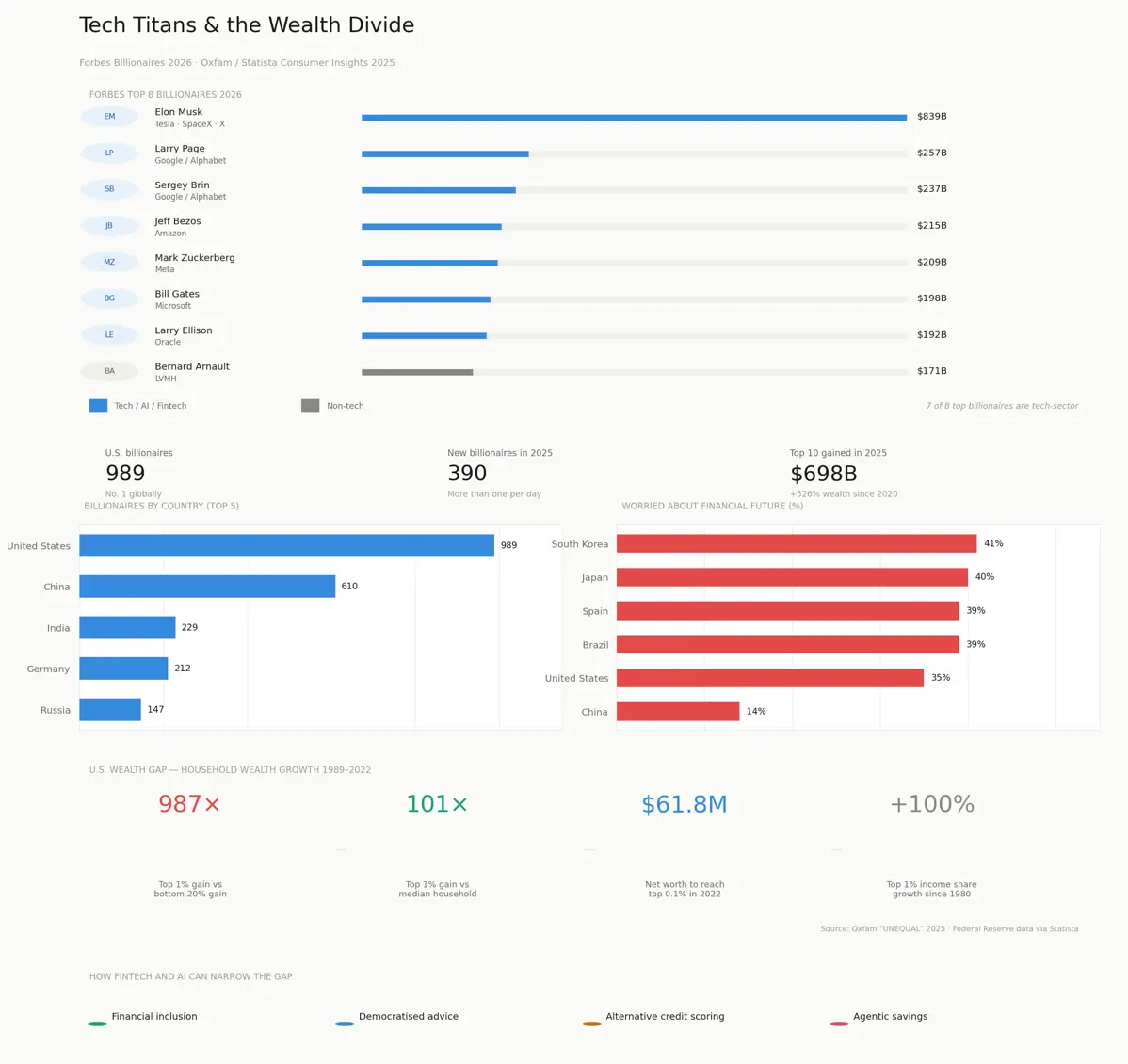
The 2026 Forbes Billionaires List looks like a ledger of the last decade’s technological progress. Elon Musk sits alone at the top with an estimated $839 billion — a fortune that has grown by nearly $500 billion in a single year. All that wealth was built almost entirely on the scaffolding of electric vehicles, commercial spaceflight, and social media. Below him, Larry Page and Sergey Brin, the architects of Google’s search empire, hold $257 billion and $237 billion, respectively. Jeff Bezos, whose Amazon built the plumbing for modern e-commerce and cloud infrastructure, follows close behind.
Of the eight wealthiest individuals on the planet in 2026, seven made their fortunes in the technology sector. The sole exception is Bernard Arnault of LVMH, who earned his $171 billion as a luxury goods executive, not a financier or industrialist in any traditional sense. The Forbes top tier is, functionally, a leaderboard for the software-and-data economy.
As the analysis unfolds, the connection to fintech and AI specifically runs deeper. Among the 390 newly minted billionaires added to the list in 2025 alone (more than one per day!) a striking number built their wealth through AI-native businesses. Sualeh Asif, a 26-year-old MIT graduate from Pakistan, co-founded AI coding tool Cursor. Surya Midha, 22, co-founded AI recruiting platform Mercor with university classmates. Luana Lopes Lara, 29, co-founded prediction market firm Kalshi. These are not legacy fortunes or inherited positions. They are prominent but notably not only examples of firms founded within the last few years, scaled rapidly on AI infrastructure, and now valued in the billions.
Global wealth distribution as linked to fintech & AI
Geography of global wealth spread
The United States remains the dominant geography for billionaire accumulation, with 989 individuals on the Forbes list. U.S. goes well ahead of China at 610 and India at 229. Germany places fourth at 212, Russia fifth at 147. The concentration of wealth in the U.S. reflects not just strong capital markets but a wider ecosystem with research universities, venture capital networks, and regulatory environments that have enabled AI and fintech companies to scale at speeds previously unavailable to any other sector.
Against this backdrop, the picture for ordinary households is sobering. According to Oxfam’s 2025 report on American inequality, the 10 richest U.S. billionaires became $698 billion wealthier in a single year. Since 2020, their inflation-adjusted wealth is up 526 percent. A household at the top 1 percent cutoff in 2022 required a net worth of over $61 million. That is nearly three times the equivalent figure in 1989. Between those two dates, the wealth gained by a household at the 1st percentile was 987 times greater than the gain experienced by a household at the 20th percentile.
The divergence is not limited to wealth. Incomes have followed the same trajectory. Between 1980 and 2022, the share of national income going to the top 1 percent doubled, while the share going to the bottom half of earners fell by a third. Close to a quarter of the U.S. workforce are classified as low-wage workers. Meanwhile, a Statista Consumer Insights survey conducted last year found that 35 percent of American respondents identified worry about their financial future as their primary financial attitude — the most commonly selected answer out of ten options. In South Korea, Japan, Spain, and Brazil, the share expressing financial anxiety reached around four in ten.
Can tech make anyone besides billionaires richer and bridge global wealth gap?
The question of whether the same AI and fintech technologies producing billionaires can address this global wealth divergence is contested, but not hypothetical. Fintech has already demonstrated measurable impact on financial inclusion. Let’s recall mobile payment infrastructure, digital lending platforms, and API-driven banking have extended access to financial services for populations previously excluded from traditional banking.
AI also holds the vast potential to lower advisory costs, personalize financial planning at scale, and improve credit access for thin-file borrowers who fall outside conventional scoring models. Agentic payment systems and open banking frameworks could automate savings and budgeting in ways that compound over time for low-income households.
None of these tools eliminates structural inequality on their own. But the same computational infrastructure that made Musk, Page, and a new cohort of 22-year-old founders extraordinarily wealthy is, at lower margins, also the infrastructure being built to serve the 35% who go to sleep worried about money.