For decades, corporate spending was treated as a back-office problem — a tangle of expense reports, paper invoices, and spreadsheet-driven procurement reviews that business finance teams managed reactively rather than strategically. That era is ending. Across industries, a convergence of economic pressure, digital transformation, and boardroom scrutiny is forcing organizations to rethink how they manage, track, and optimize every dollar they spend.

Why Corporate Spend Infrastructure Becomes Strategic Asset
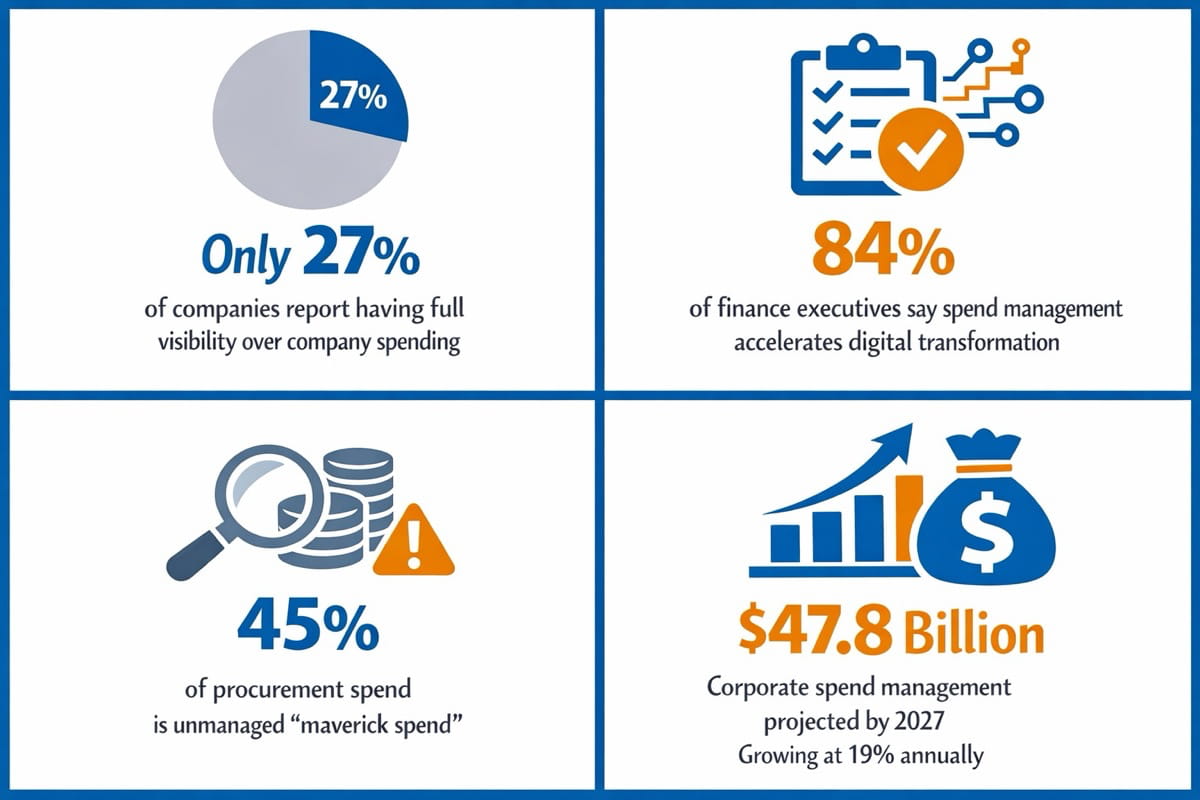
The numbers tell a striking story. Despite years of investment in enterprise software, only 27% of companies report having full visibility over company spending, leaving nearly three-quarters of organizations making consequential financial decisions with incomplete information. Meanwhile, research shows that companies which do achieve real-time visibility into supplier contracts and expenses overwhelmingly report efficient financial operations, with 99% of that group citing measurable operational benefits.
One of the tools used for corporate spend visibility boost is virtual card. Multiple forecasts now expect global virtual card transaction volume to reach $6.8T by the end of 2026, largely driven by B2B payment needs.
What has changed is the strategic weight now attached to solving the problem of corporate spend management. Finance leaders today view spend infrastructure as a lever for growth, efficiency, and competitive differentiation. According to a survey of finance executives, 84% say spend management accelerates digital transformation, 78% link it directly to revenue growth, and 77% consider it a competitive advantage. These findings represent a fundamental reframing of what corporate spend infrastructure is for.
This article examines two interconnected dimensions of that shift: how procurement and finance teams are navigating the structural challenges driving demand for modern spend tools, and how organizations are deploying automation, integrated platforms, and AI to close the gap between where they are and where best-in-class performance demands they be.
Expert Opinion on Business Finance Changes
To clarify some of these aspects, PaySpace Magazine Global approached Andrew Jamison, CEO and co‑founder of Extend, an AI-powered spend & expense management platform and payment solutions provider, for an expert commentary:
- Businesses today are looking for better ways to control and manage company spending across vendors, subscriptions, and projects. What changes in the market are driving demand for more modern spend infrastructure?
We have experienced parabolic levels of innovation in tech across every inch of our lives, but business solutions for finance teams haven’t necessarily kept up the way things like designs tools or project management software have. Finance teams are managing more distributed spend across software subscriptions, remote teams, contractors, and project-based budgets, while also being asked to move faster and operate with tighter control. At the same time, payment expectations have changed: businesses want real-time visibility, faster payment execution, stronger fraud protection, and systems that connect directly into the tools they already use. We’re also seeing growing adoption of instant payments, embedded finance APIs, AI-powered workflows, and more digital B2B payment experiences.
Now what’s really driving demand is that companies no longer see payments as a back-office utility. They see spend as an operational system that affects working capital, compliance, vendor management, and decision-making. That is why the market is moving away from static card programs and manual reimbursement processes toward programmable, integrated spend infrastructure.
- Many businesses still manage payments, expenses, and accounting across disconnected systems. What challenges does that create for finance teams, and what needs to change to make spend management more seamless?
Disconnected systems create blind spots. Finance teams end up stitching together card data, expense reports, ERP entries, receipts, approvals, and reimbursements across multiple tools, which slows down close cycles, increases manual work, and makes it harder to enforce policy consistently. It also weakens visibility into who spent what, why they spent it, and whether it matched budget, project, or vendor rules. A recent payments study found fragmentation is still the dominant reality, with most companies operating through disconnected providers and tools rather than an adaptive, integrated system.
To make spend management seamless, controls and accounting context need to move upstream, closer to the transaction itself. That means payments, policy, approvals, receipt capture, reconciliation, and ERP sync cannot live as separate after-the-fact workflows. They need to operate as one connected system, so the transaction is already coded, controlled, and explainable when it happens.
- We’re seeing more payments tied to rules, controls, and detailed transaction data across vendors, projects, and teams. Is the real innovation happening in the payment instrument itself, or in the infrastructure and data layer that surrounds it?
The biggest innovation is increasingly in the infrastructure layer around the payment, not just the payment instrument itself. A card, ACH, or real-time payment rail can move money, but the real strategic value comes from the controls, metadata, integrations, and automation attached to that transaction. That is what turns a payment into a governed business workflow.
In other words, the digital nature of virtual cards is what enables automated reconciliation, real-time insights, and stronger spend control when embedded into enterprise workflows, but the real step-change is the surrounding architecture: policy engines, approval logic, ERP connectivity, project and vendor tagging, fraud controls, and increasingly AI-driven monitoring and exception handling. That is where payments evolve from a static transaction into usable operating data for the business that can inform better real-time decision making, budget planning, and oversight.
- As companies rethink how they manage corporate spending, what does this shift mean for banks, CFOs, and the future of business payments infrastructure?
For banks, this raises the bar. Businesses increasingly expect more than access to credit or payment rails; they want integrated spend controls, richer data, and software experiences that fit into their finance stack. That creates an opportunity for banks to move up the value chain by partnering with fintech infrastructure providers and embedding spend management directly into commercial banking relationships. It seems the payments market is rapidly becoming more platform-driven, interoperable, and partnership-based everyday.
For CFOs, the shift means spend management becomes a strategic control surface, not an administrative function. The goal is no longer just processing payments accurately — it is improving visibility, protecting margin, strengthening compliance, and generating cleaner data for faster decisions.
Looking ahead, business payments infrastructure will likely be defined by three things: more programmability, more embedded finance, and more interoperability across rails, software, and data systems. The winners will be the platforms that make money movement seamless while empowering more control and intelligence.
The Spend Visibility Gap Among Main Challenges in Corporate Spend Management
The core challenge facing most finance and procurement teams is not a lack of data per se, but a lack of coherent, centralized data. Organizations have scaled their vendor ecosystems, adopted dozens of SaaS tools, and distributed purchasing authority across business units and geographies, and yet, the drawback of the scaling process is often that the ability to see total spend in real time has eroded significantly.
Research estimates that approximately 45% of procurement spend remains unmanaged or constitutes “maverick spend” — purchases made outside sanctioned channels that bypass negotiated contracts, compliance frameworks, and financial controls. In traditional organizations, fewer than 40% of total spend flows through centralized digital systems. By contrast, best-in-class organizations manage more than 80% of spend through integrated platforms. This striking gap translates directly into cost inefficiency, supplier risk, and forecasting inaccuracy.
Furthermore, visibility gap is compounded by the growing complexity of corporate spending itself. The proliferation of subscription-based software, global supplier networks, and decentralized purchasing, often accelerated by remote work, has made it structurally harder for finance teams to maintain oversight. A procurement team managing 50 suppliers a decade ago may now oversee hundreds, each with its own contract terms, payment cadence, and renewal cycle.
Cost pressure is sharpening the stakes
Against this backdrop of fragmented visibility, finance and procurement leaders are operating under intensifying pressure to reduce costs. In a recent survey of chief procurement officers, 52% cited cost reduction as their top value proposition, reflecting how economic uncertainty, inflation, and supply chain disruption have elevated spend discipline to a board-level concern.
The financial stakes of poor spend management are significant. Organizations running advanced procurement strategies saved an average of 11.2% of total addressable spend in 2023. Strategic sourcing initiatives alone delivered average savings of around 15.7%, according to procurement performance benchmarks. These figures underscore why CFOs are increasingly insisting on spend infrastructure that enables proactive cost management rather than retrospective reporting.
Yet for many organizations, acting on cost-saving opportunities requires visibility they do not yet have. Without consolidated spend data, it is difficult to identify duplicate vendor relationships, enforce contract compliance, or evaluate whether negotiated rates are being honored at the transaction level. The visibility gap and the cost pressure problem are, in practice, the same problem — which is why solving them requires the same solution.
Automation and Integration: How Organizations Are Closing the Gap
The response to these structural challenges is unfolding at scale. Across global organizations, procurement and finance teams are accelerating digital transformation programs designed to consolidate spend data, automate manual workflows, and embed financial controls directly into purchasing processes.
The business investments today are concentrated in integrated spend management platforms that unify procurement, corporate card management, expense reporting, and financial analytics in a single system of record. The market reflects this demand: the corporate spend management sector is projected to reach $47.8 billion by 2027, growing at approximately 19% annually. Today, 73% of organizations already use spend management solutions to optimize procurement processes, with 80% of procurement teams using them specifically for sourcing.
Within broader digital transformation programs, automation is emerging as the most impactful lever, both for reducing operational costs and for improving the speed and quality of financial decision-making.
Currently, around 37% of procurement processes are fully automated, and 43% are expected to reach full automation within three years. Among organizations already operating at digital maturity, a larger share of 45–50% of procurement processes may run without manual intervention. The effects of such automation are measurable in financial terms: automation of accounts payable and invoice processing can reduce processing costs by up to 60%, while digital procurement tools broadly can cut administrative costs by as much as 30%.
Artificial intelligence is amplifying these gains. Yet, corporate managers should be careful with how and what for they use the AI tools since a recent research shows they might have unintended consequences for human employee productivity too.
Nevertheless, all the aggregated evidence is converging on a clear conclusion: the organizations best positioned to manage cost pressure, regulatory complexity, and supplier risk are those that have moved beyond fragmented point solutions toward integrated spend infrastructure.
About Andrew Jamison, CEO and co‑founder of Extend:

Andrew Jamison, CEO and co‑founder of Extend
Andrew is Chief Executive Officer and Co-founder at Extend. He started Extend with a view to fill the gap in modern spend & expense tools for SMBs and their trusted bank partners. Prior to Extend, Andrew was the head of B2B Corporate Payments Products at American Express with a mandate to drive digital payment innovation and adoption. Over the course of six years, he doubled B2B payment volumes by launching and scaling new capabilities and platforms. Prior to American Express, Andrew spent eight years managing global SAP deployments for large multinational corporations. He earned an MBA from INSEAD.