The online gaming industry across South Asia and Southeast Asia has experienced explosive growth over the past three years. Markets like India, Bangladesh, Pakistan, Vietnam, and the Philippines now represent billions of dollars in annual transaction volume. With mobile internet penetration reaching record highs and smartphone adoption accelerating in tier-2 and tier-3 cities, the addressable audience for digital entertainment platforms has never been larger. Yet one critical challenge continues to plague platform operators in these regions: payment processing.
The Scale of Opportunity — and the Payment Bottleneck
India alone has over 900 million internet users, with UPI processing more than 14 billion transactions monthly. Bangladesh’s mobile financial services market has grown to over 120 million registered accounts through platforms like bKash and Nagad. Pakistan’s digital wallet ecosystem, led by JazzCash and Easypaisa, has reached similar scale. Vietnam’s MoMo and ZaloPay have fundamentally changed how consumers interact with digital services.
For gaming platforms, this massive user base translates directly into transaction volume. A mid-size platform in India might process 50,000 to 200,000 deposits and withdrawals per day. At this scale, payment infrastructure is not a back-office function — it is the operational backbone of the entire business.
Yet most platforms still rely on third-party payment gateways that were never designed to handle the unique requirements of high-frequency gaming transactions.
The Third-Party Payment Problem
The standard approach for a new gaming platform entering an emerging market is straightforward: sign up with a payment gateway provider, integrate their API, and start processing. While this gets platforms to market quickly, it introduces serious operational risks that become apparent as volume grows:
Sudden policy changes. Third-party providers can freeze funds, change terms of service, or terminate relationships without meaningful notice. For platforms handling player deposits, a sudden gateway shutdown means thousands of players cannot access their funds — destroying trust and triggering mass churn.
Opaque fee structures. Many gateway providers charge a percentage of each transaction plus fixed fees, with additional charges for currency conversion, settlement, and chargebacks. As volume scales, these fees represent a massive drag on margins. Worse, providers often increase rates after a platform becomes dependent on their infrastructure.
Settlement delays. In gaming, speed matters. Players expect instant deposits and fast withdrawals. Third-party providers typically settle to merchants on T+1 or T+2 schedules, creating cash flow gaps that complicate operations.
Single point of failure. Relying on one gateway means that any technical issue, compliance hold, or banking partner problem on their end immediately affects the platform’s ability to process payments.
Limited local method coverage. Many international gateways support credit cards and a handful of popular e-wallets, but lack deep integration with the full spectrum of local payment methods that players actually use. In India, this means missing certain UPI apps, bank-specific netbanking flows, or regional wallets.
For platforms processing thousands of transactions daily, these are not theoretical risks — they are daily operational realities that directly affect revenue, player satisfaction, and long-term viability.
The Shift Toward Self-Hosted Solutions
A growing number of operators are moving toward self-hosted payment infrastructure that gives them full control over their transaction pipeline. Rather than routing all payments through a third party, these systems allow platforms to manage deposits, withdrawals, risk monitoring, and settlement independently.
This approach has gained significant traction since 2024, driven by several factors. Regulatory environments have become more complex, requiring operators to have granular control over compliance and reporting. Competition has intensified, making payment speed and reliability a key differentiator. And the maturation of ready-to-deploy payment system solutions has made self-hosting accessible to platforms that previously lacked the engineering resources to build from scratch.
The key advantages of self-hosted payment systems include:
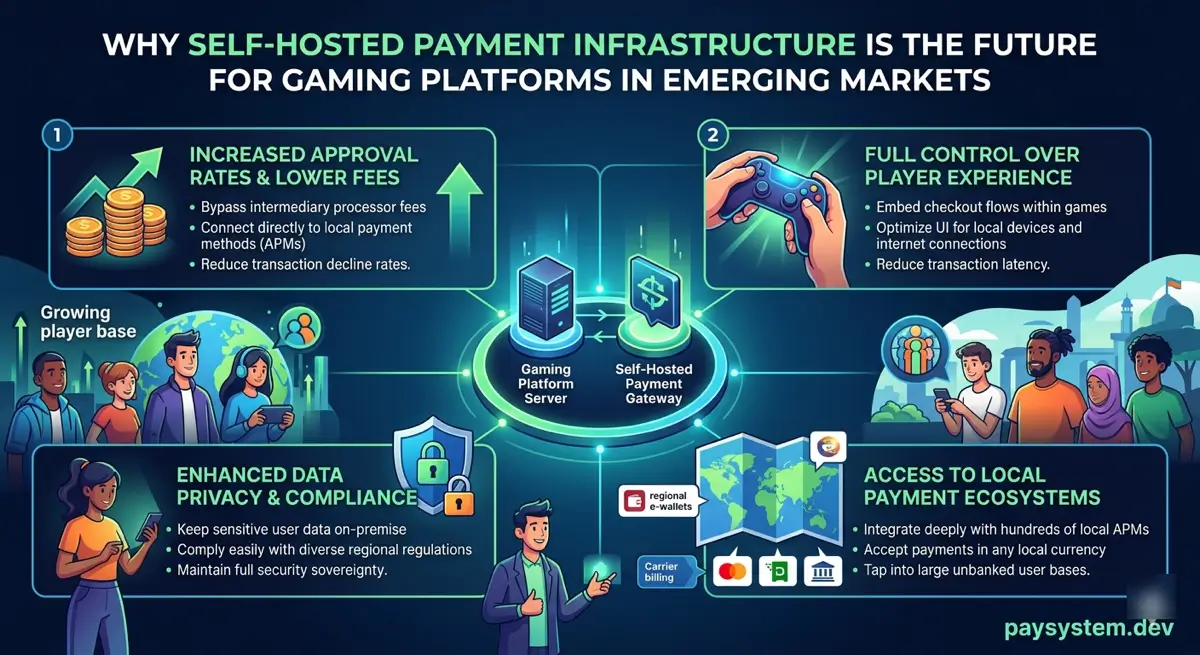
Full operational control. The platform owns its payment stack. No external provider can freeze operations, change terms, or shut down access. Decisions about risk tolerance, fee structures, and settlement timing are made internally.
Multi-country coverage from a single system. Rather than integrating separate providers for each market, a unified self-hosted system handles UPI in India, bKash and Nagad in Bangladesh, JazzCash in Pakistan, MoMo in Vietnam, GCash and Maya in the Philippines, and PromptPay in Thailand — all through a single administrative interface.
API-ready integration. Modern self-hosted solutions are designed to plug into existing gaming platforms within days, not months. Standard REST APIs, webhook callbacks, and pre-built SDKs mean engineering teams can focus on their core product rather than payment plumbing.
Built-in transaction monitoring. Real-time risk scoring, velocity checks, pattern detection, and automated fraud prevention are embedded directly in the payment flow — not bolted on as an afterthought from a separate vendor.
Lower long-term costs. By eliminating per-transaction percentage fees charged by intermediaries, platforms can reduce payment processing costs by 40-60% at scale. The self-hosted model typically involves a fixed licensing or deployment cost, with marginal costs decreasing as volume grows.
Local Payment Method Coverage Is Non-Negotiable
In emerging markets, credit card penetration remains extremely low. In India, fewer than 5% of the population holds a credit card, while over 350 million people actively use UPI daily. In Bangladesh, bKash alone has over 70 million active users. The pattern repeats across the region: mobile wallets and direct bank transfers dominate consumer payment behavior.
Any payment system serving these markets must support local methods natively — not through a chain of intermediary processors that add latency, cost, and failure points. Players expect to deposit using the same payment method they use to buy groceries or pay their phone bill. If a platform cannot accept a deposit via a player’s preferred method in under 30 seconds, that player goes to a competitor.
This is why the concept of indianpay infrastructure has become so critical — purpose-built systems that understand the nuances of UPI handles, bank account validation, IMPS routing, and the dozens of edge cases specific to Indian payment processing. The same depth of integration is required for each market.
Who Benefits Most
Self-hosted payment infrastructure is particularly relevant for several categories of operators:
Mid-size platforms scaling across multiple countries. Once a platform operates in three or more markets simultaneously, managing separate payment gateway relationships for each becomes an operational nightmare. A unified self-hosted system simplifies everything from reconciliation to dispute management.
Operators who have experienced gateway disruptions. Any platform that has suffered a gateway freeze, sudden termination, or extended settlement delay understands the existential risk of third-party dependency. For these operators, self-hosting is not a luxury — it is a survival strategy.
New platforms launching in South Asian and Southeast Asian markets. Starting with self-hosted infrastructure from day one avoids the painful migration that established platforms eventually face. It also provides a competitive advantage in payment speed and reliability from launch.
Companies looking to reduce costs at scale. At 100,000+ transactions per day, even a 1% reduction in per-transaction fees represents significant annual savings. Self-hosted systems can deliver cost reductions of 2-3% per transaction compared to third-party alternatives.
Implementation Considerations
Moving to self-hosted payment infrastructure does require careful planning. Platforms must consider compliance requirements in each jurisdiction, banking partner relationships for settlement, technical infrastructure for high-availability processing, and ongoing maintenance of payment method integrations as providers update their APIs.
However, the emergence of turnkey self-hosted solutions has dramatically lowered the barrier to entry. Rather than building a payment system from scratch — a process that typically requires 12-18 months and a dedicated engineering team — platforms can now deploy pre-built systems that include all necessary components: payment gateway, merchant dashboard, risk engine, settlement module, and local payment method integrations.
Looking Ahead
As regulatory environments evolve and competition intensifies, the platforms that control their own payment stack will have a decisive advantage. The days of relying entirely on third-party gateways — and accepting the risks that come with them — are numbered.
The trend is clear: the most successful gaming platforms in emerging markets in 2026 and beyond will be those that treat payment infrastructure not as a commodity to be outsourced, but as a strategic asset to be owned and optimized.
For operators exploring this transition, the market now offers mature, deployment-ready solutions that eliminate the need to build from scratch while providing the full benefits of ownership and control. The question is no longer whether to self-host — it is how quickly to make the move before competitors do.