Energy markets today are being shaped less by theory than by shock management. Oil prices surged above $110 per barrel in March 2026 as disruptions tied to the Iran war tightened global supply lines, while U.S. gasoline jumped above $4 a gallon for the first time since 2022, putting fresh pressure on commuters and consumers. The result is a market that is no longer just reacting to barrels and balance sheets, but to security, logistics and political risk.
The strain is already visible at the pump. Multiple news outlets highlighted growing pain for American drivers as gas prices climbed, and Reuters polling showed households increasingly feeling the impact. That pressure is not confined to the United States, directly involved in the military conflict, though.
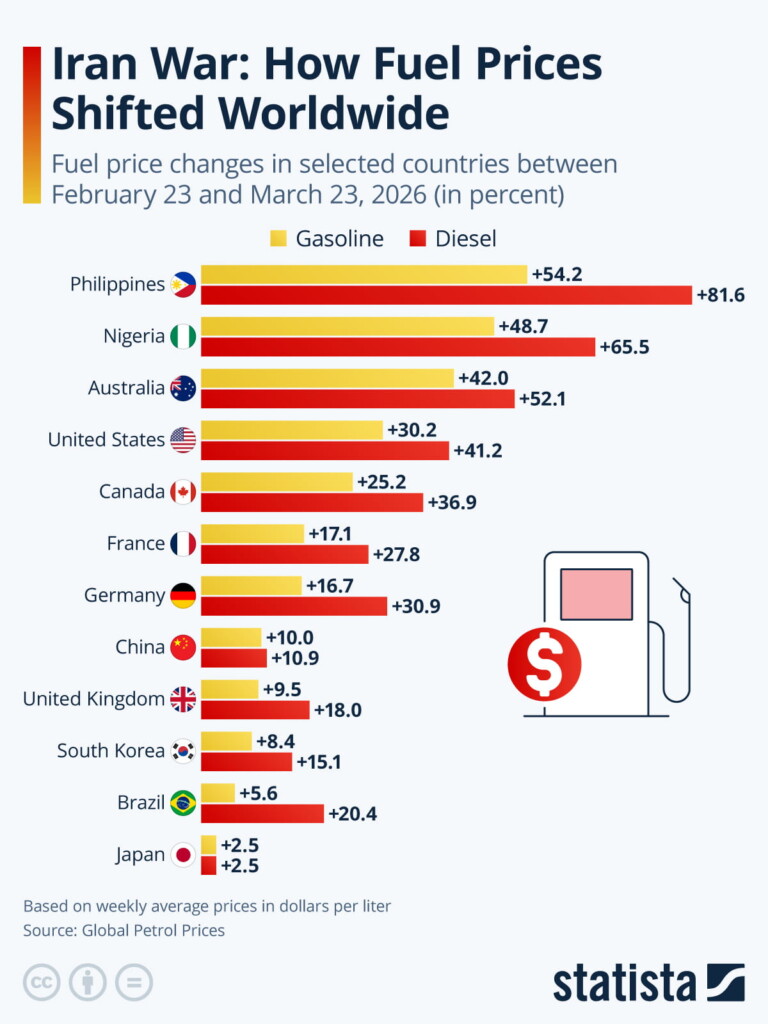
Statista’s chart on fuel-price changes since the start of the Iran war, along with its global petrol-price comparison, shows how uneven the shock has been, with some countries absorbing far steeper increases than others. In other words, this is a worldwide inflation story, but one that lands very differently depending on how much fuel a country imports and how heavily it relies on long-distance shipping.
Source: Statista
Inventories are now part of the story too. The International Energy Agency said member countries agreed to make 400 million barrels from emergency reserves available to the market in March, and warned that April could be worse as supply losses deepen. Data on IEA countries’ oil stocks is based on emergency stocks equivalent to at least 90 days of net imports. That inventory cushion matters because markets are watching not only daily price moves, but how long spare supply can last if shipping disruptions continue. While some countries have oil supplies sufficient for 200+ days, Australia, for instance, could barely make it through a half of the 90-day threshold in a current market scenario.
A pragmatic logic is showing up in the Caribbean, where leaders are pursuing a dual-track strategy. At Caribbean Energy Week, regional officials are backing oil and gas development while continuing to advance renewables, arguing that rising global demand requires both near-term supply and longer-term transition planning. The conference’s organizers have cast the event as an investment forum for Suriname, Guyana, Trinidad and Tobago and neighboring markets, while Washington used the platform to push investment-led partnerships and position U.S. companies as a strategic alternative amid intensifying global competition.
“The world’s energy transition is being outpaced by the growth in total energy demand. There’s a role for both fossil fuels and renewables in meeting global energy demand,” said Trinidad and Tobago Energy Minister Ernesto Kesar. “The reality is that the region’s reliance on oil and gas will persist for the foreseeable future.”
That same investment logic is extending into Africa, where higher shipping costs and tighter global supply chains are also changing the case for coal and minerals. African Mining Week says it will connect global investors with opportunities across Africa’s coal value chain, framing the event around supply security and capital formation at a time when energy prices remain elevated. The timing matters: when transport routes are disrupted and oil prices are high, regions with domestic resource potential tend to attract renewed interest from buyers and financiers looking for alternatives to fragile import corridors.
Yet the same price shock that is lifting fossil-fuel costs is also reviving demand for clean technologies. Thus, the war in Iran has rekindled interest in electric vehicles, rooftop solar and heat pumps, but this time the argument is less about climate virtue and more about energy security. That shift is important: when fuel prices spike, consumers and companies alike start looking for technologies that reduce exposure to imported oil and volatile transport routes.
Industry is also adjusting on the technology side. Volvo has begun on-road testing of heavy trucks powered by hydrogen combustion engines, with a commercial launch planned before 2030. The company is pitching the trucks as a practical option for long-haul freight and markets where charging infrastructure is limited, which reflects a broader pattern across energy markets today: decarbonization is still moving forward, but often through solutions that promise performance, fuel flexibility and resilience rather than a single clean-fuel pathway.
Taken together, the state of energy markets in April 2026 is best described as a contest between scarcity and adaptation. Oil shocks are lifting prices, commuters are feeling the squeeze, governments are leaning on reserves and logistics workarounds, and companies are reviving clean-energy options that also improve energy independence. From Caribbean offshore basins to African coal corridors to hydrogen freight trials in Europe, the common thread is simple: in today’s market, energy is no longer just about supply. It is about security, flexibility and who can adapt fastest when the system gets disrupted.