A coalition of more than 140 companies from different areas of financial services has agreed to back Open USD (OUSD), a new stablecoin announced on June 30, 2026, and governed by an independent entity called Open Standard. The joint initiative brings together banks, payments networks, crypto platforms and technology firms with the stated goal of returning most reserve revenue to participating partners.

Who Is Behind Open USD
Open Standard confirmed launch partners spanning several industries. Payments and financial services firms include Stripe, Visa, Mastercard and American Express. Asset manager BlackRock and banks BBVA, BNY, DBS and Standard Chartered are also listed. Crypto-native participants include Coinbase, Aave, MetaMask, Morpho and Solana. Technology and retail platforms Google, Shopify and DoorDash round out the initial partner list.
Zach Abrams, Founding CEO of Open Standard, described the project’s positioning in a statement. “It’s a stablecoin built for the internet economy, designed by the businesses growing it,” Abrams said. Abrams previously co-founded Bridge, a stablecoin infrastructure startup that Stripe acquired for $1.1 billion in 2025.
How OUSD’s Governance Differs
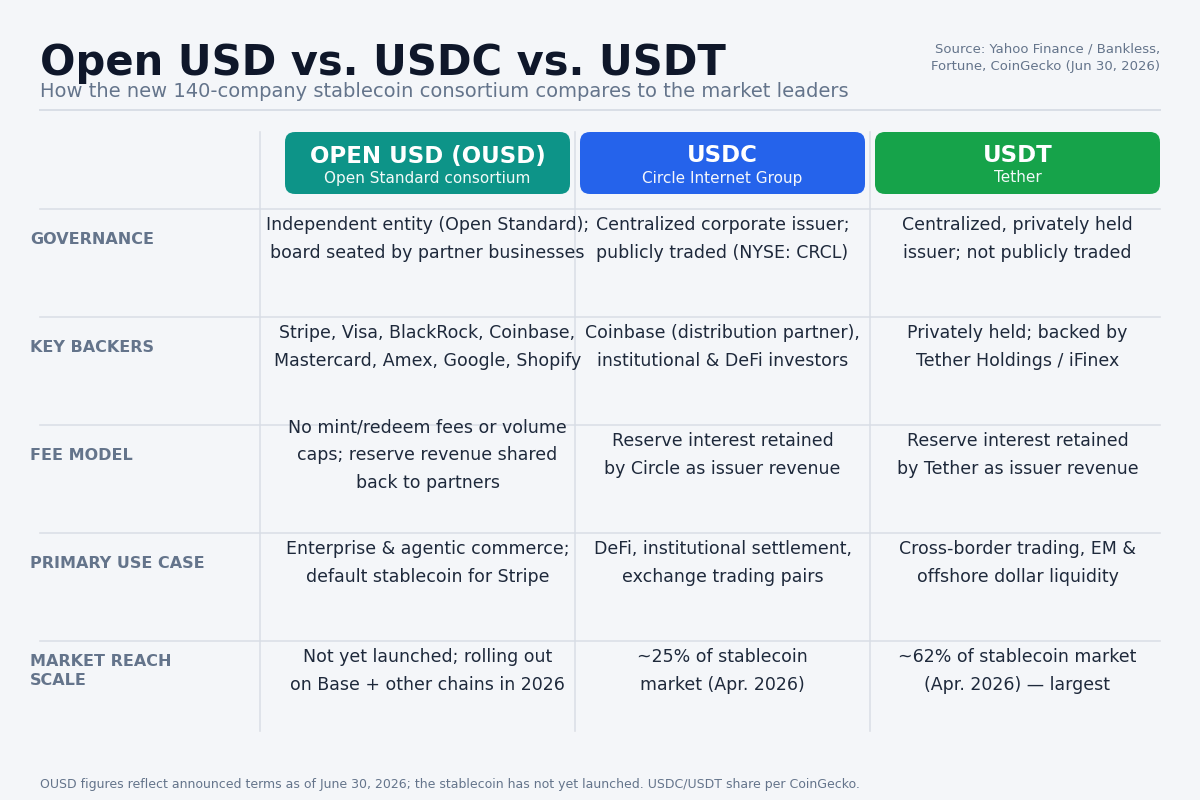
Open Standard’s structure separates it from single-issuer stablecoins. OUSD will be run by Open Standard, a separate company whose board is made up of its partner businesses, intended to keep decisions aligned with the collective network rather than a single corporate issuer. The model also changes the economics for participants. Once live, Open USD will let businesses mint and redeem the stablecoin with no fees or volume caps, while returning most of the reserve earnings back to participating partners minus a management fee.
Stripe and Coinbase have each outlined early integration plans. Stripe said it’s making OUSD the default stablecoin for businesses transacting on Stripe, while Coinbase confirmed OUSD is coming to Base and other chains later this year. Open Standard has not disclosed which blockchain will host the stablecoin. OUSD is expected to go live later in 2026.
“Stablecoins are the most important thing happening in payments right now, and we’re committed to giving our customers access to the best options available – including Open USD and beyond. The more great infrastructure this industry builds together, the faster we close the gap between what payments are today and what they should be.”
Market Position Against USDT And USDC
Tether and Circle, the two largest stablecoin issuers, are not part of the OUSD consortium. As of April 2026, Tether’s stablecoin, USDT, accounted for about 62% of the stablecoin market, while Circle’s USDC held roughly 25%, according to data from CoinGecko. Circle’s publicly traded stock fell 13% following the OUSD announcement, trading at $66 per share.
Circle CEO Jeremy Allaire responded to the announcement on social media. “We welcome continued innovation and competition in the space,” Allaire wrote. Tether did not immediately respond to a request for comment from Fortune.
Part Of A Broader Corporate Stablecoin Push
OUSD arrives roughly a year after the Genius Act, signed into law in July 2025, established a federal regulatory framework for stablecoins in the United States. Since then, corporate entrants have multiplied. Payments provider Klarna launched KlarnaUSD in November. Amazon and Walmart have both expressed interest in issuing their own stablecoins.
Consortium-based stablecoins also predate OUSD. Paxos launched USDG in November 2024 through the Global Dollar Network, whose participants include Mastercard, Robinhood and Kraken. Separately, Stripe worked with venture firm Paradigm to launch Tempo, a blockchain built for stablecoin payments. Earlier in June 2026, JPMorgan Chase, Bank of America, Citigroup and other major banks unveiled The Clearing House, a system allowing bank deposits to move as digital tokens over blockchain-style rails.
“Businesses need a stablecoin designed to work at global, industrial scale. And not at the scale of the 2026 economy, but of the 2040 economy, with flurries of activity we can only begin to imagine. That’s why Open USD will be the default stablecoin for businesses running on Stripe; they are the ones shaping the next 15 years of economic growth.”
“For years, every stablecoin issuer has tried to build a moat: proprietary rails, exclusive deals, fees stitched into every transfer. Open USD flips that logic. No minting fees, no artificial volume caps, reserve earnings split across partners rather than pocketed by one issuer. That last point matters more than it sounds. Reserve yield is the actual business model behind most stablecoins – it’s how issuers make money while promising users a ‘free’ dollar. Splitting that yield across 140 partners only works if volume is enormous, which tells you these companies think this is going to get very big, very fast.” At the same time, “No merchant wants to bet on a single stablecoin surviving, and no processor wants to hard-code one into their rails. That’s the same problem orchestration already solves on the card side – routing in real time across whichever rail actually clears. Stablecoins are just the next rail. For processors, the opportunity isn’t picking Open USD’s winner – it’s building the orchestration layer that doesn’t have to.”
Radi El Haj, CEO of RS2
Note: The article was updated on July 3, 2026, with the additional expert commentary.