The UK’s financial regulator has chosen Revolut and three other firms to trial stablecoin issuance under supervised conditions. It is the first live test of its kind in Britain, and a direct input into rules that will govern the entire sector from 2027.

Image created via Sora
The Financial Conduct Authority announced on 25 February that it has selected four companies, namely, Revolut, Monee Financial Technologies, ReStabilise, and VVTX, to participate in its stablecoin Regulatory Sandbox. The four were chosen from a pool of 20 applicants and will begin testing in the first quarter of 2026. Their findings will feed directly into the FCA’s final stablecoin rules, which are expected to be published later this year ahead of the UK’s full crypto regulatory regime that has been developed for a few years now and is finally coming into force in October 2027.
Revolut is by far the most prominent name in the cohort. The London-based neobank, currently valued at around $75 billion following a series of transactions in 2025, intends to test a sterling-denominated stablecoin — a digital token backed one-to-one with pound sterling reserves and integrated into its existing financial and crypto ecosystem. A source familiar with the matter confirmed that Revolut has already begun work on the token this quarter. Besides, a notable factor is that the company is the largest purely digital financial institution based in the UK, and its participation in the sandbox gives it direct on-premise input into the rules it would eventually operate under as a stablecoin issuer.
Each participant of the Sandbox will bring a distinct focus to the stablecoin testing scenarios:
- Revolut – focus on stablecoin settlement and trading infrastructure, integrated into Revolut’s existing app ecosystem.
- VVTX – connecting traditional finance with blockchain infrastructure through a pound stablecoin linked to consumer card services and payment functionality.
- Monee Financial Technologies – payment-focused stablecoin model, exploring operational issuance under the FCA’s proposed safeguard framework.
- ReStabilise – payment-related stablecoin use case, examining how issuance, custody, and reserve management function under draft rules.
Participants will operate under their existing permissions and registrations throughout the trial. For Revolut specifically, the ability to experiment with stablecoin transactions does not accelerate or affect the ongoing full banking licensing process, without fulfilling which the company remains in the “mobilisation phase” of its restricted UK banking licence — a phase that limits deposits to £50,000.
The FCA will monitor risk management, compliance, and governance practices while providing guidance from its specialists throughout.
“We are supporting UK stablecoin issuers to ensure they can be trusted for payments, settlement and trading. It will benefit consumers and financial transactions and help to deliver the FCA’s strategy and the Government’s National Payments Vision.”
Matthew Long, Director of Payments and Digital Assets, FCA
Notably, no major UK high street bank has joined the cohort — a gap that reflects both the caution of incumbent lenders and the advantage that digitally native firms have in moving quickly on new product categories.
Meanwhile, Revolut has been publicly associated with stablecoin ambitions for some time. The company already gives customers the ability to swap between stablecoins and fiat currency — a service launched in November 2025. The FCA sandbox now provides a supervised environment to go further, testing issuance rather than just conversion. Meanwhile, Revolut is also reportedly weighing a share sale in the second half of 2026 at a valuation exceeding $100 billion, as investors look to establish positions ahead of a potential public listing.
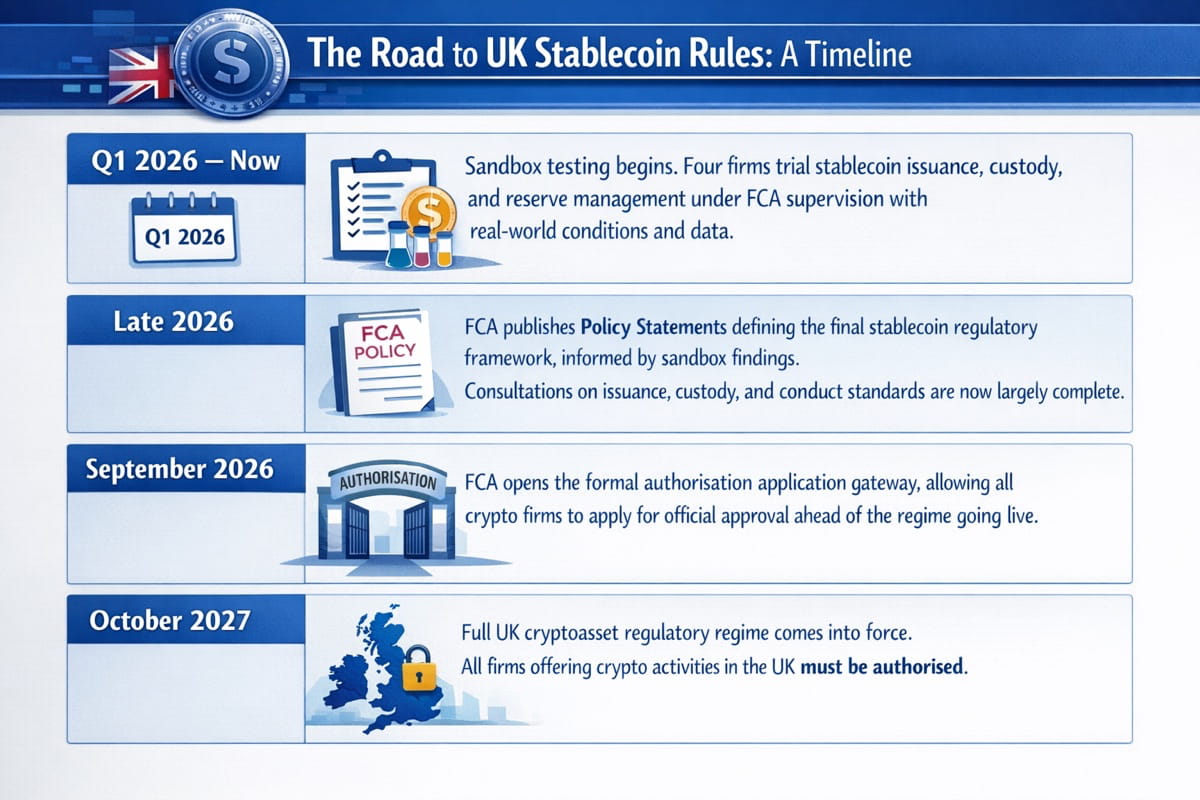
Timeline of UK stablecoin/crypto regime enforcement
Although UK regulators are testing the stablecoin issuance waters, their attitude to public use of these crypto vehicles remains unclear. Thus, there’s a growing industry dispute over a Bank of England proposal published in November 2025 that would cap individual sterling stablecoin holdings at £20,000 per person and £10 million per business. The proposal has drawn pointed criticism from across the crypto industry.
At the time the central bank’s plan was unveiled, Coinbase CEO Brian Armstrong referred to the proposal as an “innovation blocker,” saying the UK risks falling behind as other countries accelerate their crypto frameworks. A Stand With Crypto UK petition calling on the government to adopt a more innovation-friendly stablecoin regime had collected over 82,000 signatures at once. Andrew MacKenzie, CEO of Agant — a sterling stablecoin developer, also agreed that the pace of UK rulemaking was not moving fast enough to support the government’s stated ambition of making London a global digital asset hub.