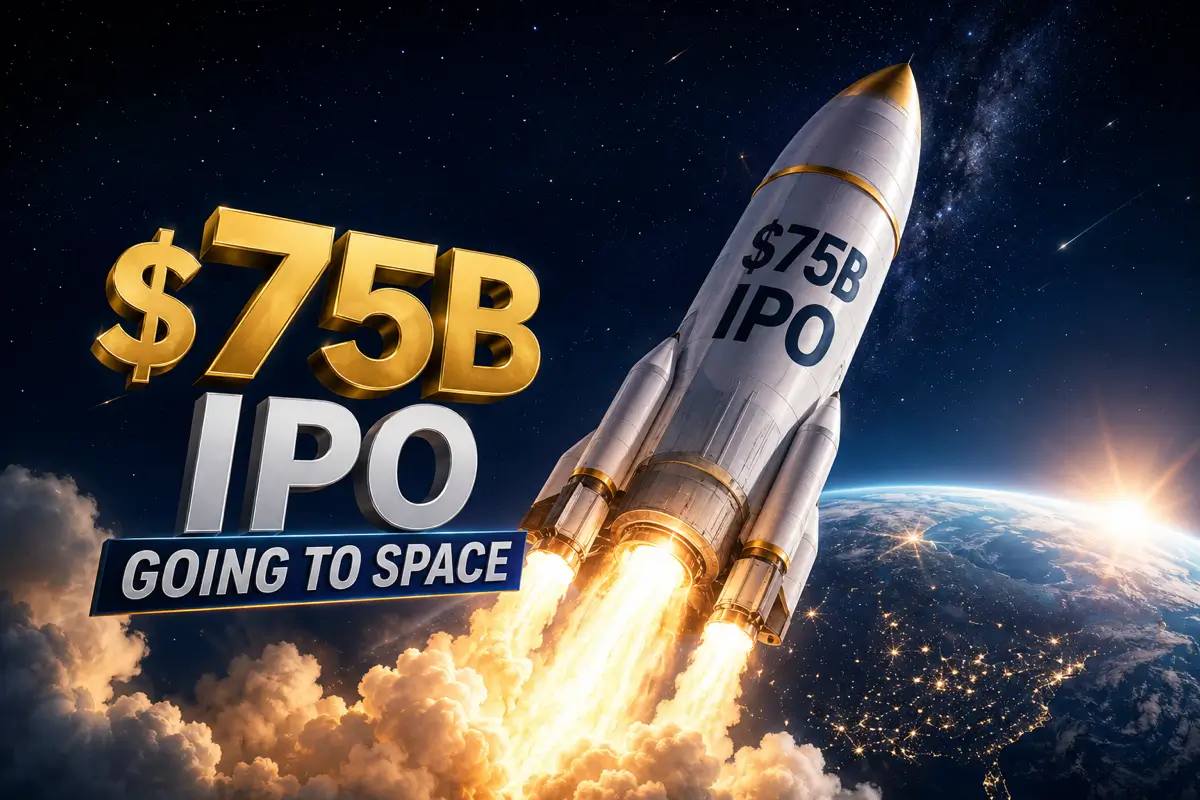
SpaceX began trading on the Nasdaq Global Select Market under the ticker SPCX on Friday, raising $75 billion in the largest initial public offering (IPO) in history. The offering puts a nearly $1.8 trillion valuation on the company, capping what has been a remarkable journey for a company that raised nearly $12 billion in private investment since its founding in 2002 to become the world’s most valuable venture-backed startup.
A Different Kind of Public Company
Going public transforms SpaceX and commercial space industry along with it in ways that go well beyond a ticker symbol. According to its listing prospectus, Elon Musk will retain a tight grip on the company by controlling the board and holding more than 80% of stock voting power. That arrangement is unusual for a company of this size, and it means SpaceX enters public markets with governance that more closely resembles a founder-controlled private firm than a typical listed corporation.
The structure of the deal itself was unconventional. SpaceX defied convention by setting a fixed price of $135 per share, rather than the traditional approach whereby investors and bookbuilders determine a range based on demand. The market responded: total investor demand reached $250 billion, making the offering nearly four times oversubscribed. BlackRock submitted an order to buy at least $5 billion in shares — a single order nearly as large as the entire $5.5 billion Cerebras IPO, the biggest of 2026 so far. Retail investors requested over $70 billion worth of shares, with up to 30% of the IPO allocated to public buyers, available through Charles Schwab, Fidelity, Robinhood, SoFi, and E*Trade.
The company posted a net loss of $4.28 billion in the first quarter of 2026, up more than 700% from a year ago. Revenue totalled $4.69 billion in Q1, up 15% from a year ago. Its megacap valuation means it is set to trade at an aggressive premium of 94x revenue. The previous all-time IPO record — Saudi Aramco’s 2019 listing, which raised $29.4 billion, is roughly 2.5 times smaller than what SpaceX has now raised.
Where Investor Money Goes
SpaceX is not simply a rocket company anymore. SpaceX touted its February 2026 merger with xAI as a key step in its plan to launch a fleet of “orbital data centers” — satellites designed to deliver computing power much like their terrestrial counterparts. The company plans to use IPO proceeds to fund AI compute, launch infrastructure, satellite growth, and future orbital data-centre ambitions.
SpaceX’s business now spans three segments:
- Space, covering the rocket business with Falcon, Dragon and Starship space missions;
- Connectivity, mainly the orbital internet business Starlink;
- and AI, which includes Grok, X and compute infrastructure.
Connectivity is the only profitable segment, generating $4.4 billion in operating profit in 2025, while Space and AI both run losses. Goldman Sachs expects SpaceX’s AI revenue to rise from $3.2 billion in 2025 to $322 billion by 2030, projecting total SpaceX revenue could reach $474 billion by 2030 — a forecast that underpins much of the valuation case being made to investors, though it remains contested.
The Japan Slice of The World’s Biggest IPO
SpaceX raised $2.2 billion from Japanese investors, according to a regulatory filing on Friday, as part of the world’s largest-ever IPO. The company reserved 16.3 million Class A shares for the offering in Japan, or about 3% of the total — making it the biggest first-time share sale in Japan since JX Advanced Metals Corp.’s IPO last year. The enthusiasm in Japan, home to about $15 trillion of household financial assets, was so fervent that SpaceX recently raised its local fundraising target by a quarter to $2.5 billion before the final $2.2 billion figure was confirmed in regulatory filings.
Who Benefits
The IPO is an enormous liquidity event for Musk, who is poised to become the world’s first trillionaire as a result, as well as for his close friend and confidant Antonio Gracias of Valor Equity Partners. Gracias has served on the SpaceX board since October 2010. The S-1 shows Gracias and Valor entities hold 503,414,530 shares, or 7% of SpaceX’s Class A common stock, representing one of the largest individual windfalls in the deal behind Musk himself. Estimates of that stake’s value range from $65 billion to over $90 billion depending on the source and methodology.
Among Musk’s backers positioned to benefit are Andreessen Horowitz, a Saudi prince, the co-founder of Palantir, and Jack Dorsey, the founder of Twitter. Early venture and corporate investors including Google, Andreessen Horowitz, Sequoia Capital, Craft Ventures, and Founders Fund are also seeing a major exit.
Don’t Call It a Market Renaissance Yet: Capital Crowds at the Top
The SpaceX offering is the first in a lineup of at least three historic IPOs this year, with generative AI giants Anthropic and OpenAI openly racing to make it to the public markets in coming months. Altogether, the three IPOs transfer some $3 trillion in value from the private to public markets. Anthropic filed confidentially on June 1 at a $965 billion valuation, and OpenAI followed on June 8, eyeing a fall listing.
But analysts caution against reading this as a broad reopening for the IPO market. SpaceX’s raise alone is slated to be more than the $47.4 billion the entire U.S. IPO market raised in 2025. A public SpaceX, OpenAI, and Anthropic would become some of the best-capitalised acquirers on the planet, with liquid stock to spend, and the bigger downstream impact for startups may be stronger M&A activity rather than a shorter IPO queue. Three companies absorbing the bulk of available capital and investor attention, the argument goes, is a concentration event first and a market reopening second.
Whether the rest of the queue finds a window this year will depend on how SpaceX performs once trading begins and how Musk manages the company whose trajectory, for better or worse, has always been inseparable from his own.
Sources used for reporting details: Crunchbase News, Bloomberg, Forbes, Reuters