Corefy added payouts company Sends as a ready-made connector on May 28, 2026, a few weeks after a paytech connector went live on the same platform. Its catalog stood at 300 integrations in April 2023 and passed 600 in January 2026. A longer catalog won’t change where the platform runs or which plan carries your brand, and we test those two gaps here.
Key takeaways:
- Corefy prints its prices, from €2,500 a month, but it runs only as SaaS on AWS and leaves its white-label package off the Standard plan.
- Akurateco is the one competitor here that advertises a self-hosted option, on your own servers or cloud account.
- Tranzzo, paytech, BR-DGE and PayPipes quote privately.
Which matters more to you, a price list you can read today or a platform you can brand and host? The five Corefy competitors below are ranked for a PSP or merchant shopping for a payment orchestration platform. Vendor figures come from each company’s own pages or filings as they stood in October and November 2026.
Corefy in 2026
You’ll find more of Corefy’s terms in public than you will for most of its rivals, so it makes a useful baseline.
What it sells
Corefy is a payment orchestration platform for merchants and payment providers, delivered as SaaS entirely on Amazon Web Services, with no on-premises edition on its site, and because it doesn’t hold client funds or issue merchant accounts, your direct PSP contracts and business bank account stay your job.
Standard costs €2,500 a month with 10,000 successful transactions included and €0.072 for each one after that, while Professional costs €6,000 with 100,000 included and €0.024 per extra transaction, though the calculator on its pricing page reads €0.06 and €0.02. Enterprise is tailored. A €3,000 one-time setup fee applies to the full platform, while the smaller Payment Bridge starts at a €1,500 monthly minimum plus €1,000 setup with 2 connectors, then €300 for each extra one.
The limits sit in the plan table. White label is unavailable on Standard and comes on demand on Professional and Enterprise, a further client-facing interface costs €1,500 a month, and the uptime SLA is 99.5% on every plan. A separate white-label provider page quotes from $4K a month. Plans bill monthly or annually with no long-term commitment.
What changed
The past year’s news is almost entirely about reach:
- On December 4, 2025, iGaming platform NuxGame announced a partnership with Corefy.
- Corefy said in January 2026 that it had passed 600 integrations with payment providers and acquirers.
- A paytech connector went live in May 2026, with cards, Apple Pay and Google Pay available without extra integration work for merchants.
- Sends announced its connector on May 28, so businesses can add its payouts through Corefy without extra development.
Each new connector saves you an integration project, which is the case for payment orchestration in the first place. None of them moves the SLA or the hosting model, so those still need their own check.
What users say
Corefy holds a 4.3 on Trustpilot from 15 reviews (as of October 30, 2026), 8 of them from the past 12 months. Reviewers praise routing and named support staff, and one team moved all its traffic in under 2 weeks. The caveats inside the five-star reviews are worth reading too. In December 2025 one reviewer wanted more ready-made integrations, and another said it isn’t plug-and-play for simple use cases.
Corefy competitors at a glance
The list splits on who runs the platform and how you pay for it.
| # | Competitor | Best for versus Corefy | Deployment | Pricing | Standout |
|---|---|---|---|---|---|
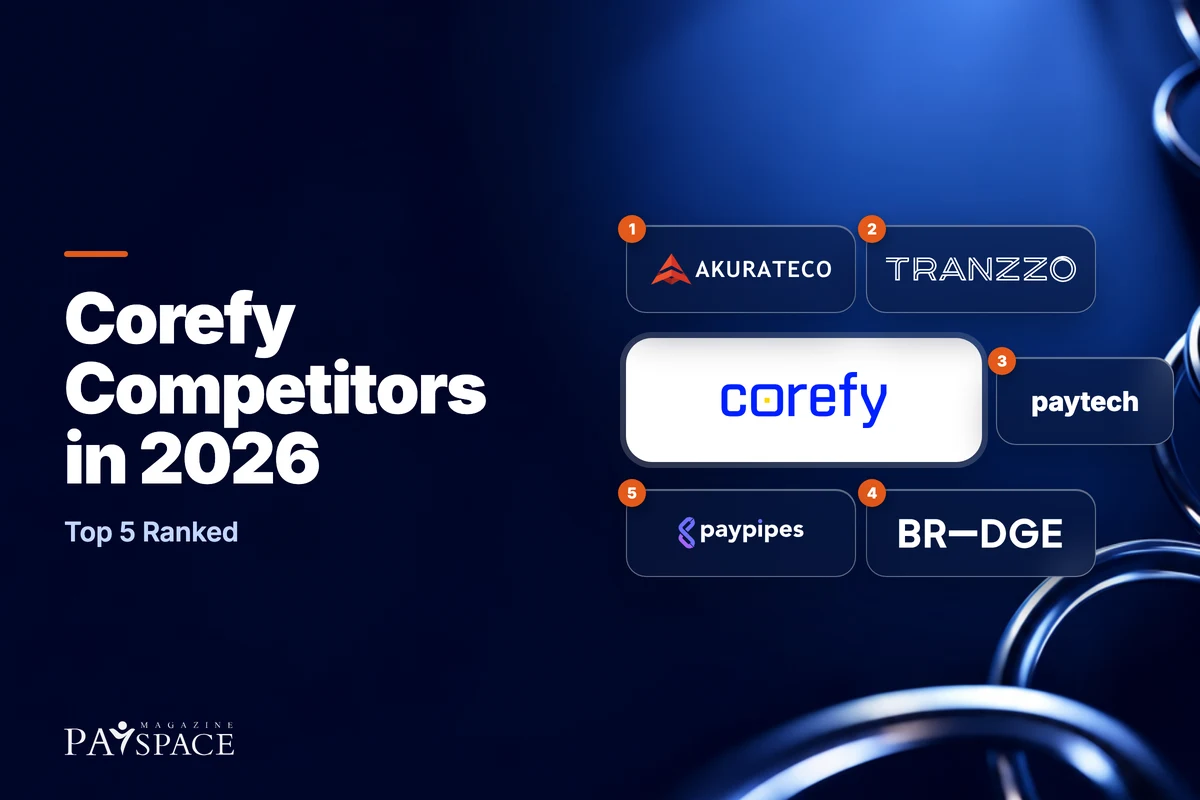
| 1 | Akurateco | Hosting the platform yourself | SaaS, own servers or cloud | Quote | 99.95% uptime SLA |
| 2 | Tranzzo | A PSP bought once | Vendor-hosted on Google Cloud | Custom quote | 330+ partner banks and PSPs |
| 3 | paytech | Branded software with finance tools | Vendor-run on AWS | One custom SaaS fee | 1000+ integrations claimed |
| 4 | BR-DGE | Platforms reselling orchestration | Multi-cloud, vendor-run | No public price | Six modular products |
| 5 | PayPipes | Brokers and prop trading firms | Operated by the vendor | Contact for pricing | 30-day data retrieval window |
Corefy’s printed list still wins on transparency here, since every other row means a sales call.
How the competitors compare
Read these against the two gaps above, hosting and branding.
1. Akurateco: a platform you can host yourself
Corefy stays on its own AWS setup. Akurateco also runs as SaaS, but you can take it onto your own servers, which needs about 60 days, or into a cloud account you control on AWS, Azure, Oracle Cloud or Google Cloud in about half that. Merchants buy the orchestration product. PSPs and banks usually want the white-label gateway, since they can put their brand on everything from the merchant portal to the domain.
You sign each acquirer yourself, then plug it into one of 700+ ready connectors, and one that’s missing takes about 14 days. Corefy’s uptime SLA reads 99.5%. Akurateco’s says 99.95%. First processing comes about 5 business days in on average, with 150 built-in configurable fraud filters screening what passes through.
Best for: PSPs and banks that must keep data and PCI scope in-house, or want their name on every screen.
Watch out for: it handles no funds and opens no merchant accounts, so acquiring contracts and any license stay with you.
2. Tranzzo: a PSP you buy once
Tranzzo’s Enterprise PSP is sold as a one-time payment with no monthly fees, set against building your own from $500,000. An August 2025 press release called it a global payment orchestration platform, and a June 2025 release launched orchestration for high-risk industries. You also get a white-label gateway, 330+ partner banks and PSPs and a three-level anti-fraud system with 200+ rules.
Its Terms describe a gateway, with licensed partners (financial companies and banks) processing the payments and holding merchant funds as agent in a pooled account.
Best for: a business that would rather pay for a PSP once than carry Corefy’s monthly infrastructure fee.
The trade-off: there’s no price list, and its pages show no self-hosted edition. Section 3.5 of the Terms allows a 540-day hold on funds after a chargeback breach, and we found no clause on exporting stored cards or tokens, so raise both before signing.
3. paytech: one fee, finance tools included
paytech powers a network of PSPs, aggregators and fintech platforms. Every build is custom, and one SaaS fee covers deployment, training, orchestration and support, which is simpler than Corefy’s add-on list. The white-label product handles settlement calculation, automated invoicing, reconciliation and currency conversion.
One published case study has Fyntek, a US payment company, integrating 12 acquirers in 45 days. An October 29, 2026 post claims 1000+ integrated solutions, and since May it has itself been a connector on Corefy. It acts as software only. It isn’t an acquirer or a payment institution, and it doesn’t hold customer funds.
Best for: a new PSP that wants branded software and back-office finance tools under one contract.
Watch out for: its price is unpublished, and it’s vendor-run SaaS on AWS with no self-hosted edition on any page we read.
4. BR-DGE: orchestration that platforms can resell
BR-DGE, set up in Edinburgh in 2018, has six modular products. White Label is the one that lets platforms and ISVs centralize payment connections and earn referral fees. Published case studies name William Hill (Evoke), Kenwood Travel and FirstGroup UK.
Existing PSP tokens can come into its vault through an API call when the PSP supports migration, using credentials you supply so BR-DGE can retrieve the card data.
Best for: an ISV or platform that wants orchestration under its own name, where Corefy treats white label as an on-demand extra.
Watch out for: there’s no price list or self-hosted edition, and connection counts differ by page (100+ payment providers on one, over 400 connections on others). Ask for the list covering your markets.
5. PayPipes: built around trading and brokerage
PayPipes groups its homepage success stories under prop trading, brokerage, payment institutions and e-commerce. That sets it against Corefy’s own forex pitch, which claims 3 of the world’s 5 largest brokers without naming them. Counters on its homepage read 120+ currencies and 300+ PSPs. A declined card rolls to the next available gateway while the customer stays on the page.
Its exit terms are in print. Section 12.7 of its General Business Terms gives you 30 days after termination to retrieve or export your data through standard tools.
Best for: a broker or prop firm that wants a vendor already working in its niche.
The trade-off: pricing is by contact only, and section 12.5 lets PayPipes change its terms unilaterally after 30 days. If you object, the agreement ends on that date.
Where Corefy sits among 70 payment platforms
We put one plain test to the 70 vendors in this series, including vaults and billing tools. Does the vendor’s own site show a price for its core service? 26 do, and Corefy is among them. None of its five rivals above passes.
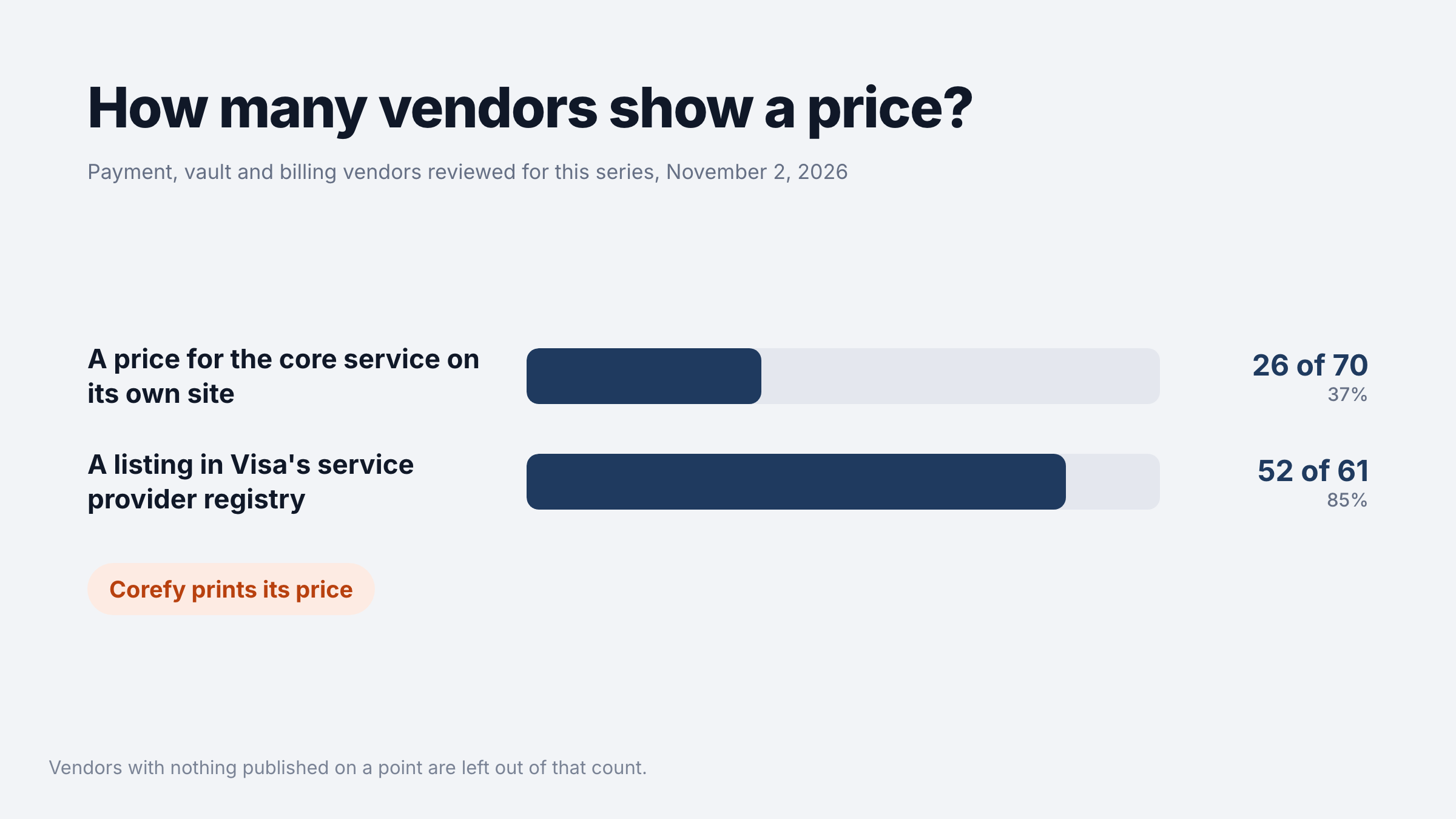
Visa’s Global Registry of Service Providers is the second test. We searched for 61 of these vendors and found 52, including Akurateco’s Portuguese company, listed through March 31, 2027. Corefy wasn’t part of that search, so read its pricing page’s PCI DSS Level 1 statement as its own and ask for the attestation. These counts date from November 2, 2026.
What to verify before you sign
Run these checks on any vendor, because a switch away from Corefy is a chance to close what its plan table leaves open. The rules are moving as well. The EBA and ECB counted €4.2 billion of EEA payment fraud in 2024, up from €3.5 billion in 2023, and EU lawmakers provisionally agreed new payment rules, PSR and PSD3, on November 27, 2025.
| Decision area | Question to ask | Evidence to request | Red flag |
|---|---|---|---|
| Uptime | What SLA applies on our plan, and what do we get if it’s missed? | The SLA clause with its credits | A website figure missing from the contract |
| White label | Which screens carry our brand at our tier? | A demo on our own domain | Branding priced after signature |
| Hosting | Can data stay in an account or region we choose? | The hosting map and any self-hosted terms | Residency answered only by phone |
| Stored cards | How do cards and tokens leave, and who pays? | The written export procedure | No export clause anywhere in the terms |
| Fraud rules | Who changes the rules when EU requirements do? | The rule list and its change process | Every change needs a support ticket |
Keep each answer with the order form, because the sales team you hear them from may not be the one you deal with in two years.
The bottom line
Stay with Corefy if a readable price list and 600+ integrations outweigh where it runs. If you need self-hosting or your brand from the first day, start with Akurateco. paytech and BR-DGE fit smaller branded builds, Tranzzo fits a one-off purchase, and PayPipes fits trading firms. Whichever of these Corefy competitors you choose, get the SLA and the card export terms in writing.
Questions about Corefy competitors
Is Corefy a payment processor?
No. It holds no client funds and offers no financial services, so you need direct PSP contracts and a business bank account alongside it. Its PayAtlas project can help with opening merchant accounts.
Who are Corefy’s main competitors?
Among orchestration vendors selling to payment businesses, Akurateco, Tranzzo, paytech, BR-DGE and PayPipes come closest. They differ mainly on who hosts the platform and how openly they price it.
How much do Corefy alternatives cost?
Corefy starts at €2,500 a month plus a €3,000 setup fee for the full platform. Among Corefy alternatives here, all five set prices per client, so ask each for a figure at your transaction count.
Can you self-host Corefy?
Its site lists no on-premises edition, and the platform runs on AWS as SaaS. Akurateco is the competitor here that offers your own servers or cloud account.
Does Corefy offer a white label?
Yes, on demand on Professional and Enterprise, but not on Standard. A further client-facing interface costs €1,500 a month, and the white-label provider page starts from $4K a month.