Adyen spent 2026 building businesses next to its payments one. It bought loyalty platform Talon.One for €750 million and billing platform Orb, closing both deals on July 1, and in October it said heavier spending on its team and products would hold its 2026 margin at 50%. Processing isn’t the weak spot, with third-quarter volume at €451.1 billion.
Key takeaways:
- Adyen’s white label keeps you on its licenses and its acquiring, so decide first whether you want that.
- Akurateco, NMI, Gr4vy, UniPay and Fluid Pay run on acquirers you or your partners bring, while Ikajo adds merchant accounts through 60+ partner banks, gambling included, which Adyen bars from its platforms.
- UniPay prints a white-label price, from $15,000 a month, and Akurateco’s calculator shows figures by deployment. NMI, Gr4vy and Fluid Pay publish no amounts.
So what do you want to own? A branded payments business running on Adyen’s licenses, or a gateway under your name with acquirers you can change? The six Adyen competitors below are ranked for a SaaS platform or payment business comparing white-label payment processing, with figures from each vendor’s own pages and filings, checked in October and November 2026.
Adyen in 2026
Most rivals sell against Adyen, so start with what it offers today.
What it sells
Adyen runs online and in-store acquiring on one platform, with financial products on top, in 150+ currencies. It holds banking licenses in Europe and the US.
White-label payment processing is the part of that business this article tests. Through Adyen for Platforms, a SaaS company or marketplace offers payments, accounts, lending and card issuing under its own brand on one integration, with dozens of payment methods in 150+ countries. Adyen handles verification and compliance, and you set the fees your users pay in its dashboard.
Each transaction costs a fixed $0.13 plus a fee for the payment method, and for Visa and Mastercard that fee is interchange and scheme costs passed through plus Adyen’s 0.60% markup. A minimum invoice can apply depending on your industry, but there’s no setup or monthly fee. Other Adyen products are priced separately.
Gambling is where it gets strict. Legal gambling merchants need extra documentation before onboarding, while platforms that let others sell gambling get turned away, as does any gambling service based in the US.
What changed
Four dated moves shape how Adyen sells in 2026:
- On April 23, Adyen agreed to pay €750 million in cash for Talon.One, a loyalty platform with 300+ merchants, as PaySpace Magazine reported.
- Adyen announced a Category II license from the Central Bank of the UAE on June 28, giving it direct access to local payments in a market it has served since 2020.
- Both acquisitions closed on July 1. Orb, the San Francisco billing platform, keeps supporting merchants that run several payment providers during the first phase.
- Third-quarter net revenue, reported on October 28, rose 23% to €738.1 million. Adyen said it now expects a 2026 EBITDA margin of 50%, and it joined the European Central Bank’s digital euro pilot as an acquirer.
Why does the pilot matter to you? The ECB plans to run it in 2027 and wants e-commerce merchants to express their interest, so ask each vendor whether it’s in. The harder question for a platform is how much of its product ends up tied to one supplier once loyalty and billing come from Adyen too.
What users say
Look Adyen up on Trustpilot and you’ll see a 1.3 from 449 reviews (as of November 1, 2026). Most recent reviewers are small sellers and fundraisers describing held payouts and slow support, so the sample says little about how a large platform fares. If your users are small sellers, though, expect those tickets to land on your own support team.
Adyen competitors at a glance
The split that matters is who supplies the acquiring. Adyen does it itself, while white-label gateway software usually leaves it to you.
| # | Competitor | Best for versus Adyen | Acquiring | Hosting | Pricing |
|---|---|---|---|---|---|
| 1 | Akurateco | Running your own branded gateway | Acquirers you sign | SaaS, own servers or cloud | Quote + online calculator |
| 2 | NMI | ISOs and SaaS selling through partners | 200+ processors to choose from | Self-hosting not listed | No public list |
| 3 | Gr4vy | Platforms that need an isolated instance | PSPs you connect | Dedicated cloud instance | No public price |
| 4 | UniPay | Buying the source code | Your banks or processors | Cloud, hosted or on-premise | From $15,000 a month |
| 5 | Ikajo | Gambling and other high-risk business | 60+ partner banks | Own hardware or AWS | From 1.2% |
| 6 | Fluid Pay | US ISOs and vertical SaaS | The partner’s own | Hosted on Google Cloud | No public amounts |
UniPay and Ikajo print figures and Akurateco’s calculator gives base fees, so those three can go in a spreadsheet before anyone calls you.
How the competitors compare
Each profile covers what the company sells, any public pricing and the catch against Adyen.
1. Akurateco: keep the acquiring decisions yours
Adyen’s white label puts your brand on Adyen’s licenses. Akurateco sells software instead, a white-label payment gateway that PSPs and banks run under their own brand, plus a payment orchestration platform for merchants. You sign the acquirers, and it connects them through 700+ ready connectors, with 150 built-in configurable fraud filters and a 99.95% uptime SLA.
Your branding reaches dashboards and merchant portals, right down to the domain. It runs as SaaS or self-hosted, on hardware you own or inside a Google Cloud, AWS, Azure or Oracle Cloud account you control, so allow about 30 days for a cloud account and about 60 for dedicated infrastructure. Processing starts in 5 business days on average, and a new integration takes about 14 days.
Costs are a one-time setup fee, a subscription and a per-transaction fee. The calculator shows setup at €8,000 on SaaS or €60,000 on-premises. Transaction volume sets the monthly cost on SaaS, and on-premises adds it to a €4,000 monthly fee.
Best for: payment businesses and platforms that want their own branded gateway and the freedom to swap acquirers without replacing it.
Watch out for: Akurateco doesn’t process funds or open merchant accounts, so every acquiring contract and any license your model needs stay with you, and no per-transaction price is published.
2. NMI: a partner channel for ISOs and SaaS
NMI calls itself an embedded payments platform for ISOs and SaaS, which makes it the closest match to Adyen’s platform buyer. Its white-label gateway covers online and in-store payments. It sells only through partners (banks, ISOs, PayFacs and SaaS providers) and counts 6,000 channel partners and 1.2+ million active merchants.
Processor choice is the draw, since the gateway integrates with 200+ payment processors and 125+ shopping carts. In May 2026 NMI also bought Dwolla, an account-to-account payments provider.
Best for: an ISO or SaaS company that wants its own branded gateway and a say in which processor sits behind it.
Watch out for: there’s no gateway price list and no self-hosted option we could find. Leaving costs $0.50 a record or $500, whichever is higher, and network tokens stay behind, because they can’t be exported to another gateway.
3. Gr4vy: a white label in its own cloud instance
Gr4vy speaks to platforms directly, offering “a white label solution for you and your sub-merchants”. Each client runs on a dedicated, single-tenant cloud instance that shares no servers with other merchants, scales across regions and supports data residency in several places.
Tokens move in and out of Gr4vy, and card data in its vault works across multiple PSPs without re-tokenization. On September 22, 2026 it announced that Pure Interactive chose it to power Apple Pay across real-money mobile games in the US.
Best for: an enterprise platform whose security review rules out shared infrastructure.
Watch out for: no price is published, and Gr4vy describes no self-hosted edition, so “your own instance” still means its cloud.
4. UniPay: three models, with the prices printed
UniPay, from New York’s United Thinkers, is gateway software for platforms, ISOs and PayFacs. It isn’t strictly a payment service provider, so acquiring has to come from elsewhere.
Three price points sit on its site. The pay-as-you-go model, Payments as a Service, charges 2.9% + $0.25 on each transaction, though UniPay doesn’t say whether that includes interchange. The hosted white-label gateway starts from $15,000 a month, and white-label clients set their own underwriting and funding rules. Buying the software outright means an on-premise license from $150,000, or $250,000 on its license page, source code included and no transaction fees.
Best for: a PayFac that wants control of underwriting and a route to owning the code.
The trade-off: planning a new bank or processor integration can take 3-6 months, and we found no published procedure for taking data or tokens out of a hosted instance.
5. Ikajo: merchant accounts first, white label second
Ikajo takes business Adyen bars from its platforms. It opens merchant accounts for high-risk businesses, gambling and forex among them, through 60+ partner banks. An account can be ready within 2 business days, though some wait up to 31 days.
The software side is a white-label payment gateway for building your own branded gateway company, with 100+ connectors in 150+ currencies and cloud deployment on your own hardware or AWS. Pricing starts at 1.2% on the payment gateway, and starting rates by vertical run from 2% (CBD, advertising) to 3% (gambling).
Best for: a gambling, forex or dating business that Adyen has turned down, or a payment company serving them.
Watch out for: you’ll be settled in USD or EUR only, and how often you get paid depends on your business type, turnover, country and acquiring bank.
6. Fluid Pay: partner-only gateway for US channels
Fluid Pay is a Tennessee gateway for ISOs, ISVs and vertical SaaS platforms, partner-only since 2017 and tied to no bank or processor. It puts your logo, colors and domain on the merchant portal, hosted payment pages and receipts.
Switching acquirers doesn’t mean replacing the gateway, and its Gateway Emulator accepts legacy request formats, so most merchants move by changing endpoints rather than code. You pay once to activate the white-label gateway, then a monthly platform fee tied to portfolio size, with no markup on transactions and no amounts on the site.
Best for: a US ISO or vertical SaaS company that already has acquiring relationships.
The trade-off: Fluid Pay doesn’t underwrite or open merchant accounts, runs only as a hosted service, and the pages we read name no supported countries or non-US acquirers, so confirm coverage if you sell abroad.
Where Adyen sits among 70 payment platforms
Across the 70 payment vendors covered in this competitor series, vaults and billing tools included, 26 publish a price for their core service on their own site. Adyen is one, and so are UniPay and Ikajo, while NMI and Gr4vy quote privately.
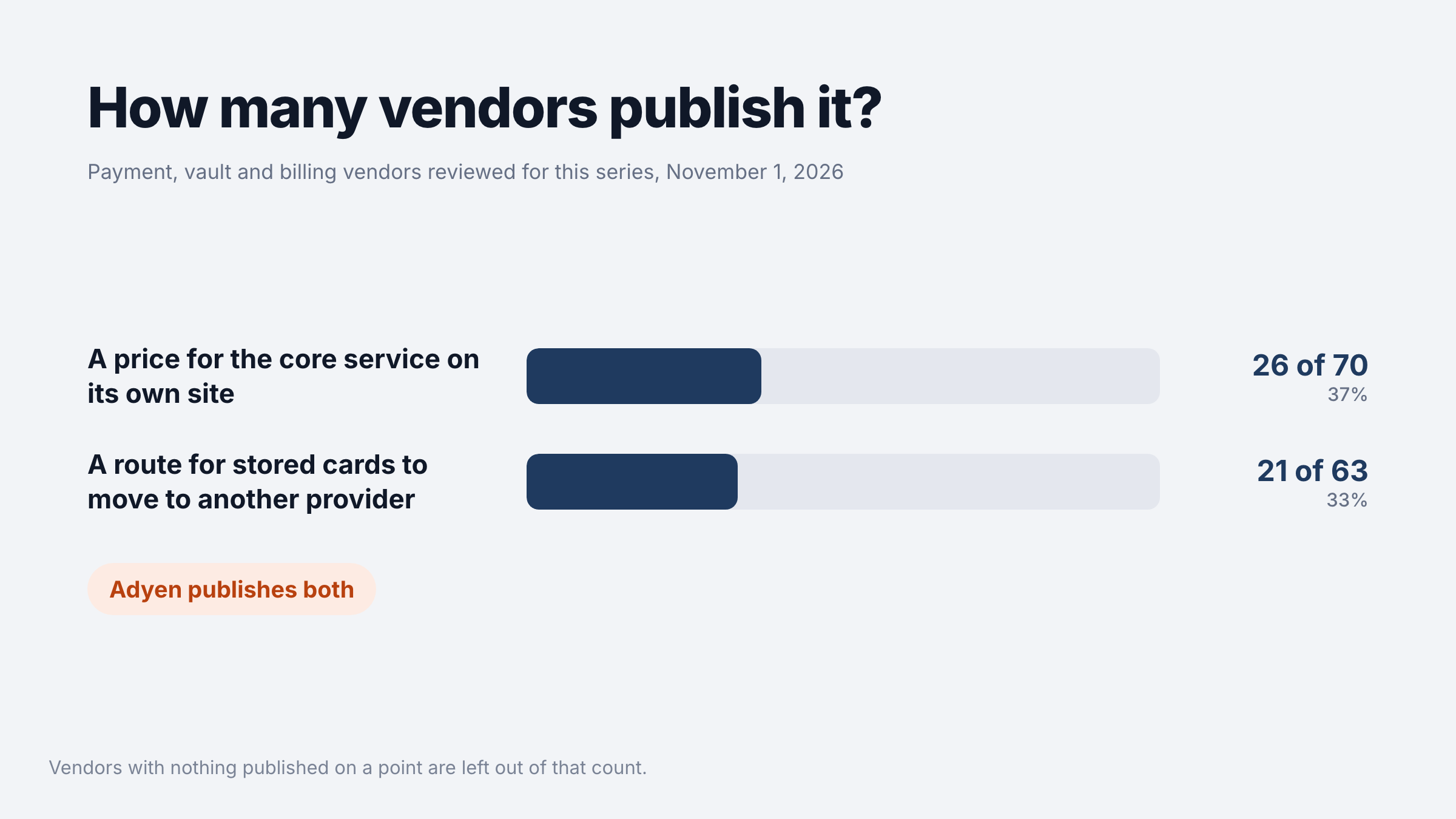
Stored cards show a wider gap. Of the 63 vendors that publish anything on the subject, 21 describe a route for cards to move elsewhere, and Adyen’s Forward feature puts it in that group alongside NMI and Gr4vy. These counts date from November 1, 2026. A vendor that publishes nothing on a point is left out of that count, not marked as a no.
What to verify before you sign
Run these checks whichever vendor you pick, because a white label is hard to unpick once your users know it as your product. Network tokens deserve a direct question, since Visa reports a 4.6% authorization lift for tokenized card-not-present payments over card numbers.
| Decision area | Question to ask | Evidence to request | Red flag |
|---|---|---|---|
| Licenses | Whose licenses cover our users, and what must we hold ourselves? | A written split of regulatory duties | “We’ll cover that at onboarding” |
| Acquiring | Can we change acquirers without changing the gateway? | The acquirers already connected in our markets | Connections only through the vendor |
| Stored cards | How do our cards and network tokens move if we leave? | The export procedure and its fee | A per-record fee disclosed late |
| Branding | Which screens and emails carry our brand? | A demo under our own domain | The vendor’s name in a footer or URL |
| Restricted verticals | Which of our users would be refused? | The restricted list that applies to platforms | Approval only after integration work |
Attach the answers to the contract, so they outlast a change of account manager.
The bottom line
Who should carry the acquiring and the licenses? Settle that first. If a supplier should, test Adyen’s platform product against your verticals and payout regions. If you should, Akurateco or UniPay put the gateway on your own infrastructure, NMI and Fluid Pay suit an existing partner channel, and among Adyen competitors for restricted verticals, Ikajo is the one to call. Either way, get the card-export route in writing.
Questions about Adyen competitors
Does Adyen offer white-label payment processing?
Yes. Adyen for Platforms lets a SaaS company or marketplace sell financial products under its own name, on Adyen’s licenses and infrastructure.
Who are Adyen’s main white-label competitors?
NMI comes closest for ISOs and SaaS companies, and Gr4vy sells a white label to platforms and their sub-merchants. Akurateco, UniPay, Ikajo and Fluid Pay also sell white-label gateways, mostly to payment businesses that bring their own acquiring.
How does a white-label gateway differ from Adyen’s white label?
With Adyen, the licenses and the acquiring come from Adyen, which means less to build and less control later. With gateway software you hold those relationships yourself, so you carry more work and can replace an acquirer without replacing the product.
How much does white label payment processing cost?
Adyen lists $0.13 plus a method fee per transaction. UniPay’s hosted white label starts from $15,000 a month, Akurateco’s calculator shows €8,000 to set up on SaaS and €60,000 on-premises, and Ikajo’s gateway pricing starts at 1.2%. NMI, Gr4vy and Fluid Pay keep amounts off their sites.
Which Adyen alternatives accept gambling merchants?
Adyen takes legal gambling merchants with extra documentation but refuses platforms that let others sell gambling. Among Adyen alternatives, Ikajo opens gambling accounts with rates starting at 3%, and Gr4vy powers Apple Pay for Pure Interactive’s real-money mobile games.