Becoming a payment service provider in 2026 is a promising perspective. Though the market may seem already saturated, plenty of payment challenges remain unresolved, no matter how far the technology goes. Most of the industry problems can be addressed by good-quality payment gateways. Yet, building that infrastructure from scratch takes 18 months or more and costs that few startups can absorb. In many cases, businesses may and should rely on white-label payment gateways. This guide explains what to look for in a while-label payment gateway solution, maps the verified cost difference between building and buying, and profiles the leading white-label platforms operating in 2026.
Innovative and efficient PSP solutions can bridge the gap between the desired speed and ease of payments and infrastructure obstacles preventing them. However, the payment service road is not without its challenges. Connecting to a single or even several card processor(s) is not nearly enough. Modern PSP founders and fintech operators are expected to run regulated, scalable payment infrastructures that support multiple acquirers. But that is only the tip of the iceberg. Beneath that visible infrastructure support surface, there’s a need to deliver full financial transparency and adapt quickly to new markets and payment methods.
White-label payment gateways deliver all those features with an important nuance: absence of huge upfront costs and a dedicated internal developers team. They offer a complete, compliant, rebrandable payment stack that a business can deploy in weeks, not years. Here’s how to choose the most suitable and reliable white-label payment gateway platform for your business in 2026.
Why the Demand for White-Label Gateways Is Growing Now
The demand for white-label payment infrastructure in 2026 is driven by two intertwined forces. First, there’s a relentless growth of digital payments globally, that expect some software to process the enhanced volumes. Second, payment providers face the increasing diversification of payment methods that merchants and consumers now expect. Here we must note not only more and more variations of so-called traditional digital payment methods (e.g. tokenized virtual cards, digital wallets, A2A payments) but also the emergence of agentic transactions as well as blockchain-based cryptocurrency payments that add to an already wide payment mix.
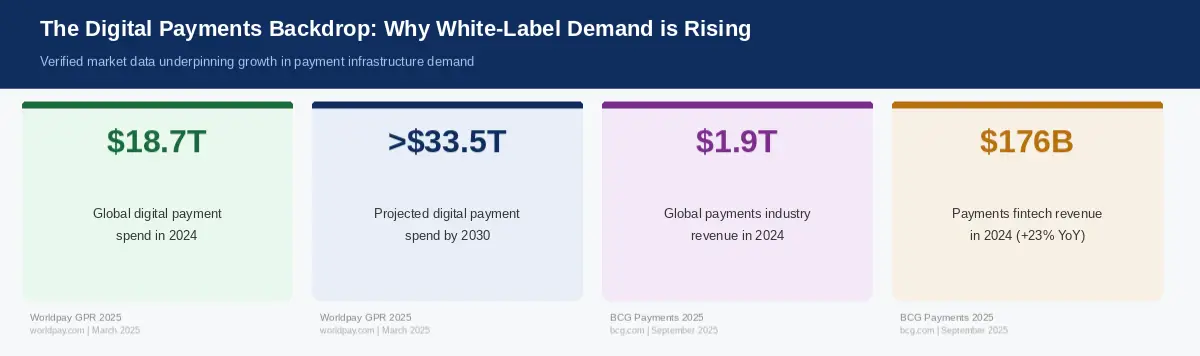
Image 1 — Verified global payments market data underpinning infrastructure demand
By 2024, global digital payment spend had reached $18.7 trillion, an impressive eleven-fold increase from $1.7 trillion in 2014. This figure is projected to exceed $33.5 trillion by 2030. At the same time, the composition of those payments is shifting from early-days payment card monopoly:
- Digital wallets now account for 53% of online purchases globally;
- A2A payments grew 40% in 2025;
- BNPL reached $342 billion in e-commerce spend in 2024;
- Meanwhile, cash’s share of POS transactions has fallen from 44% to just 15% over the past decade.
For any company that wants to operate as a PSP or just embed payments functionality into its product, this diversity means one obvious thing: a gateway must support many payment methods, on both global and local levels. Building those integrations independently, given that each of them might be taking months of engineering time, is simply not viable for the majority of smaller-scale businesses. Thankfully, white-label platforms that ship 500–600+ pre-built connectors change the calculation entirely.
The payments fintech sector also reflects this momentum. Payments-focused fintechs generated $176 billion in revenue in 2024, growing at 23% annually, and have attracted over $135 billion in equity funding over 25 years, according to BCG’s 2025 Global Payments Report.
Build vs Buy: The Verified Cost Difference Between While-Label Platforms and In-House Payment Gateways
The decision to build a payment gateway from scratch versus licensing a white-label solution always must take into account №1 economic factor. The costs of building proprietary payment stacks are substantial and well-documented.
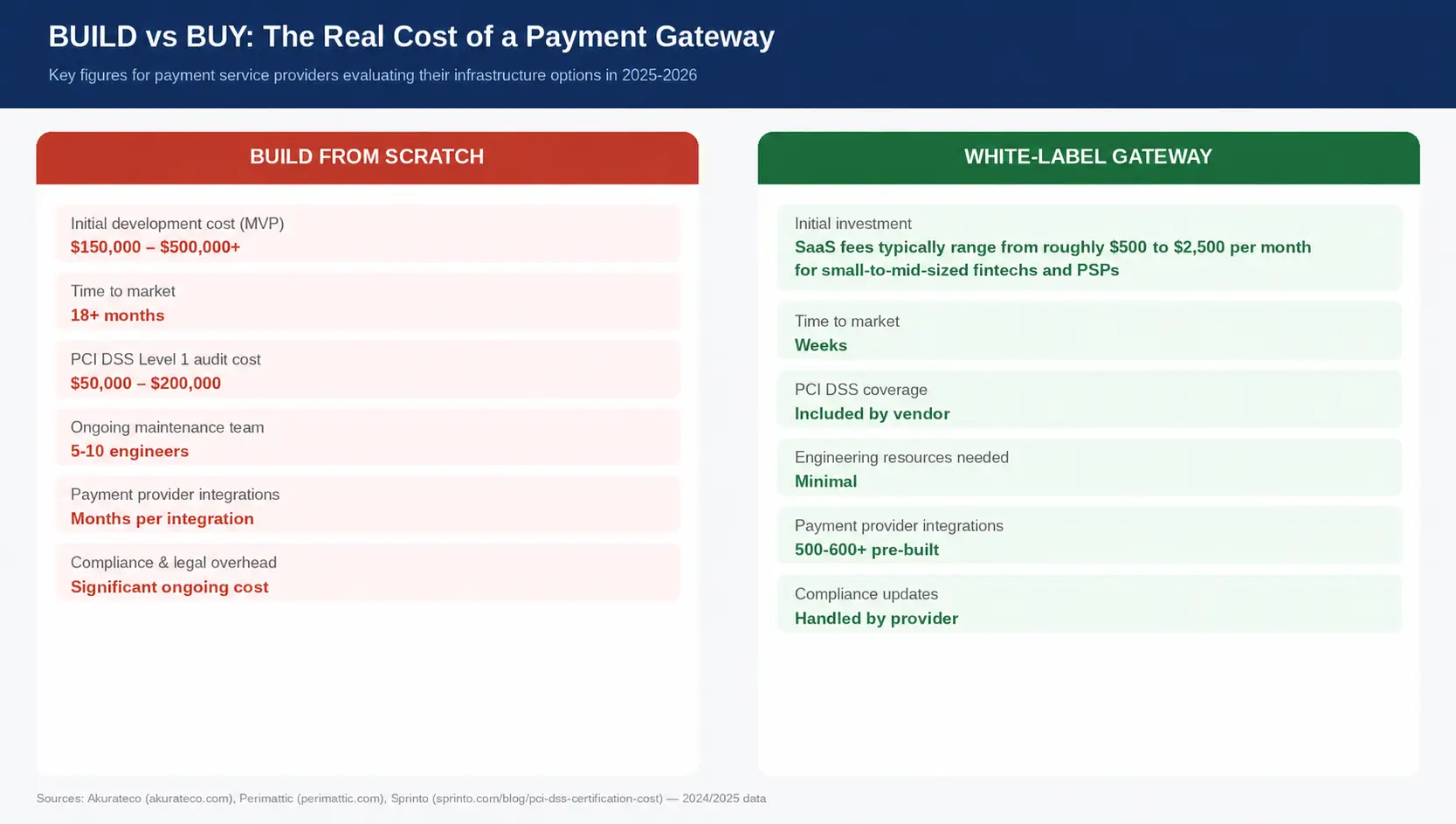
Image 2 — Build vs Buy cost comparison
The cost of building from scratch
Development cost (MVP): There is no set amount you’re going to pay for developing a payment gateway in-house, as it’s a very individual solution depending on the features and requirements. However, estimates from multiple software development sources place the cost of building a basic payment gateway MVP at between $150,000 and $500,000, depending on complexity, included tools, and the engineering team’s location.
Time to market: Akurateco, citing its own experience with clients, states that “designing, testing, certifying, and launching your own PSP typically takes 18 months or more.” This timeline is broadly consistent with industry experience.
PCI DSS compliance: PCI DSS Level 1 certification, required for organizations processing over 6 million card transactions per year, involves an annual Report on Compliance (RoC) conducted by a Qualified Security Assessor (QSA). Industry sources assess this type of compliance cost at $50,000 to $200,000 per audit cycle, not to mention potential associated infrastructure upgrades, which can add significantly to this total.
Ongoing maintenance: Finally, any live payment gateway requires continuous attention: security patching, integration maintenance, regulatory updates, fraud model tuning, and infrastructure operations. The list goes on… Realistically this requires a dedicated team of 5-10 engineers, representing a significant ongoing labor cost, not to be disregarded.
The case for white-label payment gateway adoption
White-label payment gateway vendors absorb all the nuisances of the development, certification procedures, and maintenance costs in exchange for a SaaS fee. The buyer gets a fully brandable fintech product. Numerous aspects of this solution, from checkout UI to API documentation and merchant portal, are handled under its own domain and corporate identity, but with no upfront capital expenditure for gateway technology.
Building and maintaining a processing platform from scratch can cost any amount of capital between $500,000 and $1,000,000+ for the MVP alone. With white-label payment gateways, the costs of implementing similar capabilities just in different form are reduced “to the equivalent of a single developer’s monthly salary,” estimates Akurateko. Other vendors cite similar cost ranges, though, naturally, enterprise deployments could cost substantially more depending on transaction volume, integrations, compliance scope, and fraud tooling. At the same time, in these circumstances, the price tag of platform build will also grow accordingly.
All in all, despite some margin of error in cost estimations, the core trade-off is crystal clear: white-label trading capital expenditure and engineering time for recurring SaaS cost and vendor dependency. For most PSP startups and fintech platforms that are not themselves already involved in the business of building payment technology, it’s a win-win situation.
What to Look for in a White-Label Gateway
White-label payment gateway solutions may seem similar at first glance. However, the differences do exist and they may be fundamental. While the first thing you see by choosing the proper platform are marketing promises, looking past them and towards more detailed technical examination requires time and effort. However, without due analysis, you risk adopting a solution that doesn’t fit your business model, operational needs and compliance requirements. The following criteria are the most important to mind while choosing a white-label payment gateway.
Payment provider connectivity (connectors)
The amount of pre-existing connections to banks, acquirers, and alternative payment methods available to businesses affects how quickly they can expand into new regions. The top platforms in 2026 will provide anywhere from 500-600+ connections. The total number of connections, however, is of far less importance than the quality and completeness of each connection (i.e., how well the integration has been implemented) since poor-quality connections result in increased support costs. If seeking to expand into new regions or enrich your selection of supported payment types, inquire vendors specifically what regions or payment types they support. Check if the available connections suit your target markets and audiences.
Intelligent routing and cascading
An automatic smart routing process (when you get all your transactions routed automatically to the one acquirer or PSP that can accept and approve them at the lowest cost and highest efficiency) is one of the main differentiators in today’s payment industry. Automatic cascading/retrying of several alternative connections after the initially chosen one fails to work also reduces false declines. Although many leading-edge platforms offer both of these automatic processes, they proceed with varying levels of sophistication; some use static rules to route their transactions, while others combine more advanced machine learning technology and perform via real-time AI analytics to determine where each transaction will be attempted next. Routing and cascading aren’t compliance-neutral, though. Each additional acquirer or PSP in a cascade path is another point where cardholder data is captured, transmitted, or routed, and the integration model determines who owns which controls at that point.
PCI DSS compliance level
Vendors must be PCI DSS certified. Ideally, you should look for Level 1 compliance (the highest PCI DSS standard). This certification means the vendor has passed an independent audit by a Qualified Security Assessor. This aspect should not ever be ignored, since using a PCI DSS compliant vendor reduces (though does not 100% eliminate) your own compliance burden. The scope of your PCI obligations depends on your integration method and how cardholder data flows through your system. Please verify which SAQ (Self-Assessment Questionnaire) type applies to your specific implementation. It will help you understand the exact scope of your remaining compliance responsibilities and what risks you still carry even when using a PCI DSS compliant vendor. Ask vendors how their routing/cascading architecture is designed to preserve your SAQ-A eligibility (e.g., do all cascade paths stay within a tokenized/hosted-field model, or can some paths touch raw PAN data).
Full white-label capability
White-label capabilities at their fullest essentially mean that your branding is visible everywhere: checkout pages, merchant portal, API documentation, email notifications, and domain URLs. However, some vendors offer partial branding. You need to check these details to avoid confusion beforehand. Confirm that no vendor branding appears to end customers or merchants at any stage, or check where it does appear and whether it’s suitable for your particular business needs.
Tokenization and recurring billing
Any business that accepts subscription payments and/or stores credit card information must ensure that its payment gateway offers a PCI compliant tokenization solution. Tokenization replaces sensitive card data with unique tokens to limit the risk of exposure if an unauthorized person accesses those codes/values. When it comes to recurring billing, it is also important to have features such as retry logic, some level of flexibility in the billing schedule(s), and dunning management with those products that utilize subscriptions.
Merchant management tooling
A white-label PSP must be able to manage multiple merchant accounts from a single admin panel. Key features of this panel include:
- merchant onboarding workflows,
- per-merchant routing rules,
- fee configuration,
- settlement reporting,
- dispute/chargeback management, etc.
Operational productivity at scale can be determined by depth and efficiency levels of the above-mentioned toolsets if they are used properly.
Risk and fraud management
Fraud detection, risk assessment and transaction monitoring regulations (to name only a few), including 3-D Secure (3DS), are considered standard aspects of a majority of contemporary payment processing systems. Some more advanced systems also provide integration options for connecting to third-party fraud services. Additionally, inquire about the vendor’s method for using artificial intelligence (AI) to enhance their fraud detection capabilities. For instance, IXOPAY purchased Congrify in 2025 solely to bring payment intelligence functions to its platform without extra programming skills.
Deployment model and data residency
As of 2026, Cloud SaaS is the default deployment model. However, many businesses are operating in jurisdictions with data residency requirements (e.g., GDPR in the EU or local data localization laws in certain markets). Therefore, one needs to verify where exactly transaction data is processed and stored to avoid unintentional law violations. Some vendors offer on-premise or hybrid deployment options, details that can make no difference for individual businesses but greatly matter for regulated entities.
Provider Overview: Three Established Platforms in 2026
The white-label gateway market has dozens of vendors that operate on a global level. Here are the examples of three prominent solutions that stand out as of May 2026.
Important note: Features, pricing, and capabilities are up-to-date at the moment of writing; however, they change frequently. Contact the vendors directly to find out the exact fees and numbers you’re interested in.
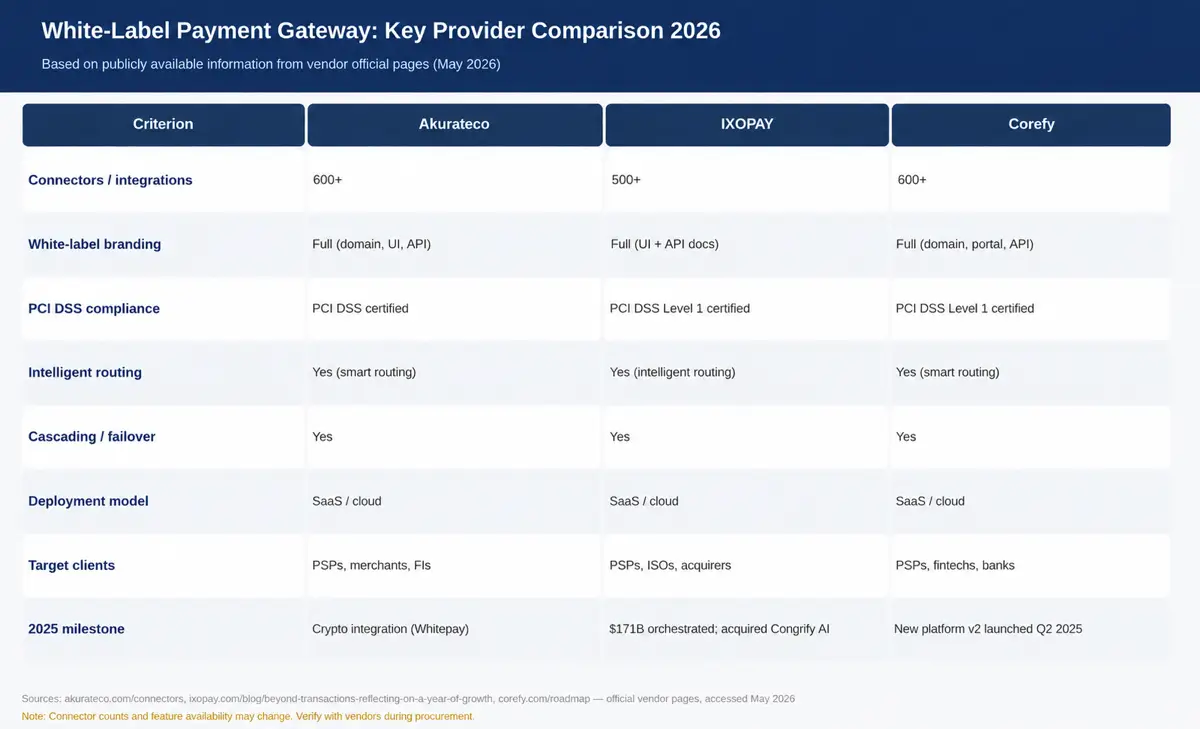
Image 3: Key provider comparison based on publicly available information (May 2026)
Akurateco
Akurateco is a global white-label payment software vendor based in Europe, offering a platform for PSPs, acquirers, enterprise merchants, and financial institutions with several deployment options, including SaaS, on-premises, and Cloud-Agnostic. It positions its platform as reducing infrastructure and development costs for clients.
- Connectivity: 650+ pre-developed integrations with banks, acquirers, and APMs, accessible via a single integration — per official connector catalogue (akurateco.com/connectors, accessed May 2026)
- White-label: Full branding, including payment pages, merchant dashboards, and API documentation, under the client’s own domain
- PCI DSS: Level 1 Certified (PCI DSS compliant, per akurateco.com/about-us)
- Key features: Intelligent routing, cascading, network tokenization, recurring billing, fraud prevention, automated merchant onboarding, payment analytics, and others.
- 2025 update: among the publicly announced integrations delivered throughout the year were Visa Connect API, Apple Pay, Google Pay, Whitepay, Calypso Pay, Enza, MPGS, AstroPay, Tap Payments, MyFatoorah, Skrill, a Paysafe Experience, Coinspaid Solutions, and many others, supporting payment flows across Europe, Africa, LATAM, Asia, and MENA.
IXOPAY
IXOPAY is an Austrian fintech company (part of the IXOLIT group) founded in 2014 in Vienna. It operates as an independent, PCI-certified payment orchestration platform for white-label clients and enterprise merchants.
- Connectivity: 500+ adapter connections (200+ acquirers/PSPs and 300+ payment methods)
- White-label: Full branding — all UI elements, logos, colors, fonts, domain names, and API documentation can be customized (ixopay.com/en/white-label-payments)
- PCI DSS: PCI DSS Level 1 certified
- Key features: Intelligent routing, cascading, risk management, automated reconciliation, settlements, SDKs for mobile, hosted payment pages, server-to-server API
- 2025 milestone: $171 billion in transactions orchestrated through the platform; 2.1 billion+ tokens stored; acquired Congrify (AI-powered payment intelligence platform); added four new development teams
Corefy
Corefy (formerly PayCore.io) is a payment orchestration platform that also offers a white-label PSP solution. It received a Bronze Award from PaySpace Magazine Awards in 2021 and has been a PCI DSS Level 1 certified platform since 2020.
- Connectivity: 600+ provider integrations in the connector catalogue (corefy.com/connectors, accessed May 2026)
- White-label: Full branding — branded merchant portal on client’s domain, white-label API documentation, customizable checkout
- PCI DSS: PCI DSS Level 1 certified (corefy.com/roadmap)
- Key features: Smart routing, cascading, real-time monitoring, AML/KYC automation, chargeback management, fee configuration
- 2025 milestone: Launched completely revamped platform (Corefy V2) in Q2 2025, described as featuring “an intuitive interface, advanced customisable checkout, new processing capabilities, and optimised performance.”
Critical Questions to Ask During Procurement
Before selecting any white-label gateway vendor, you’ll need to discover specifics regarding the following aspects. Vague responses should be treated with precaution as a potential red flag.
- Which PCI DSS level are you certified to, and can you share your current Attestation of Compliance (AoC)?
- Which integration method (hosted fields, redirect, server-to-server) reduces my PCI scope to SAQ-A or SAQ-A-EP?
- Which of your 500+ connectors are fully production-ready versus in beta or limited availability?
- How is routing logic defined, e.g. rule-based, ML-driven, or hybrid? Can I configure rules without engineering resources?
- What is your uptime SLA, and how is downtime handled for live merchant transactions?
- Where is transaction data stored? Is EU data processed in EU infrastructure?
- What does your merchant onboarding workflow look like? How long does it take to bring a new merchant live?
- How are scheme fees, interchange, and processing costs visible in settlement reporting?
- What is your roadmap for AI-driven fraud prevention and real-time payment method support (FedNow, SEPA Instant)?
- What happens to our merchants and transaction data if we terminate the contract?
The Compliance Landscape in 2026
White-label gateways operate within a frequently shifting regulatory environment. It is especially evident today, considering the upcoming addition of emerging agentic payments to the tech stack. Understanding the current legal landscape is essential for any business evaluating these platforms so that you know which levels of compliance you can expect.
PCI DSS v4.0
The Payment Card Industry Data Security Standard version 4.0 became the only active standard on March 31, 2024, replacing PCI DSS v3.2.1. Version 4.0 introduces more flexible implementation options (“customized approach”) and new requirements around multi-factor authentication, web-skimming prevention (particularly for e-commerce checkouts), and password management. White-label vendors that are PCI DSS certified have updated their infrastructure to meet v4.0 requirements. Businesses using white-label gateways still carry residual PCI scope. The latter depends on how card data flows through their systems.
SEPA Instant Payments Regulation (EU)
The EU’s SEPA Instant Payments Regulation required European banks to be able to receive instant payments by January 9, 2025, and to send them by October 9, 2025. This mandate is accelerating A2A payment adoption across the EU and creating new connectivity requirements for payment gateways operating in European markets. White-label vendors with strong EU coverage should have SEPA Instant integrated into their connector catalogue.
Open banking and PSD3
PSD2 compliance remains mandatory for European payment service providers. In the meantime, its successor directive, PSD3, is progressing through the bureaucratic stages of EU legislative process. Its provisions are expected to further standardize open banking APIs and strengthen consumer protection. White-label gateway operators need to monitor these developments carefully. Regulatory changes typically require platform updates within defined timelines.
Conclusion
White-label payment gateways have shifted from being a niche option for well-funded startups to becoming the go-to infrastructure for anyone launching a PSP or adding payments to a platform.
Many businesses cannot decide whether the white-label payment processing alternative is suitable for them or if they should venture into their own development process. When you compare the numbers, the choice becomes pretty clear. Building a payment system from scratch can easily cost $150,000–$500,000+ for an MVP, take 18+ months to launch, and require PCI DSS audits that add another $50,000–$200,000 per cycle. Against that, licensing a white-label solution is usually the more practical and cost-efficient path for most companies.
In this situation, the question remains which solution to choose and how to structure the partnership. The evaluation criteria in Section 3 of this guide are a good starting point, but they’re not enough on their own. It’s important to go deeper, e.g. run technical due diligence, speak with existing clients, and carefully review the contract, especially around data ownership, portability, and exit terms.
In a fast-moving digital payments market, speed matters. The providers that help you launch quickly without compromising compliance are typically the ones worth the most serious consideration.