Payrails launched Merchant of Record on October 7, 2026, three weeks after it announced a partnership with Saudi infrastructure company Moyasar at Money20/20 Middle East. It runs on Payrails’ own orchestration and is pitched for MoR in some markets and direct acquiring in others, yet the docs support only the United States so far. Who hosts the platform and what it costs are still open questions.
Key takeaways:
- You won’t find a Payrails price, and its pricing URL returns a page-not-found message.
- If the platform has to sit on your own servers or cloud account, or you sell payments under your own brand, look at Akurateco.
- Spreedly prints $750 a month for its vault. Hyperswitch’s core code is free to download, but PCI DSS and the daily running of it become your job.
Do you want one vendor across payments and finance, or only routing and a vault that you can replace later? The five Payrails competitors below are ordered for a large merchant or payment business choosing a payment orchestration platform. We checked vendor figures against their own sites and documents during October and November 2026.
Payrails in 2026
Payrails has spent this year widening what it sells rather than deepening what it charges in public.
What it sells
Former fintech leaders from Delivery Hero founded Payrails in Berlin in 2021. Its homepage now calls it an operating system for payments, modular by design, and the modules cover orchestration, tokenization, payouts, reconciliation, analytics and in-person payments, the last still in preview in its docs. Stripe, Adyen, Forter and SAP are among the 100+ integrations, and Puma, Vinted and Flix are named customers. Prices stay private.
The Token Vault holds credentials independently of any PSP and supports Visa, Mastercard, American Express, JCB and Diners Club network tokens. Payrails says the vault can cut a merchant’s PCI burden from SAQ-D to SAQ-A. Payrails runs that vault itself, on funding that passed $52 million with a $32 million Series A in June 2025.
What changed
Most of the year’s news points at the Gulf and at finance teams:
- On February 5, Ecommpay announced a strategic partnership with Payrails aimed at large e-commerce businesses.
- On February 25, Payrails said it was setting up a Middle East headquarters in Dubai’s financial center.
- On September 15, it added Moyasar in Saudi Arabia.
- On October 7, it launched Merchant of Record, which also handles sales tax, VAT, GST, invoicing and disputes, with drop-in checkout only and no partial refunds for now.
A buyer in the Gulf gets a stronger story from all this. Anyone comparing vendors on hosting or price learns nothing new. Keep asking.
What users say
There’s almost no public record to read. You won’t find it on Gartner Peer Insights, TrustRadius, SourceForge or Trustpilot (checked October 29, 2026). That leaves its own status page, with 4 incidents in the 90 days to that date, one labeled critical. So ask for references in your own vertical.
Payrails competitors at a glance
Hosting splits this list more sharply than features do, so read that column first.
| # | Competitor | Best for versus Payrails | Deployment | Pricing | Standout |
|---|---|---|---|---|---|
| 1 | Akurateco | Your own infrastructure or brand | SaaS, own servers or cloud | Quote | 99.95% uptime SLA |
| 2 | Gr4vy | A private instance per customer | Single-tenant cloud | No public price | Tokens import and export |
| 3 | Hyperswitch | Code your team can read | Self-hosted or hosted | Paid editions by quote | Apache 2.0 core |
| 4 | Spreedly | Cards in an independent vault | Multi-tenant SaaS | Vault from $750 a month | 150+ gateway connections |
| 5 | ProcessOut | Measuring routing uplift | Vendor-run | Sales only | Control group on every rule |
Spreedly gives you a number to work with before a sales call, though not a full quote.
How the competitors compare
Two questions decide this list. Who runs the platform, and how do your cards leave when the contract ends?
1. Akurateco: infrastructure you can keep in-house
Payrails operates its vault for you. Akurateco also runs as SaaS, but its payment orchestration platform and its white-label gateway can go on servers you own, or into an Azure, Google Cloud, AWS or Oracle Cloud account of yours. A cloud move takes roughly 30 days and dedicated hardware roughly 60.
You bring your own acquirers and plug them into 700+ ready connectors. The average start takes 5 business days, a new integration takes about 14 days, the SLA promises 99.95% uptime, and 150 built-in configurable fraud filters are included.
Best for: a PSP, bank or big retailer required to hold its data and PCI scope itself.
Watch out for: it holds no funds and opens no merchant accounts, it has no Merchant of Record service, and stored-card exports get one passage in its migration guide rather than a full procedure.
2. Gr4vy: a private instance for each customer
Where Payrails sells breadth, Gr4vy sells isolation. Each customer gets a single-tenant cloud instance with its own sandbox and production hostnames, and the infrastructure page says data can reside in more than one place. A single integration covers 400+ payment methods, and adding a PSP or anti-fraud tool leaves checkout untouched.
Tokens come in and go out, and a stored card can run through any connected PSP without re-tokenization. Platforms can also white-label it for sub-merchants. In June 2026 it added Airwallex for direct access to global acquiring.
Best for: an enterprise checkout or a platform that wants its own environment without running servers.
Watch out for: gr4vy.com/pricing shows only “Page not found”, and you won’t find a self-hosted option.
3. Hyperswitch: orchestration you can inspect
Hyperswitch has been open source since Juspay released it in 2022, with its core repository under Apache 2.0. On a self-hosted build, payment data stays in your infrastructure and you decide storage location, access, encryption and retention. Native, outsourced and hybrid vaults are all supported, which is a flexibility Payrails’ operated vault doesn’t advertise.
The cost shows up in staffing. The checklist asks for Kubernetes, Rust, Postgres and Redis skills, and above 1 million card transactions a year the docs require a QSA Report on Compliance. Stored cards leave as a PGP-encrypted CSV over SFTP, only to a PCI-compliant processor and only after its security team approves.
Best for: a merchant with a platform team that treats payments as core engineering.
The trade-off: Juspay’s paid editions are quote-only, and the integration count varies by page, from 90+ to 300+.
4. Spreedly: tokens first, routing after
Spreedly began in 2007 as a simpler way to store cards, and that history shows. You hold credentials in a vault you control, use them with any provider, and change processors without customers re-entering cards. Cards can leave automatically for supported gateways through its store API, or as an encrypted file for other PCI-compliant systems.
Spreedly connects to 32+ fraud and risk tools, 60+ payment methods and 150+ gateways. On October 21, 2026 it introduced Composer, a no-code canvas that arranges routing, authentication and fraud checks.
Best for: a merchant who already has acquirers and worries most about card lock-in.
Watch out for: that $750 covers the Independent Vault only. Routing, retries and 3DS sit on a tier sold through sales, and the architecture is multi-tenant.
5. ProcessOut: proof before you commit traffic
Checkout.com bought ProcessOut in 2020 and keeps it as a standalone unit that doesn’t share tech resources with its parent. One API reaches 100+ payment providers. Its Smart Router keeps a small control group on each rule, which lets the dashboard measure uplift on your traffic rather than against a benchmark.
Telescope monitoring also takes in data from the PSPs you already use, so you can compare them before routing anything live. Card data comes in through your account manager, encrypted with its public key.
Best for: a payments team that wants evidence for each routing change.
The trade-off: its docs carry no guide for exporting a card vault, processout.com shows no price, and its parent company also sells processing.
Where Payrails sits among 70 payment platforms
Start with the simplest question we asked across this series of 70 vendors, vaults and billing tools among them. Is a price for the core service on the vendor’s own site? It is at 26, and not at Payrails.
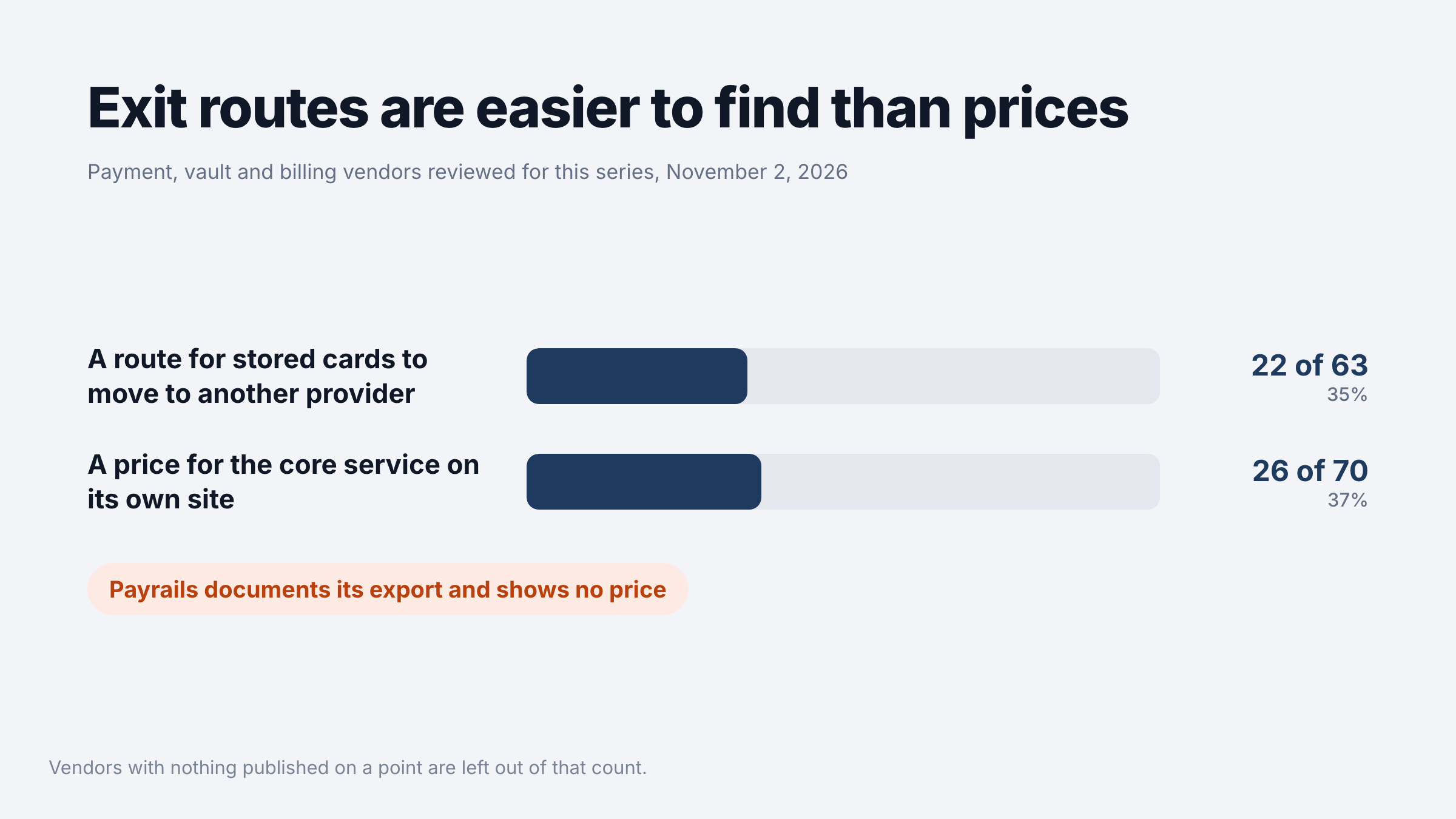
Stored cards are where Payrails does better. Only 22 of the 63 vendors with a public position document a way out, and Payrails is among them, along with Gr4vy, Hyperswitch and Spreedly. That’s a rare answer. It exports through two APIs, Search & List Tokens and Search & List Instruments, while full card numbers stay out of standard exports and need a separate process under PCI DSS. These counts date from November 2, 2026.
What to verify before you sign
Fee visibility is the reason finance teams buy this category at all. Core scheme and processing fees climbed at least 25% in real terms between 2017 and 2023, according to the UK’s Payment Systems Regulator. Remittance data is changing too, since the Swift ISO 20022 cutover finished on November 22, 2025.
| Decision area | Question to ask | Evidence to request | Red flag |
|---|---|---|---|
| Stored cards | How do full card numbers leave, and who pays? | The written export process | Tokens only, with PANs “on request” |
| Merchant of Record | How do we move a market back to our own acquiring? | The contract clause and a timeline | Exit priced after signature |
| Hosting | Who operates the vault, and in which regions? | A hosting map and PCI attestation | Residency answered only in a call |
| Reconciliation | Does it match our ledger and our PSP fees? | A sample run on our own files | A demo on vendor data only |
| Incidents | What happened in the last 90 days? | Status history and the SLA credits | No credit for a critical incident |
Bring those answers to your finance lead as well as your payments lead, because a platform this broad changes both of their jobs.
The bottom line
Stay with Payrails if one vendor across orchestration, reconciliation and MoR is the point and its Gulf reach helps you. If you need your own servers or your own brand, start with Akurateco. Gr4vy gives you isolation without the operations work, Hyperswitch gives you the code, Spreedly protects your cards, and ProcessOut proves its results first. Whichever of these Payrails competitors you shortlist, get the card export and the hosting map in writing before anyone migrates a token.
Questions about Payrails competitors
Is Payrails a payment processor?
Its platform connects the PSPs and acquirers you choose through 100+ integrations. The exception is its Merchant of Record product, US-only for now, which resells digital products under Payrails’ own entities and handles tax and disputes.
Who are Payrails’ main competitors?
For orchestration, Akurateco, Gr4vy, Hyperswitch, Spreedly and ProcessOut come closest. They differ on who runs the platform and on how your stored cards move.
How much do Payrails alternatives cost?
Payrails has no price list. Among Payrails alternatives here, you can read one list price, $750 a month for Spreedly’s vault. Gr4vy, ProcessOut and Hyperswitch’s paid editions go through sales.
Can you self-host Payrails?
It operates the Payrails Vault itself and describes no self-hosted edition, so ask directly. Akurateco and Hyperswitch both offer deployment in your own environment.
Can you take your cards with you when you leave Payrails?
Yes, there’s a documented route through its APIs. Full card numbers need a separate process under PCI DSS, so agree that process in the contract.