AI has made it easier than ever to apply for a job, yet fintech companies are not hiring any faster.
In this article, Anastasia Zencika, Founder & CEO of Evotym, a European recruitment and executive search agency specialising in fintech, payments and crypto, explains why what looks like a talent shortage is often a signal problem, and what companies can change to recognise the right candidates sooner.
For candidates, applying for a job now takes minutes. For companies, there are more tools than ever to process those applications at scale. Yet fintech hiring itself can still feel slow, especially when companies are looking for a very specific combination of experience.
AI can make recruitment more efficient, but efficiency and hiring effectiveness are 2 different things. Processing 500 applications in minutes is valuable only if it helps identify the 5 people who could actually succeed in the role.
In my view, many fintech hiring problems come down to signal. When anyone can apply in seconds, it becomes much harder to stand out, and the volume this creates often slows companies down.
Easier applications, weaker signals
Candidates can now tailor a CV to a job description in seconds and repeat the process across dozens of vacancies. Greenhouse reports that 74% of candidates now use AI in their job search, while its 2025 Workforce & Hiring Report found that 22% had used bots to apply for roles automatically.
The wider European recruitment market shows how quickly application volume has grown. According to Greenhouse’s 2026 European recruiting benchmarks, based on more than 17 million applications across 800+ companies, annual applications per recruiter increased by
385% between 2022 and 2025, while applications per job grew by 85%. Over the same period, time-to-fill increased by 40%, from 44.39 to 62.24 days.
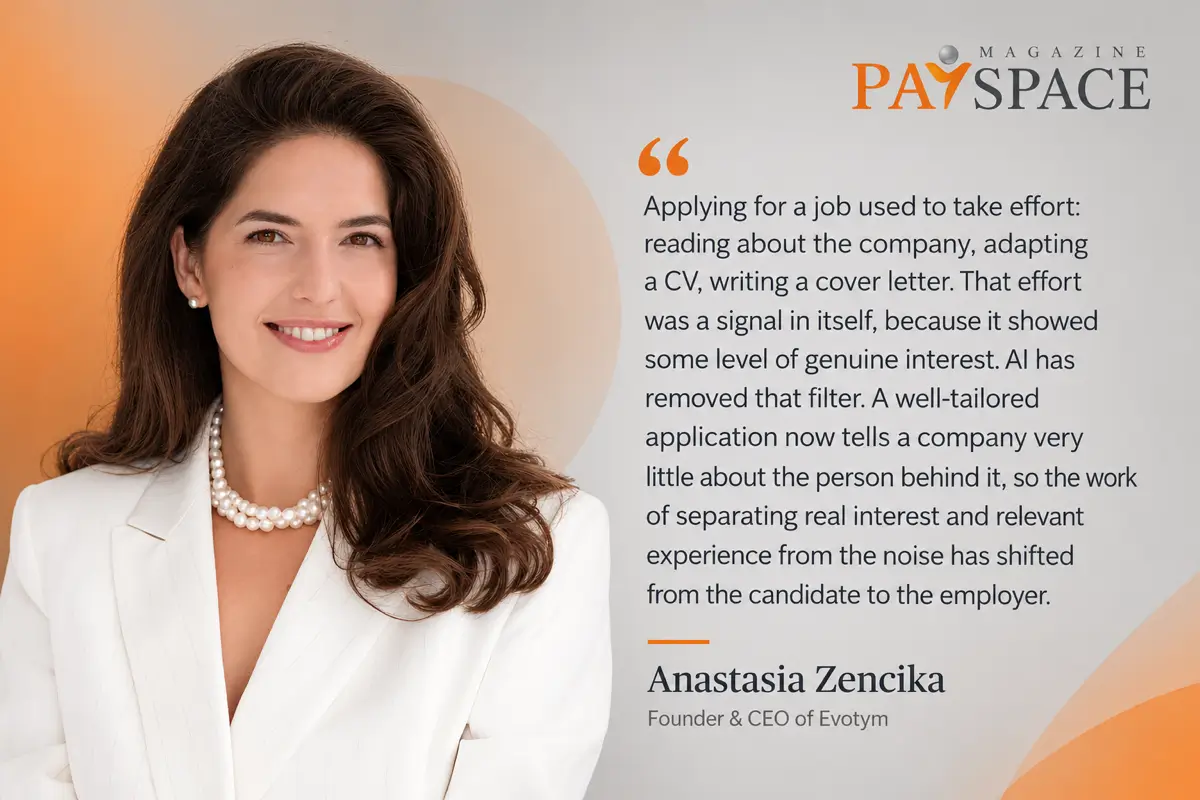
These numbers alone don’t prove that more applications are what makes hiring slower. But I think they point to something that has quietly changed. Applying for a job used to take effort: reading about the company, adapting a CV, writing a cover letter. That effort was a signal in
itself, because it showed some level of genuine interest. AI has removed that filter. A well-tailored application now tells a company very little about the person behind it, so the work of separating real interest and relevant experience from the noise has shifted from the candidate to the employer.
In a recent Evotym survey, we asked fintech companies how long it takes them to hire. 48% said 1 to 2 months. For specialised, senior or C-level positions, that is a reasonable timeline. The more important question is where that time goes, and how much of it is spent looking for signal in a growing pile of applications.
For many roles, qualified professionals are out there, and the difficulty lies in the gap between the talent available in the market and the people companies know how to identify, attract and assess. In some niches, the pool is genuinely small. A company looking for someone who combines European regulatory expertise, crypto or blockchain knowledge and hands-on licensing experience may have very few suitable people to choose from, and those people are unlikely to be in the applicant pile at all. These are 2 different problems, and they need different solutions.
AI can only find the signals it’s told to look for
For employers, the technology brings real benefits. It can help structure candidate information, highlight relevant experience and make large applicant pools easier to navigate. The difficult part is deciding what it should be looking for.
If a company knows which responsibilities, achievements and experience matter for the role, automation can help find those signals faster. If it screens mainly by job titles or keywords, it may miss people whose experience is relevant but described differently.
Take a Head of Payments search. Keywords such as payments, acquiring, PSP or banking partnerships can help surface relevant profiles. They do not show whether someone personally built acquiring partnerships across several markets, developed banking infrastructure or simply managed relationships that already existed.
The same applies to compliance. Having Head of Compliance on a CV does not tell us whether someone has personally led a licensing process, worked with a particular regulator or built the function from the ground up.
This matters in fintech because 2 candidates with the same title can have very different experience. A leader who has managed an established 50-person function may be excellent at their job and still be the wrong person for a 15-person business that needs someone hands-on.
Having personally interviewed more than 1,000 candidates, I’ve found that the most useful information sits in the context around a title: what the person built, what they inherited and which decisions were actually theirs. Technology can surface potentially relevant experience faster. Deciding how relevant it is to a specific business still takes human judgement.
The search often starts before the role is clear
One of the most common hiring mistakes I see starts before sourcing begins.
A company may have a detailed job description and still be unclear about the actual problem the person needs to solve. Sometimes one description combines expectations that would normally belong to several different profiles. In other cases, the same business problem could be solved by different types of people.
That’s why the brief itself is worth questioning before the search starts. What should be different 6 or 12 months after the person joins? Which experience is essential, and which requirements are preferences? How may the role change as the business grows? A company may initially believe it needs a senior manager and then realise that the immediate challenge requires a hands-on specialist. Or it may search for an individual contributor when the real task is to build an entire function.
In my experience, this is where a search is won or lost: before a single candidate is contacted. Challenging the brief early can save weeks of sourcing against a profile the market either cannot supply or the business does not actually need.
The decision-makers also need to agree on the criteria before interviews start. If a founder, functional leader and HR are assessing the same person against different expectations, each additional interview adds another opinion without bringing the team closer to a decision. Every interview stage should have a clear purpose, answer a different question and come with clear evaluation criteria.
The best candidates don’t apply, and don’t wait
For roles where several companies are competing for the same small pool of experienced specialists, strong candidates can move through the market in around 10 days. They may already be speaking to several companies, receiving direct approaches or considering opportunities without actively applying anywhere.
Even when a company finds the right person, that person still needs a reason to move. Compensation matters, but senior candidates are often weighing other things too: the chance to build something, enter a new market, influence decisions, work with a particular product or take on broader responsibility. I’ve seen strong candidates step away from a process because nobody explained clearly enough why the opportunity was worth their time.
A strong hiring process therefore needs to work in both directions. The candidate has to explain to the company how he could solve their problem, and the company has to show the candidate why they are the best possible next step for him.
What fintech companies can change
The goal is to remove the parts of the hiring process that consume time without improving the decision.
1. Define the business outcome before defining the candidate profile.
Identify 2 or 3 results the person should deliver within the first 6 to 12 months. Then ask what previous experience would show that they can achieve them.
2. Use recruitment technology around those criteria.
Use automation to surface relevant responsibilities, project scope and results, and check whether strong candidates could be missed simply because they use different titles or terminology. Companies also need to understand how candidate data is being processed and make sure AI tools are used securely and with appropriate human oversight.
3. Understand the talent market before relying on applications.
Find out how many people with the required experience actually exist, where they work and how likely they are to apply themselves. For specialised and senior roles, market mapping, direct outreach, referrals and specialist networks are be more effective than waiting for applications.
4. Treat candidate feedback as market feedback.
If several relevant people decline because of compensation, scope, location or the way the role is positioned, one of the assumptions behind the search may need to change.
5. Remove unnecessary waiting.
Faster hiring comes from removing duplicated interviews, unclear ownership and days of waiting for internal feedback, while keeping the assessment each role genuinely requires.
AI will continue to make many parts of recruitment faster, and companies that learn to use it well will have an advantage. Technology works best when the hiring process underneath it is clear.
AI can help companies recognise the right candidate faster, once they have decided who “right” is.