A phone rings. The voice on the other end sounds exactly like a bank representative, a company executive or even your grandchild. Unfortunately, it is not. Artificial intelligence (AI) can now reproduce a person’s voice closely enough to fool even the people who know that voice best, and criminals are using the “smart” technology against bank customers at a growing scale.
How AI Voice Cloning Works
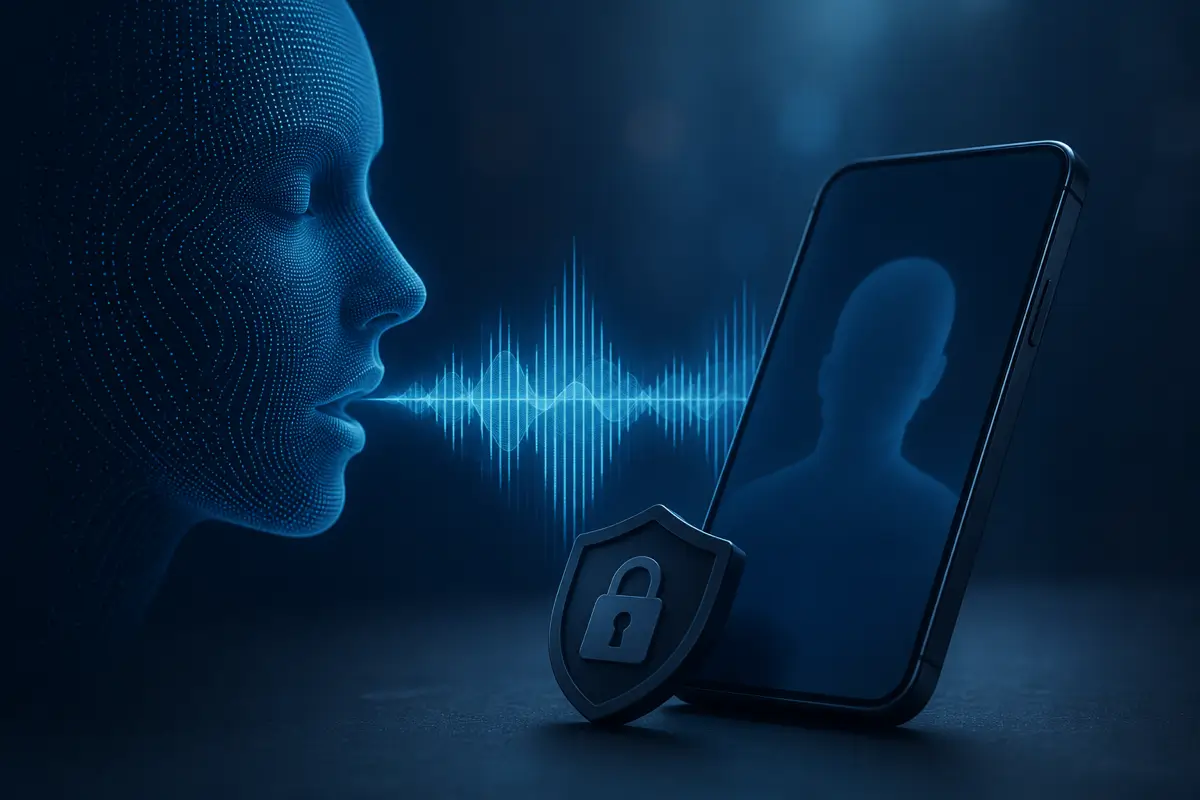
Voice cloning tools require very little source material. Generative AI systems are capable of creating functional voice replicas based on audio samples of just three seconds, which can be obtained from a voicemail, social media video, or recorded phone conversation. Upon the development of the model, the criminals are able to create any utterance using the voice of the victim and a technology that simulates the call ID of a real bank or even a relative and create the illusion of a real conversation.
The financial impact is already measurable. Voice phishing attacks increased 442% during 2025 as generative AI tools became cheaper and easier to access. The FTC logged approximately 250,000 complaints tied to AI voice cloning scams and companies facilitating those schemes in the first quarter of 2026 alone. A figure that’s already impressive is even more so once you realize that regulators describe it as a fraction of actual incidents since many victims do not report the crime. Reported losses per victim average around $12,500, with some cases exceeding $100,000.
Banks are not immune either. In one widely documented 2024 case in Hong Kong, a finance employee authorized a $25 million transfer after a video conference call where a deepfaked chief financial officer and several deepfaked colleagues appeared to approve the transaction. Every participant on that call except the employee was AI-generated. In this case, not just AI voice cloning but also deepfake AI video technology was used. In combination, these two technologies facilitate thousands of social engineering scams, bank impersonation frauds, Ponzi schemes with fake celebrity endorsements, etc.
Why This Scam Works
Traditional phone scams rely on a stranger’s voice sounding urgent or official. But strangers voices are not often perceived as credible. Voice cloning removes that weak point. In situations involving trusted individuals, it is easy for victims to be tricked by fraudsters when they don’t verify what and whom they hear. The common strategy used by fraudsters is to create a situation of urgency such as a money transfer, legal issue, or fraud alert and then press the victim into transferring funds or sharing sensitive information without granting any time for crosschecking.
Warning Signs Of A Cloned-Voice Bank Call
A few red-flag patterns show up consistently across reported cases:
- Unusual urgency. Most finance institutions would not ask for any immediate money transfers or purchase of gift cards to solve an issue.
- Requests for passwords, PINs, or one-time codes. Banks also do not request passwords, PINs, or any one-time codes from customers.
- Pressure to keep the call secret. Scripts that discourage hanging up or calling a family member for a second opinion are a red flag regardless of who the voice belongs to.
- Slightly off audio quality. Even advanced clones can carry a flat tone, odd pacing, or background inconsistencies, though this is becoming less reliable as the technology improves.
- A call that matches a recent public post. Scammers often harvest source audio from content the target or their family has posted publicly.
How To Verify A Call Is Real
The most effective defense is not detecting a fake voice. Truly, the technology got so good, that many of us won’t be able to distinguish. What we can do, however, is verifying identity through a channel the caller cannot control.
- Hang up and call back using a known number. Use the number printed on a bank card or the official banking app, never a number provided during the call itself.
- Set a family verification phrase. A short phrase known only to close family members, required before any emergency financial request, defeats voice cloning regardless of how convincing the audio is.
- Never confirm sensitive details over an inbound call. Legitimate institutions can verify an account without the customer reading back a PIN, password, or one-time code.
- Treat video calls with the same skepticism. Deepfake video tools have advanced alongside voice cloning, so a familiar face on a screen carries the same verification requirement as a familiar voice on a phone.
- Report suspected attempts. Reporting to the bank’s fraud department, the FTC, and the FBI’s Internet Crime Complaint Center helps regulators track the scale of the problem, even when no money changes hands.
What Regulators Are Doing About Voice Cloning Bank Scams
Oversight is beginning to catch up. The US Federal Communications Commission has unanimously classified AI-generated voices used in robocalls as illegal under the Telephone Consumer Protection Act, giving state attorneys general authority to prosecute the networks that carry these calls. Banks and payment networks are also deploying their own AI-based detection systems, though the arms race between fraud tools and fraud detection continues to move quickly in both directions. In late 2025, PaySpace Magazine Global reached out to several industry experts for predictions and here’s what they said:
“Looking ahead to 2026, AI is going to shape both the threat and the defense. Fraudsters will keep using generative and automated tools to scale up attacks and mimic users more convincingly. At the same time, financial institutions will rely on AI models that can read micro-behaviors, detect unusual patterns, and evaluate digital trust in real time. The companies that succeed will be the ones that bring identity, behavior, and device intelligence together into a single, adaptive view of trust.”
Michele Tucci, Chief Strategy Officer and co-founder of Credolab
Bottom Line
AI voice cloning has closed the gap between a stranger’s scam call and one that sounds exactly like someone you know and trust. Add up a sense of urgency, call at a rush hour, unexpected news, and you may end up on scammers’ hook even with all the cybersecurity and tech awareness. The technology is not going away, and audio quality alone is becoming a less reliable signal than, say, couple years ago. A callback to a verified number, a family verification phrase, and a policy of never confirming sensitive information on an inbound call remain the most reliable defenses regardless of how convincing the voice on the other end sounds.
FAQ
What is an AI voice cloning bank scam?
An AI voice cloning bank scam involves offenders utilizing AI technology to reproduce the voice of another person impersonating a bank representative, a relative, or a coworker. The objective is typically to persuade the victim to wire cash, disclose personal account information, or provide one-time passcodes.
How do scammers clone someone’s voice?
Thanks to contemporary AI voice cloning programs, it’s now feasible to produce a convincing imitation in a matter of seconds. Criminals usually collect voice samples from social media videos, voicemail messages, podcasts, and recorded phone conversations to create fake speech in real time or via a prepared speech script.
Can AI really sound like a bank representative?
Certainly. AI technology enables the generation of realistic-sounding voices imitating speech patterns and emotions. When combined with caller ID spoofing, it makes it possible for scammers to place calls making them appear legitimate.
How can I tell if a bank call is fake?
Watch out for red flag signs such as demands for passwords, PIN codes, one-time passwords, or immediate transfers. Authentic banks normally don’t exert pressure on consumers to act at once or prevent them from ending the call and calling back using the official bank number.
What should I do if I receive a suspicious bank call?
Terminate the call and immediately reach out to your financial institution through the number found on the back of your debit or credit card or through the bank’s legitimate app. Do not return the call to the number given in the suspicious call or follow any link sent by the fraudster.
Can AI clone a family member’s voice?
Absolutely. AI can mimic the voice of a close relative or friend if the criminal has obtained enough samples of someone’s voice. In the age of social media, it is not unusual. Hence, the experts in cybersecurity recommend coming up with a family passphrase known only to the closest members of the family in case of unforeseen financial emergencies.
Can banks detect AI voice cloning scams?
Cybersecurity specialists say that financial institutions use AI-based systems to detect fraud by analyzing the behavior of customers and the patterns in transactions, devices, and client authentication signals. Although these systems help prevent fraud, the role of customers is still crucial, as they have to verify suspicious requests on their own.
Is AI voice cloning illegal?
The use of AI-voiced technology for fraudulent purposes is illegal in many countries. In the USA, the communications regulatory authority pointed out that AI-generated voices used in illegal robocalls infringe telephone regulations, enabling law enforcement agencies to take action.
What is the best protection against AI voice cloning bank scams?
The most effective protection is independent verification. Always confirm unexpected financial requests by contacting your bank through an official channel, never share passwords or one-time verification codes during an incoming call, and establish a family verification phrase for emergencies.