The Fintech Revolution Summit in Bahrain took place just a few weeks before the geopolitical landscape in the region shifted dramatically. Just as the summit’s conclusions on where the kingdom stands in a regional fintech race were still circulating among the event attendees, US-Israeli strikes on Iran on February 28, 2026, followed by Iranian retaliatory missile attacks on Bahrain and several other Gulf states, have placed every assumption made at that summit under urgent revision.
Fintech Revolution Summit: Themes and Challenges Addressed
The Fintech Revolution Summit addressed all the pressing issues in modern finance, but three topics dominated the summit’s agenda: regulatory compliance, cybersecurity, and the integration of artificial intelligence (AI) into financial services. These themes were surfacing most often not by accident. They reflect the pressure points of a maturing fintech ecosystem of Bahrain that has moved past the startup excitement of the 2010s and is now confronting the harder work of institutional integration.
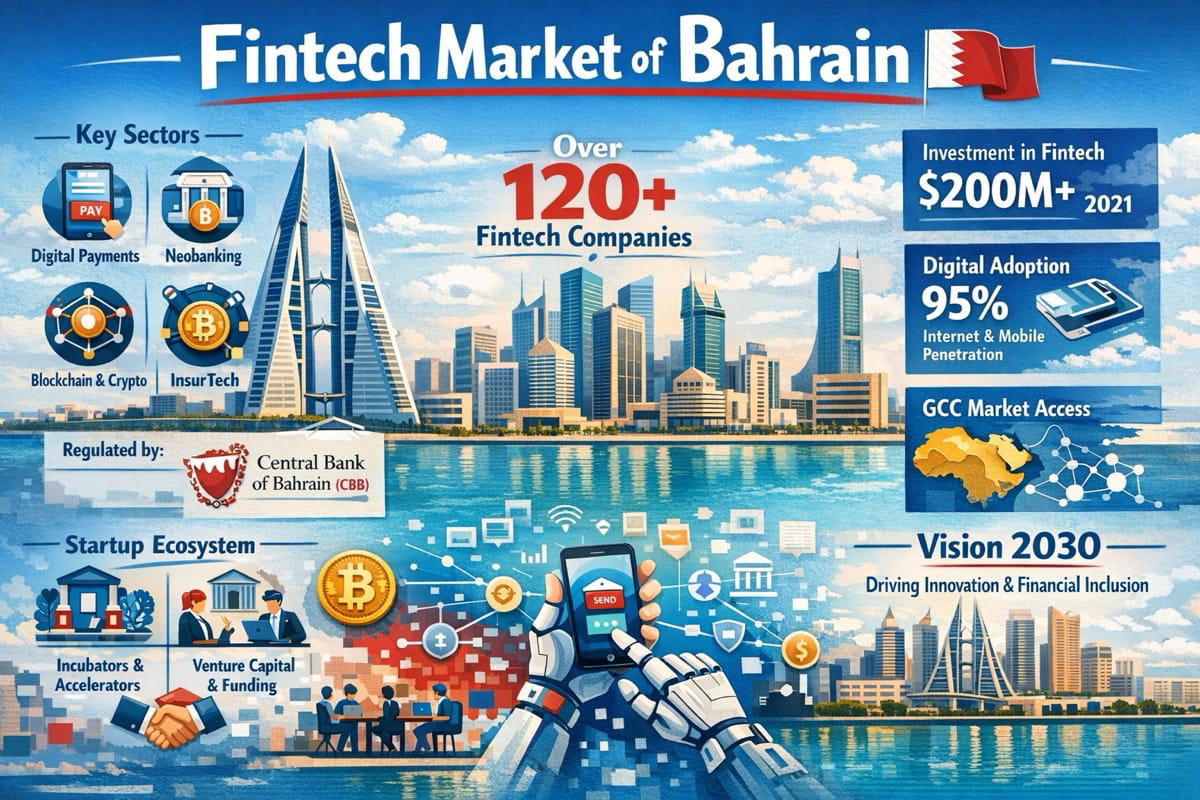
On compliance, speakers acknowledged that the regulatory environment in Bahrain remains one of the most accommodating in the Gulf. The Central Bank of Bahrain’s regulatory sandbox, established earlier than comparable frameworks in neighbouring states, has earned a genuine reputation as a low-friction entry point for foreign fintech companies looking to test products in the region. For early-stage ventures, this still represents a meaningful competitive advantage.
Cybersecurity emerged as a theme with particular urgency, and in retrospect, a kind of prescience given what has followed. Financial infrastructure across the Gulf has long been a high-value target for cyber malefactors, and the sector’s growing reliance on digital rails has widened the attack surface considerably. Summit participants discussed the need for shared threat intelligence frameworks and clearer regulatory expectations around incident disclosure, areas where the regional conversation is still catching up to global standards.
Artificial intelligence drew the predictable mix of enthusiasm and caution. Use cases in fraud detection, credit scoring for the unbanked, and customer service automation were cited repeatedly. The more searching question how AI-driven decisions interact with existing compliance obligations received less satisfying answers, reflecting a challenge the entire industry is still working through globally.
Bahrain’s Fintech Story: How Fintech Pioneer Hub Changed Its Role Over the Years
Understanding the summit’s discussion premises requires some historical context. Bahrain was genuinely ahead of the fintech curve. Before 2011, it functioned as the Gulf’s de facto financial hub — a role reinforced by a long tradition of offshore banking, a relatively open economy by regional standards, and proximity to Saudi Arabia’s vast consumer base. The Central Bank of Bahrain was licensing and regulating financial institutions when most of its neighbours were still building the institutions to do so.
Then Dubai accelerated. The Dubai International Financial Centre offered a common law jurisdiction, a larger talent pool, a more developed logistics and connectivity infrastructure, and the sheer gravitational pull of a city that had positioned itself as a global node. By the mid-2010s, the fintech conversation in the region had largely shifted northward across the Gulf. Abu Dhabi entered the race with the Abu Dhabi Global Market, adding another competitor with deep pockets and an aggressive licensing strategy.
Bahrain’s response has been to double down on what it can offer that its larger rivals cannot easily replicate: speed, accessibility, and regulatory intimacy. For a startup that cannot afford to wait eighteen months for a licence or spend two years navigating a bureaucracy built for global banks, Bahrain’s streamlined approach has real value. The kingdom has also cultivated a fintech community infrastructure with incubators, accelerators, and industry associations that punches far above its weight for a country of a small size.
The main problem is that the country’s size itself is the binding constraint for its fintech growth. Bahrain’s domestic market of roughly 1.5 million citizens is simply not large enough to sustain a fintech ecosystem of meaningful scale on its own. The country also has one of the highest bank-per-capita ratios in the region, meaning that any fintech targeting deposit-taking, lending, or payments is entering a highly competitive market where incumbent financial institutions are deeply embedded and well-resourced. Innovation in this environment tends to be incremental rather than disruptive, and the path to profitability for a domestic-focused fintech is genuinely difficult.
The combination of a favourable regulatory environment with a crowded, small market has produced a pattern where Bahrain functions more as a fintech launchpad than the ultimate destination. Nevertheless, this is an important role in fintech ecosystem as well. Bahrain is the market where most fintech innovations in the region start from scratch. Let’s recall that it was the National Bank of Bahrain (NBB) that introduced a Bitcoin-linked Structured Investment for accredited investors – the first offering of a kind in the Cooperation Council for the Arab States of the Gulf (GCC) region in 2024. Companies establish here, test their products, build a compliance track record, and then pursue growth in the broader GCC. That model has value, though it means Bahrain captures less of the long-term economic upside than its early fintech investment might have warranted.
How the New Military Actions in the Region Change the Agenda
The events of the last several days have introduced a category of risk that no fintech summit agenda can adequately prepare for. On February 28, US and Israeli forces conducted coordinated strikes on Iran. On March 1, Iran retaliated with missiles and drones targeting Bahrain alongside several other Gulf states that host US military facilities. Bahrain, home to the US Navy’s Fifth Fleet headquarters, was a direct target. By March 2, the moment of writing, flights to and from Bahrain International Airport remain cancelled, the Strait of Hormuz may not be closed on paper but is clossed for vessel passage in practice while many insurers also plan to withdraw coverage of war risks for vessels entering the Persian Gulf, and the kingdom is simultaneously managing the aftermath of physical strikes and the acute uncertainty of not knowing whether a broader escalation is coming.
The immediate economic consequences are already visible. Foreign direct investment into the Gulf region had already begun to soften in the second half of 2025 as tensions in the area rose, and the current escalation will presumably accelerate that caution sharply. The factual closure of the Strait of Hormuz, a narrow channel on Iran’s southern border that connects the Persian Gulf with the Gulf of Oman, even temporarily will surely have implications for global energy markets that ripple well beyond the Gulf, but the local effect on confidence and capital flows will be felt immediately and acutely in Bahrain given the kingdom’s dependence on petrochemical revenues to fund public spending.
For the fintech sector specifically, the risks crystallise around several vectors. First, the cybersecurity threat environment has deteriorated materially overnight. Iran has a well-documented history of deploying offensive cyber capabilities against financial infrastructure in adversarial or rival states, and Bahrain’s designation as a direct strike target places its financial sector on a heightened alert footing that may persist for months regardless of how the military situation resolves. The summit’s cybersecurity discussions, which may have felt somewhat academic a week ago, have acquired immediate operational relevance today.
Second, the talent and capital pipelines that Bahrain’s fintech ecosystem depends on are vulnerable to the kind of sustained uncertainty this conflict generates. International founders and investors making location decisions tend to price in stability as a baseline requirement. A kingdom that is actively receiving missile strikes faces a confidence deficit that will take considerable time to rebuild after the military situation stabilises. The advantage Bahrain holds as a regulatory safe haven diminishes substantially if the physical security environment is perceived as unreliable.
Third, Bahrain’s strategic positioning as a gateway to the Saudi market depends on the broader Gulf remaining functionally integrated. If the conflict disrupts regional connectivity through airspace closures, supply chain interruptions, or the retreat of multinational firms from the region, the logic of using Bahrain as a regional hub becomes harder to sustain. Hopefully, that won’t happen, but one should be prepared for all kinds of different scenarios in modern world full of unpredictable geopolitical events.
What Does It Mean in the Long Term?
None of this means Bahrain’s fintech story ends or pauses here. The kingdom has navigated regional instability before, and its regulatory infrastructure and accumulated institutional knowledge do not disappear because of another geopolitical shock. If the military situation de-escalates quickly and the Strait of Hormuz reopens so ships that carry crude, liquified natural gas and oil products may continue their planned trade voyages, the damage may prove containable.
But the summit’s underlying message that Bahrain must work harder than its rivals to attract and retain fintech activity given its structural size constraints becomes even more pressing in a conflict environment. The kingdom’s pitch to the fintech world has always rested on the argument that its compensating advantages outweigh its limitations. That argument just got harder to make, but to be fair, not only for Bahrain but also for the wider Gulf region.
The fintech executives who gathered at the summit were wrestling with questions of compliance architecture and AI governance. The questions they face this week are much more fundamental: whether the environment in which they have built their businesses remains stable enough to plan around, and what it would take to restore the confidence that Bahrain’s fintech ecosystem spent more than a decade carefully constructing.