Choosing a payment solution for a SaaS company is quite different than the same process for, let’s say, an e-commerce retailer. What retailer typically needs to do is to accept a single payment at checkout. A SaaS business, meanwhile, must charge customers on a recurring schedule. It immediately complicates things with handling upgrades and downgrades mid-cycle, urgent need to retry failed charges intelligently, etc. SaaS businesses also need to recognize revenue across multiple periods and stay compliant with sales tax law in dozens of jurisdictions. And all that happens simultaneously.
Besides the fact, that it’s technically difficult to perform, the gap between expected efficiency of SaaS payment solution and reality of it shows up directly in revenue terms. According to Recurly’s analysis published in January 2024, failed payments alone could have costed subscription businesses an estimated $129 billion in 2025 globally. The software sector recovered over $155 million of that lost revenue in 2025 through smart recovery tooling. On one hand, that gives businesses hope, meaning the money is there to reclaim, but, on the other hand, it is true only for companies with the right infrastructure in place.
This practical guide here maps the current landscape of SaaS payment solutions, explains what distinguishes them from generic payment gateways, and outlines the criteria that matter most when evaluating your options in 2026.
Market Meaning Is Best Seen in Context: Why Payment Infrastructure Has Become Strategic
There are several aspects of the modern business landscape that shift payment solution choice from mere practical tool to strategic decision that defines SaaS model success.
The SaaS market is large and it is growing fast
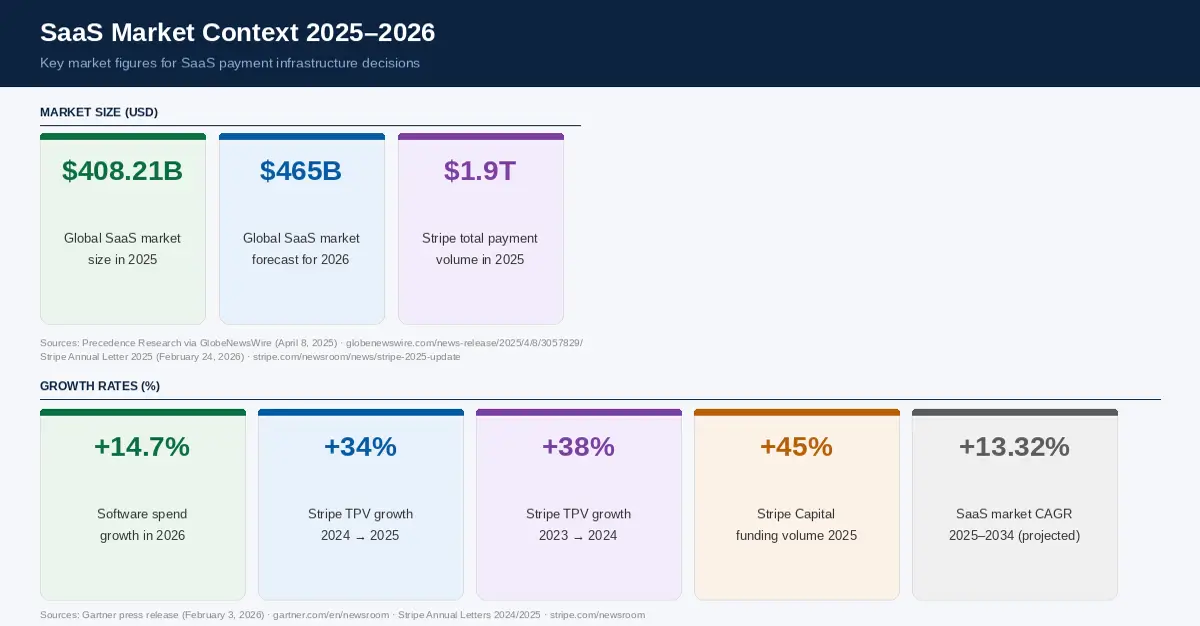
The global SaaS market reached $408.21 billion in 2025, according to Precedence Research, and is projected to grow to approximately $465 billion in 2026, continuing to expand at a compound annual growth rate of 13.32% through 2034. To get you into even more context, let’s also recall Gartner’s February 2026 forecast, which put software spending growth at 14.7% for 2026, the fastest-growing category in worldwide IT spending.
Stripe’s 2025 Annual Letter, published in February 2026, also provides a ground-level view of this growth. Although not a purely SaaS business itself, as a payment provider Stripe powers many SaaS companies that rely heavily on online payments and recurring billing platforms for their subscriptions. Thus, businesses running on Stripe generated $1.9 trillion in total payment volume in 2025, up 34% from $1.4 trillion registered on same criteria in 2024. This volume is equivalent to roughly 1.6% of global GDP. Stripe now powers more than 5 million businesses, including 90% of the Dow Jones Industrial Average and 80% of the Nasdaq 100. Many of them also rely on software-as-a-service for profit.
Pricing models are becoming more complex
Today, SaaS businesses are evolving, using different methods of payment. The subscription-only pricing model that defined early SaaS is no longer the default or the only viable opportunity. According to Chargebee’s 2025 State of Subscriptions and Revenue Growth Report, 43% of companies now combine subscriptions with usage-based pricing in hybrid models. This shift is significant for payment infrastructure required. If once a billing system designed only for flat monthly fees was enough, today it will break under the weight of metered usage, credit-based consumption, or tiered overages.
The fastest-growing SaaS segment is AI companies. They are not only growing but getting profitable at un precedented scale. According to Stripe’s 2024 Annual Letter (published February 2025), the top 100 AI startups on the platform are reaching $5 million in annualized recurring revenue 13 months faster than comparable SaaS companies did in 2018. These companies monetize expertise and tech through token usage, API calls, and compute consumption. Those models require billing infrastructure built for high-frequency metered events rather than fixed seat fees.
SaaS market in perspective
The Hidden Revenue Problem Reflects in Failed Payments and Involuntary Churn
Before evaluating any billing platform, SaaS leaders need to understand the scale of the problem they are trying to solve with new payment solution. Strange as it may sound, it is the failed payments, not voluntary service cancellations, that are often the single largest source of subscriber loss.
The scale of involuntary churn
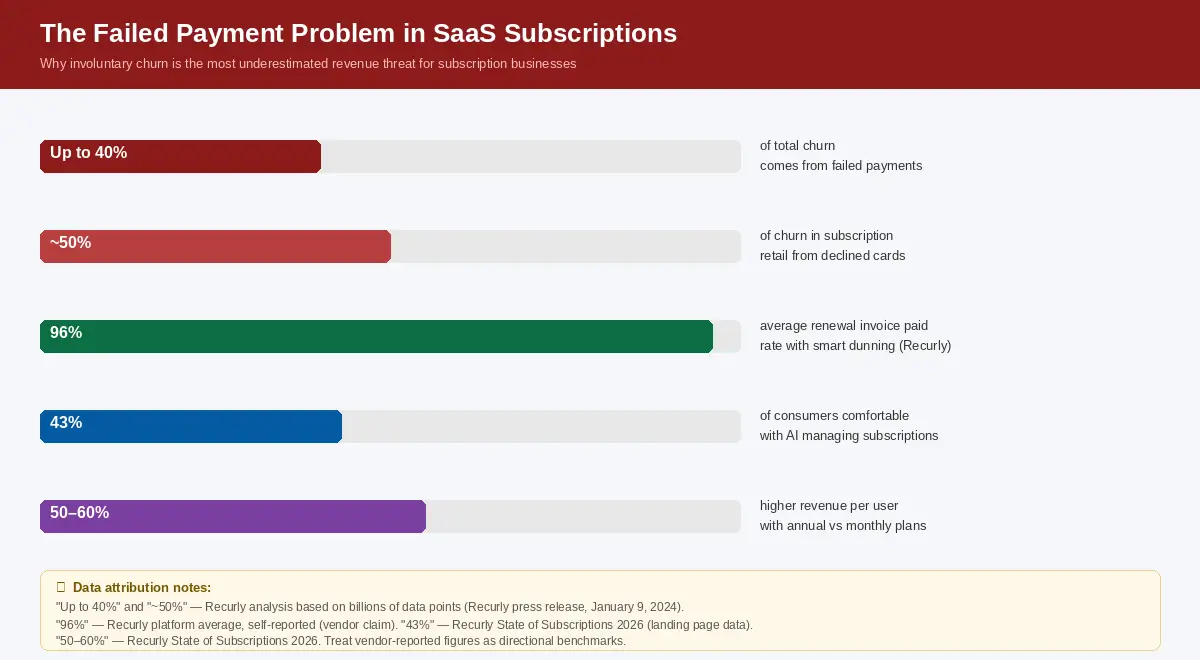
Involuntary churn occurs when a subscription payment fails due to a technical reason, i.e. an expired card, insufficient funds decline, a gateway timeout, or one of roughly 2,000 other failure codes documented by billing platforms. As mentioned above, Recurly estimated that inadequate churn management could cost subscription businesses $129 billion in 2025, derived from their analysis of billions of recurring payment data points.
What smart dunning delivers
Dunning refers to a set of strategies billing system uses after a payment fails.These include automated retry schedules, customer notifications, card updater services, and fallback payment methods. The difference between naive dunning (retry on day 3, cancel on day 7) and intelligent dunning (ML-optimized retry timing based on decline reason, card type, and customer history) is defining for the business success.
When dunning is managed properly, invoice paid rates gets a significant boost. Additionally, the 2026 State of Subscriptions report indicates that top SaaS performers brought up a 337% increase in subscription pause usage. By giving customers an alternative to cancellation, they directly reduced involuntary churn and preserved customer loyalty.
Annual billing plans also demand special attention from the payment solution providers. Though, sccording to Recurly’s 2026 State of Subscriptions, annual plans generate 50–60% higher revenue per user compared to monthly plans, they also carry higher renewal risk and smarter dunning tactics (including those managed by AI) when the annual charge arrives.
Failed payments pose significant problem to SaaS subscriptions
SaaS Payment Solution & Standard Gateway: What’s the Difference?
Standard payment gateways process a transaction. A SaaS billing platform manages the entire revenue lifecycle instead. The distinction matters when evaluating vendors: a company that outgrows its billing system will face months of engineering work migrating to something more capable, often at exactly the wrong moment in its growth.
At the same time, do not pay attention only to the marketing name of the solution. Today, payment gateways are increasingly evolving into payment orchestration platforms. The number of businesses using payment orchestration is growing by 19-25% each year. Orchestration functionality helps gateways to evolve from a single-function payment tool to a flexible, intelligent superapp — a central platform where businesses and users interact with multiple financial functions, from e-commerce to embedded banking, under one login or API.
Subscription lifecycle management
This is the core function that differentiates a billing platform from a single-function payment gateway and that SaaS businesses desperately need. Subscription lifecycle management covers:
- creating and modifying subscription plans;
- handling proration when customers upgrade or downgrade mid-cycle;
- managing trial periods and conversions;
- processing pauses and reactivations;
- and generating accurate invoices for each state change.
The complexity scales quickly as a business adds pricing tiers, add-ons, and customer-specific contracts. The platform you’re looking for need to be flexible to meet those changes with flying colours.
Usage-based billing
For AI companies, developer tools, communication APIs, and other types of products driven by consumption patterns, the billing system must track and analyse usage events in real time, aggregate them accurately over the billing period, figure out the correct pricing tier to apply, and generate a final invoice based on all this data. This requires event ingestion pipelines, metering infrastructure, and the system’s ability to handle high-frequency events. Those capabilities often sit outside a standard payment gateway offering.
Global tax compliance
SaaS products sold globally face fragmented landscape of sales tax, VAT, and GST obligations that are not only different in different country but also change constantly. Stripe Tax, Chargebee’s built-in tax automation, and Paddle’s Merchant of Record model, as popular solution examples, each address this differently. If you are selling services in multiple regions (which is what the vast majority of moder cloud-native SaaS businesses, not restricted by physical selling premises, does) the key question is: whether the platform responsible for your financial flows automatically calculate, collect, and remit the correct tax in every jurisdiction where you sell, or does this remain your team’s responsibility?
Merchant of Record (MoR) solutions take the most comprehensive approach to taxation. The MoR vendor legally becomes the seller of record, absorbing the full tax compliance obligation for its client businesses. This substantially reduces complexity for SaaS companies selling globally, though it typically comes with less flexibility in checkout customization compared to self-managed solutions.
Revenue recognition
Under ASC 606 (US GAAP) and IFRS 15 (international standard), subscription revenue must be recognized over the period of service delivery, not at the point of payment. For a SaaS company accepting annual prepayments, this means recognizing 1/12th of the contract value each month. Automating this correctly and producing audit-ready documentation requires dedicated revenue recognition functionality that billing platforms provide and generic payment gateways often do not.
Local payment methods and checkout conversion
Checkout conversion is a direct revenue driver. Paddle’s internal data, published in a blog post this March, shows that offering local payment methods increases SaaS checkout conversion from 4.3% to 6.5%. The same data indicates that companies offering local currencies see 25% more conversions on average, with lifts of 5-10% in specific markets like Germany and France.
The Three Categories of Best SaaS Payment Solutions in 2026
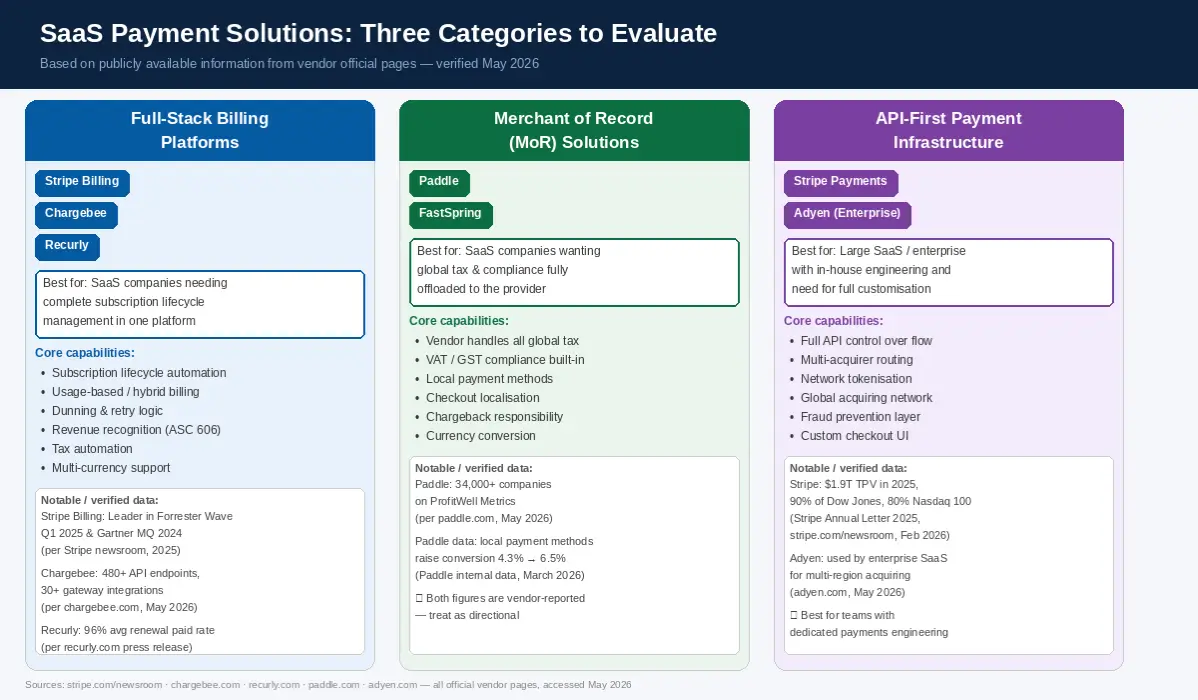
SaaS payment solutions in 2026 fall into three main categories. Each is not perfect and presents a different set of trade-offs between comprehensiveness, control, and operational overhead. There is no single solution that offers “one-size-fits-all” approach to SaaS payments. But that’s actually not a bad thing, since there’s also no single existing SaaS strategy and every business is unique. The right choice of SaaS payment solution depends on your team’s engineering capacity, your pricing model complexity, and your geographic footprint.
Full-stack billing platforms
Full-stack billing platforms manage whole subscription revenue lifecycle from plan creation and checkout, which is just the beginning of a payment path, through invoicing, dunning, revenue recognition, and finally reporting. They integrate with multiple payment gateways and typically handle multi-currency payments, tax automation, and analytics out of the box.
Stripe Billing is the most widely deployed example. According to the corporate data, Stripe Billing is used by more than 300,000 companies and manages nearly 200 million active subscriptions. Stripe Billing passed a $500 million revenue run rate as of early 2025, while the broader Revenue suite, comprising Billing, Invoicing, and Tax, is now on track to reach a $1 billion annual run rate. Stripe Billing also has industry recognition, including mentions in The Forrester Wave: Recurring Billing Solutions and the Gartner Magic Quadrant for Recurring Billing Applications.
When a business moves to a well-optimized billing platform, it can be felt in specific positive customer outcomes. For instance, Forbes saw a 23% uplift in subscription revenue in the six months following its move to Stripe Billing; Intercom increased conversion by 2.1% after switching; and Turo captured an additional $114 million in annual revenue through Stripe’s Optimized Checkout Suite (per company’s data).
Chargebee also offers a comparable full-stack platform. This one has particular depth in enterprise billing complexity like CPQ (Configure, Price, Quote) workflows, entitlement management, and ASC 606/IFRS 15 revenue recognition. Per its official product page, Chargebee supports 30+ payment gateways and offers 480+ API endpoints. It is mainly positioned for B2B SaaS companies moving upmarket into sales-assisted and enterprise motions.
Meanwhile, Recurly focuses specifically on the subscription and revenue recovery layer. The firm publishes industry benchmarks for churn, payment decline rates, and recovery performance. Its 2026 State of Subscriptions report is one of the more substantive free industry benchmark resources available in the subscription space. Therefore, many customers choose its data-driven approach, assuming that those loads of actionable insights must certainly be used for practical improvements of the company’s end-to-end recurring revenue management solution.
Merchant of Record (MoR) solutions
Merchant of Record model is notable for businesses since it allows the payment vendor to legally become the seller of record for all transactions. This means the vendor, not business itself, is responsible for collecting and remitting sales tax, VAT, GST, or other applicable tax charges in every jurisdiction where your customers purchase.
For SaaS companies selling globally without a dedicated tax and legal team, this is the most operationally simple approach to global compliance. Of course, such a duty-free position doesn’t come without its pitfalls. The main tradeoff of MoR model is that you, as a business, give up a meaningful amount of control, margin, and direct ownership of the customer relationship. Payment solution provider largely decides on checkout customization, payment method selection, and dispute management. Though businesses may have a say in those aspects, but their influence is limited to set extent compared to a self-managed billing setup.
Paddle is the most widely used MoR solution purpose-built for SaaS and digital products. It serves as Merchant of Record for digital product businesses across over 200 countries and territories. More than 34,000 companies use Paddle’s ProfitWell Metrics analytics product too. Such platforms may be especially suitable for companies at early and mid-stage growth that prioritize simplicity over control. Bigger companies with bigger budgets for personalized self-managed solutions and large dedicated internal teams may choose otherwise.
API-first payment infrastructure
For large-scale SaaS enterprises of the type described above, API-first infrastructure offers maximum flexibility. Instead of accepting the trade-offs embedded in a full-stack platform or MoR, these companies build their own billing logic on top of core payment processing APIs. They are free to combine multiple providers for different functions, which might be a great option since large businesses typically have different departments with inconsistent or even contradictory payment flow management needs.
Stripe Payments (not to be confused with Stripe Billing) is the most widely deployed example of API-first payment platform. Adyen, that serves enterprise merchants across 35+ currencies and supports over 250 payment methods globally, is another popular option for enterprise SaaS with multi-region acquiring needs. Adyen’s Unified Commerce platform serves as a single integration layer for online, in-app, and in-person payments. It has direct acquiring licenses in multiple regions, basically eliminating intermediary processors involved in the process. Therefore, Adyen provides business customers greater control over routing and authorization optimization.
The downside for greater control is simple: more money. API-first approach requires significant in-house engineering investment. You don’t outsource your payment management. You own it, so be ready to pay the people who are going to maintain tech and legal aspects with your individual corporate vision in mind. Period. The billing logic, revenue recognition, dunning, and tax compliance that full-stack platforms handle automatically must be built and maintained by your own team. This is the right trade-off for companies at scale that need specific customizations. But for companies at early or mid-stage growth where engineering time is better spent on product choosing such a solution might turn into an unsustainable financial burden.
Three categories of SaaS payment solutions compared
Five Questions You Should Ask Before Choosing a SaaS Payment Solution
The payment vendor landscape is very much crowded with big brand names and smaller challengers and every platform claims to handle everything. These five questions will help you find the one based on what matters most to your particular business.
1. Does this platform support your current and future pricing model?
If you are on flat subscriptions today but expect to move to usage-based or hybrid pricing, ask specifically how the platform handles metered events: What is the ingestion latency? How are billing periods closed? What happens when a customer exceeds a tier mid-cycle? A platform that cannot handle usage-based billing will require a full migration when your pricing evolves. The one that handles both variants can remain your partner through different growth stages. Think twice if you need an extra stress of platform transition when you scale into uncharted territory.
2. What is the retry logic, and is it static or adaptive?
Static retry logic recovers just a fraction of what adaptive ML-based retry logic achieves. For some businesses, it would be enough, for others low recovery rates translate to lost billions. Ask vendors to explain specifically how their retry engine works: does it vary timing by decline reason? By card type? By customer tenure? Request data on their average recovery rate by decline category. Project those calculations on your own business scale. Is the potential lost sales rate affordable in your use case?
3. How does tax compliance work in your key markets — and who is liable?
This question reveals the fundamental MoR vs. self-managed distinction. Understand exactly which party bears the tax liability in each of your target markets, and what happens if a tax authority audits a past period. Think of what it would cost your team to manage taxes on their own in terms of time and money. Weigh the tradeoffs between legal simplicity and less control over the billing aspects carefully.
4. Can you show us conversion data for our specific geography?
General conversion benchmarks are good, but often less useful than data specific to your customer location profile. Ask vendors what payment methods are available in your top markets, what their checkout conversion rates are for those markets, and whether they support local currency pricing.
5. How does revenue recognition work, and what does the audit trail look like?
For any company that may seek investment or eventually pursue an IPO, having clean, ASC 606-compliant revenue recognition from early stage is quite valuable. Ask vendors to walk you through how they handle the most complex scenarios in your model: multi-element arrangements, variable consideration, contract modifications. Request sample audit documentation.
Conclusion
When selecting a SaaS payment provider in 2026, it’s much more than just processing payments. This strategic decision impacts revenue recovery, international expansion, pricing flexibility, compliance and the long-term viability of your business. As subscription pricing continues to evolve from pure subscription pricing to hybrid and usage-based pricing, the actual payment infrastructure becomes increasingly impactful to business success.
There’s no “one size fits all” solution when it comes to selecting a SaaS payment provider. There are three basic types of providers: full-stack billing, which simplifies operations and drives business growth; Merchant of Record, which alleviates compliance requirements for selling internationally; and API-first provider, enabling enterprise customers to have full control and customization with their payment solution. Each of these three payment offering types come with tradeoffs in terms of simplicity, flexibility, operational costs and transactional costs.
It’s important to understand where your company is now and where you plan to grow over the next few years before deciding on which payment provider to go with. Companies that evaluate payment infrastructure solely based on current needs will likely experience costly migration to another payment provider later. Companies that take a strategic approach to billing throughout the entire organization are in a better position to minimize involuntary churn, improve conversion rates at checkout, accommodate changing pricing strategies and later expand their global business through fewer operational limitations.