Visa and Mastercard work almost everywhere, yet launching a card program in a new country still means starting from scratch, even as the card becomes the base for everything companies build on top of it.
Every new market brings its own issuing bank, local processors, KYC rules, card logistics and dispute handling, so companies that expand internationally, often end up rebuilding the same program country by country.
Abdul Assal, General Manager of Pomelo Global Card, argues that the real barrier to globalizing cards is fragmentation, not technology. In this interview with PaySpace Magazine, he explains how Pomelo’s Global Card lets businesses launch Visa and Mastercard programs in 150+ countries through a single integration, funded in dollars and stablecoins. He also covers how local payment habits, regulation and banking systems shape global programs, why digital wallets sit on top of cards rather than replacing them, and where the next wave of issuing innovation will come from.
Is card infrastructure truly global today, and are there technical barriers that still prevent its globalization?
Card networks are global. Card programs are not. Visa and Mastercard work everywhere, but launching a program in a new country means dealing with a different set of local pieces: a licensed issuing bank or BIN sponsor, local processors, regulation and KYC rules, local payment rails, card production and logistics, and fraud and dispute handling. Most of these are tied to the country, so a company that expands usually ends up integrating and operating the same program again in each market.
The barriers are less about what the technology can do and more about fragmentation. There are different providers, different APIs, different compliance requirements and different operating models in every country, and each one adds time and cost to every launch.
That’s the gap Pomelo focuses on. We give clients one integration and one platform to launch, operate and scale card programs across multiple countries. They don’t have to rebuild the stack in each market.
What are the biggest challenges companies face when expanding card issuing and processing beyond their home markets?
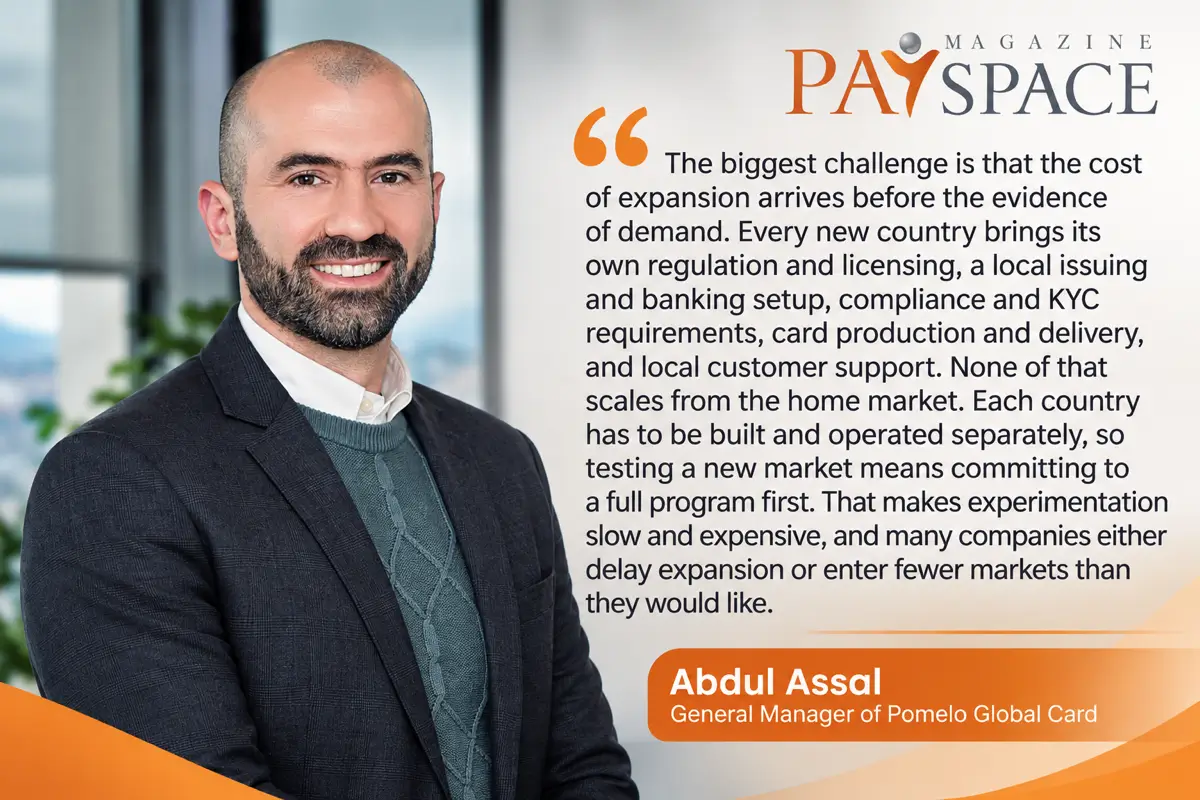
The biggest challenge is that the cost of expansion arrives before the evidence of demand. Every new country brings its own regulation and licensing, a local issuing and banking setup, compliance and KYC requirements, card production and delivery, and local customer support. None of that scales from the home market. Each country has to be built and operated separately, so testing a new market means committing to a full program first.
That makes experimentation slow and expensive, and many companies either delay expansion or enter fewer markets than they would like.
That’s what we built Pomelo to change. With one integration, a company can issue cards across 150+ countries while we handle operations, compliance and regulation. They can test a market, see if there’s demand, and scale from there, without setting up a local entity or infrastructure in each country.
How does your new product, Pomelo Global Card, change the way businesses launch card programmes across multiple countries?
Before, launching a card program in a new country meant standing up a separate setup there: local issuing, regulation, compliance, operations. Each launch was its own project. Global Card changes that. With a single integration, a company can launch Visa and Mastercard cards in 150+ countries, and we run the operation behind them: issuing, processing, compliance, fraud and chargebacks.
Because the cards are native to dollars and stablecoins, clients don’t need to set up local currency accounts or funding in each market. They can fund in the currency they already use.
The practical result is that a company can issue globally from day one, with no local entities or infrastructure. Expansion becomes a configuration decision instead of a new build, so teams can spend their time on the product and on their customers.
How do local payment habits, regulations and banking systems affect global card programmes?
Each of the three changes how a program has to work. Payment habits decide which products succeed: in some markets people rely on installments or on cash and bank transfers (as example Pix in Brazil, UPI in India, Bre-B and still cash in Colombia), while in others cards are the default, so acceptance and usage can look very different from one country to the next. Regulation sets the rules for who can issue, how customers are verified, and what monitoring and reporting are required. Banking systems determine how funds move: local rails, settlement times, and who is allowed to hold or move money.
Operating across Latin America has shown us that a program only works if it respects those local realities. That’s why monitoring, KYC/KYB and compliance are part of how we operate, not an add-on.
A global model also involves trade-offs, such as less customization at the market level. The right balance depends on the company’s stage and strategy: a single global program is a fast way to enter and test many markets, and companies can add local depth in the markets where they scale.
As digital wallets gain ground, what roles will physical and virtual cards play in the future of payments?
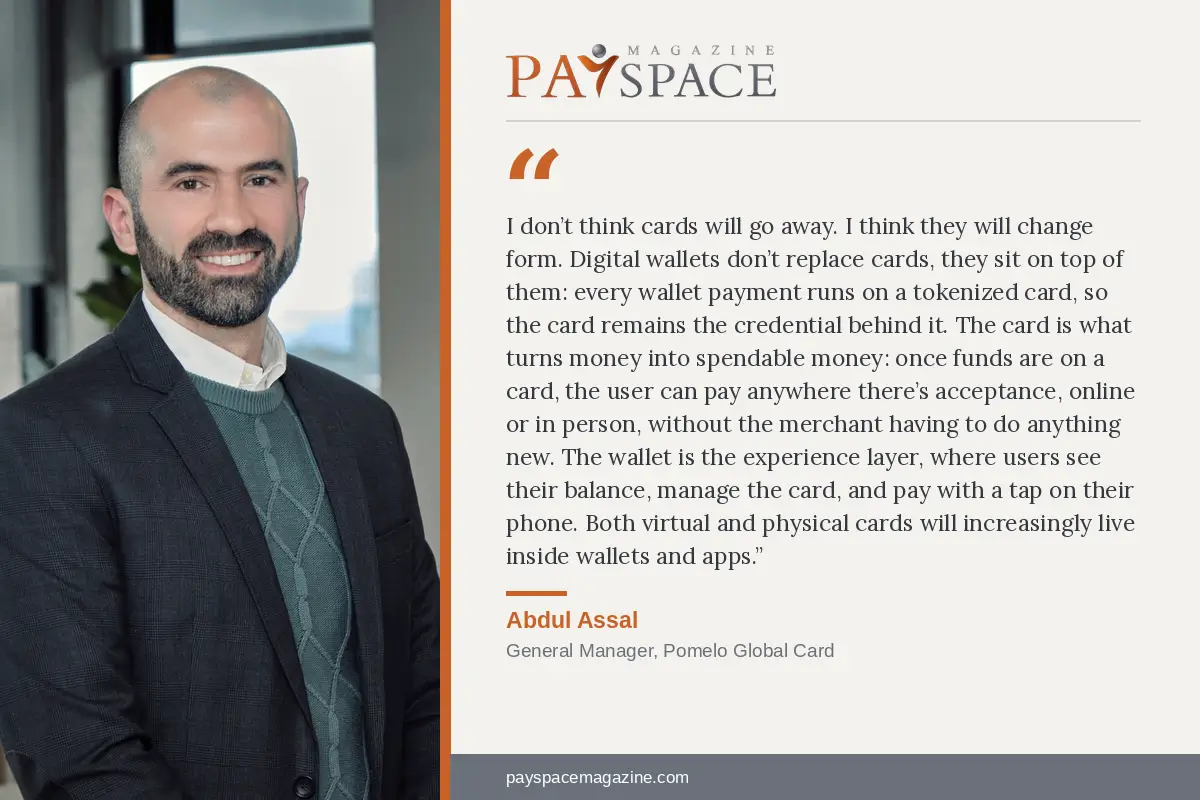
I don’t think cards will go away. I think they will change form. Digital wallets don’t replace cards, they sit on top of them: every wallet payment runs on a tokenized card, so the card remains the credential behind it.
What changes is how cards are used. Virtual cards, which can be issued instantly and for a specific purpose, will keep growing for things like online spending, subscriptions, and business expenses. Physical cards will matter less as the primary way to pay, but they’ll still have a role as a backup, for example when a phone runs out of battery or a merchant doesn’t accept wallet payments. And they’ll remain a tangible part of a brand’s offer. Both will increasingly live inside wallets and apps.
That’s why tokenization and wallet capabilities are part of the platform we build at Pomelo, not a separate layer. When the card is the credential, the issuer has to support every way a customer might want to use it.
In embedded finance, what distinct roles do cards and digital wallets play in the customer payment journey?
They play different roles in the journey. The card is what turns money into spendable money: once funds are on a card, the user can pay anywhere there’s acceptance, online or in person, without the merchant having to do anything new. The wallet is the experience layer, where users see their balance, manage the card, and pay with a tap on their phone.
We see this across the platforms we work with. A payroll platform can let workers spend their salary the day they’re paid, a remittance platform can make received money usable immediately, and a spend management platform can give employees cards with controls. The pattern is the same each time: the card makes the money ready to use, and the wallet makes using it seamless.
When a non-financial business integrates financial services, how should it decide whether to offer a card, a digital wallet, or both?
Start with the business model and the job the money has to do for the user. A few questions help. Where do users need to spend: online, in person, domestically or across borders? How often do they use the money, and how quickly do they need it? And how much of the experience does the business want to own? Do they need a tool that makes their dollar assets spendable?
If users need to spend in many places or in other countries, a card is the foundation, because it works wherever there’s acceptance. A wallet then adds convenience and a smoother experience, like paying with a tap, managing the card, and seeing balances. A business whose users only spend within its own app might not need a card at first.
In our conversations with clients, the answer usually ends up being both, but not necessarily on day one. That’s why we think of cards, tokenization and wallets as one modular platform: companies can launch with a card and add wallet capabilities as their users and needs grow.
What trade-offs do businesses face when choosing between a single global infrastructure provider and multiple local partners?
The trade-off is depth against reach. Local partners give businesses more customization and tighter integration with national payment systems, which matters in a market where they want to compete deeply. But each partner covers one country, so every new market means another contract, another integration, and another set of compliance and reconciliation processes, and complexity grows with each one.
A single global provider offers faster time to market and multi-country operations through one integration. The trade-offs are less room for market-level customization and more dependence on one vendor.
A useful way to decide is by stage. A company that is consolidating a market it already knows may benefit from local depth. A company exploring several new markets usually gets more from the speed and simplicity of one integration. That’s why at Pomelo we offer both local and global programs.
As card infrastructure becomes more accessible globally, where do you see the next major opportunities for innovation in issuing and processing?
I see three main areas. The first is stablecoin-native cards and settlement. Cards that can be funded and settled in stablecoins reduce the time and cost of moving money across borders, require less working capital for pre-funding and let users spend balances they already hold.
The second is new use cases built on instant, spendable money. Payroll, creator payouts, remittances and spend management all benefit when money can be used the moment it arrives, instead of waiting to be transferred and withdrawn.
The third is modularity. As issuing and processing become easier to access, the advantage moves to what companies build on top: credit, RTP, loyalty, fraud prevention and other capabilities they can add as they grow. The card stops being just a payment method and becomes the base of a financial product.
That’s the direction we’re building toward at Pomelo, so that any company can launch a card product globally and spend its time on what it adds, not on the infrastructure underneath.
- Stablecoin payments often work better for one party than the other. Wesley Rios asks how payment providers can make the arrangement worthwhile for both the payer and the recipient.
- We debunk the 5 most common myths which may prevent you from using contactless payments.
- Consumers trust payment systems that work in a familiar way, irrespective of gateway, payment method, or digital wallet, says Rahul Jain, CEO and co-founder of Peach Payments.
- A business might have sophisticated AI tools for detecting unusual transactions, but if a fraudster has successfully changed a supplier’s bank details in its system, the payment could still appear perfectly legitimate. This is why data quality has to be the foundation of financial automation.