As businesses race to automate more of their finance operations, Sis ID’s GM for Europe, Patrice Bouexel, argues that one fundamental problem is being overlooked: AI and automation are only as reliable as the financial data they are acting on.
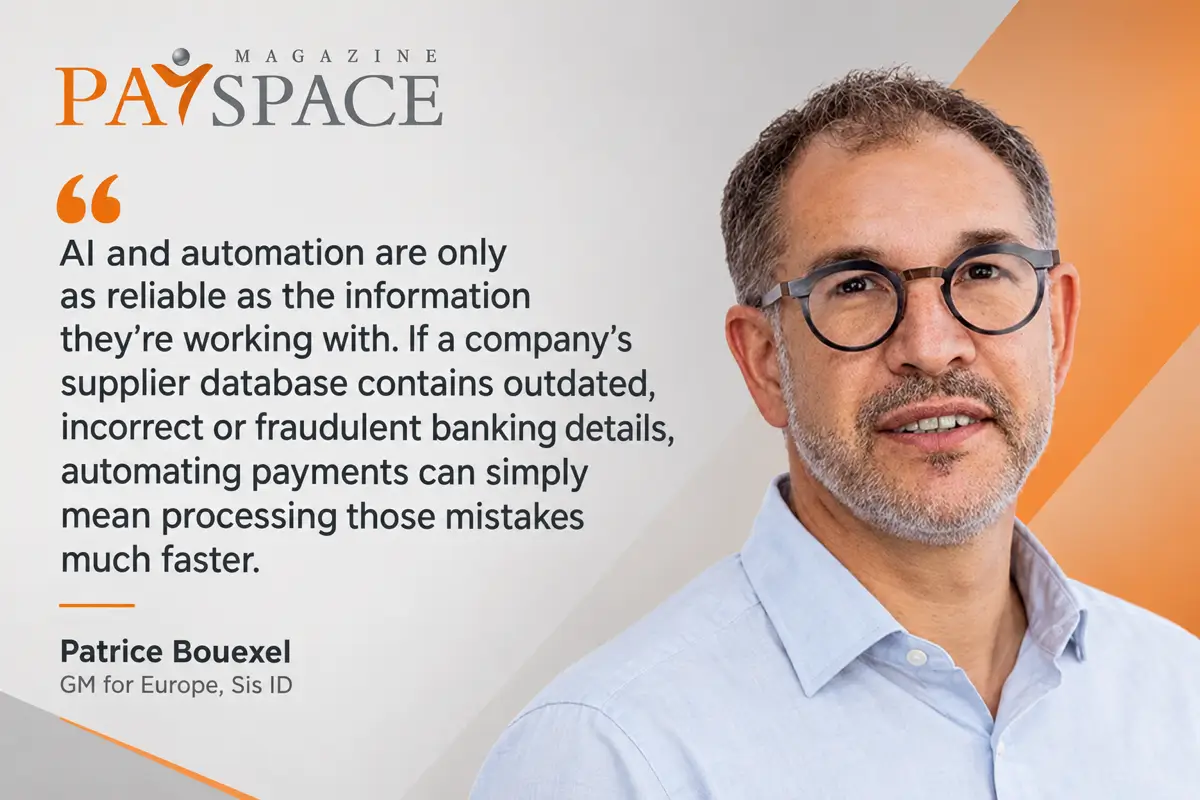
In this interview, the General Manager of a French fintech company Sis ID that focuses on fraud prevention, Patrice Bouexel explains how sophisticated AI tools impact both businesses and criminal groups. He also explores the notions of collective intelligence, crucial role of data in preventive activities, and why businesses shouldn’t mistake regulatory compliance for complete protection against fraud.
Why is payment fraud becoming harder for businesses to prevent?
Payment fraud is becoming harder to prevent because fraudsters are getting more sophisticated, while businesses are processing payments faster and with greater automation. Criminals no longer need to rely on poorly written phishing emails or obviously suspicious payment requests. They can impersonate suppliers, compromise legitimate email conversations and use AI to make fraudulent instructions increasingly convincing. At the same time, instant payments are reducing the window businesses have to identify mistakes or intervene before money leaves an account. Traditional controls, particularly manual checks and periodic supplier verification, weren’t designed for this combination of speed and sophistication. Fraud prevention needs to happen continuously, not just when a supplier is first onboarded.
How can poor-quality payment data undermine progress brought by AI and financial automation?
AI and automation are only as reliable as the information they’re working with. If a company’s supplier database contains outdated, incorrect or fraudulent banking details, automating payments can simply mean processing those mistakes much faster. For example, a business might have sophisticated AI tools for detecting unusual transactions, but if a fraudster has successfully changed a supplier’s bank details in its system, the payment could still appear perfectly legitimate. This is why data quality has to be the foundation of financial automation. Businesses need to know that their suppliers are genuine, their banking details are accurate and any changes have been independently verified. The objective shouldn’t simply be to process more payments with fewer people, but to make payments faster without sacrificing security.
Why can’t banks and businesses fight payment fraud effectively on their own anymore?
Because fraudsters don’t operate within the boundaries of a single company or bank. A fraudulent bank account used to target one business may also be used against dozens of others. But if each organisation only has visibility of its own transactions, it can miss warning signs that another company has already identified. Banks have valuable information about account ownership, while businesses have information about their suppliers and payment relationships. Bringing those different sources together gives everyone a much more complete picture of the risk. At Sis ID, we’ve seen how collaborative intelligence can help organisations identify suspicious banking details that might otherwise go undetected. Fraud prevention is increasingly a collective responsibility, and the more reliable information organisations can share, the harder it becomes for criminals to exploit gaps between them.
What are the biggest challenges companies face when sharing and verifying payment data?
One of the biggest challenges is that payment information is fragmented. Banks, suppliers and businesses all hold different pieces of information, often in systems that don’t communicate easily with one another. There are also legitimate concerns about confidentiality, data protection and the accuracy of shared information. Companies need to be confident that the data they’re using is reliable, up to date and shared securely. Another challenge is scale. Large businesses may have thousands of suppliers across multiple countries, each with different banking systems, naming conventions and verification requirements. Checking every detail manually simply isn’t practical. And a bank account that was legitimate six months ago might not be the account a supplier is using today, so verification needs to reflect that information can change.
How can those challenges be solved in your experience?
The most effective approach is to combine independent data verification, automation and collaboration between businesses. At Sis ID, we’ve built a collaborative network that allows companies to verify payment details against multiple sources of information and benefit from fraud intelligence shared by other organisations. This means a suspicious bank account identified by one company can help protect others before they fall victim to the same fraud. It’s also important to make verification part of the normal payment process, rather than treating it as an additional administrative task. Businesses should be able to check supplier details when onboarding, when banking information changes and before payments are released. The goal is to make secure payments the easiest option, rather than forcing finance teams to choose between speed and safety.
Could trusted business and banking data become as important as traditional financial infrastructure? Why?
Absolutely. We tend to think of financial infrastructure in terms of banks, payment networks and the technology that moves money. But none of that infrastructure can guarantee a secure transaction if the information about who is receiving the money is wrong. As payments become increasingly automated, trusted data is becoming just as important as the systems processing the transactions. A payment can be technically successful, arrive within seconds and still end up in a fraudster’s account. I think we’re moving towards a world where independently verified business identities and banking details become a fundamental part of how companies transact. Just as businesses expect their payment systems to be available and reliable, they should expect the information underpinning those payments to be trustworthy. Without that, faster payments simply mean faster opportunities for fraud.
How is AI changing the way fraudsters operate?
AI is making fraud cheaper, faster and more convincing. Criminals can now generate highly personalised phishing emails, create realistic fake documents and even imitate the voices or appearances of senior executives. Previously, a finance employee might have spotted a fraudulent request because of unusual language or an unfamiliar communication style. Those clues are becoming much less reliable. AI also allows criminals to scale their operations, automating parts of the process and tailoring attacks to different organisations. But AI is also helping businesses fight back, identifying suspicious patterns and analysing large volumes of transactions far more quickly than a human team. The important distinction is that AI can help identify suspicious activity, but it doesn’t automatically establish whether a supplier or bank account is genuine. That’s why independent verification remains essential.
How are new regulations affecting the way businesses approach payment security and identity verification?
Regulation is pushing payment security towards a more proactive model, where verification happens before money moves rather than after something goes wrong. A major example is the EU’s Instant Payments Regulation. Since October 2025, payment service providers in the eurozone have been required to offer Verification of Payee, checking whether the recipient’s name matches the bank account details before a transfer is authorised. Another important development is the global transition to ISO 20022, which is driving the adoption of a common, structured language for payment data, improving consistency, transparency and the ability to detect suspicious transactions. Both are important developments, but businesses shouldn’t mistake regulatory compliance for complete protection against fraud. A matching name and bank account doesn’t necessarily prove that a payment request is legitimate or that the intended supplier hasn’t been impersonated. Companies therefore need to think beyond the minimum regulatory requirements, maintaining accurate supplier records, independently verifying changes to banking details and building additional controls into their payment processes. Regulation and industry standards are helping establish a stronger baseline for payment security, but businesses still need to take responsibility for protecting their own transactions.
What are the three most important steps finance leaders should take today to protect their payment processes?
First, get your supplier data in order. Audit existing beneficiary records, verify bank account details and make sure information is regularly updated. There’s little value in investing in sophisticated payment technology if the underlying data can’t be trusted. Second, make verification continuous and independent. Don’t rely solely on information supplied by a vendor or a change requested over email. Verify new suppliers, check changes to banking details through a trusted channel and build automated checks into payment workflows. Third, stop treating fraud prevention as something your company can do alone. Take advantage of trusted banking information, independent verification services and collaborative fraud intelligence. Criminals reuse techniques and banking details across organisations, so the ability to learn from threats identified elsewhere is a significant advantage. My advice to finance leaders is simple: before you invest in making payments faster, make sure you can trust where the money is going.