Where rapidly developing artificial intelligence ambushes crypto security, one of the most pressing risks in digital finance arises. Experts warn that AI-driven transactions and other automated financial activities are emerging in such volumes that they’re beginning to overwhelm existing compliance frameworks. What happens next if AI commerce is just starting to bud?

Industry leaders describe the situation as an emerging “AI arms race,” where both attackers and defenders are scaling their use of automation trying to outpace each other. This crazy race lands onchain faster than any oversight systems can adapt.
Recent warnings from blockchain analytics firms, including Elliptic CEO Simone Maini who shared her insights in a recent Coindesk interview, highlight a key concern: compliance infrastructure in digital assets was built for a world of human-paced financial activity. However, today it faces autonomous AI agents executing thousands of transactions across multiple platforms in seconds. It’s not like no one was prepared for that. However, As AI systems increasingly generate, route, and optimize financial flows, many monitoring tools are struggling to maintain visibility in real time.
The issue is not limited to fraud detection alone. AI agents are capable of interacting directly with decentralized finance (DeFi) protocols, executing trades, borrowing assets, and moving funds across chains with minimal human intervention. This introduces a scale problem: compliance teams are not only dealing with more transactions, but with faster, more complex, and more opaque behavioral patterns.
While traditional finance (TradFi) faces similar pressures from AI, particularly in algorithmic trading, fraud detection, and compliance alert overload, the structural differences between TradFi and crypto significantly change the risk profile.
In TradFi, financial systems are built with centralized intermediaries such as banks, clearing houses, and payment processors. These institutions introduce friction, delay, and oversight checkpoints into transaction flows. Even when AI accelerates trading or fraud attempts, systems can often intervene through reversals, account freezes, or regulatory escalation. Settlement is slower, identity verification is stronger through KYC processes, and error recovery mechanisms are well established.
Crypto systems, on the other hand, operate on near-instant settlement rails with limited intermediaries. Transactions are typically irreversible once confirmed. Pseudonymous wallet structures make attribution and enforcement even more difficult. This means that when AI agents execute malicious or unintended actions, e.g. exploiting pricing inefficiencies, interacting with vulnerable smart contracts, or rapidly moving funds through DeFi protocols, there is often no practical mechanism to reverse the outcome.
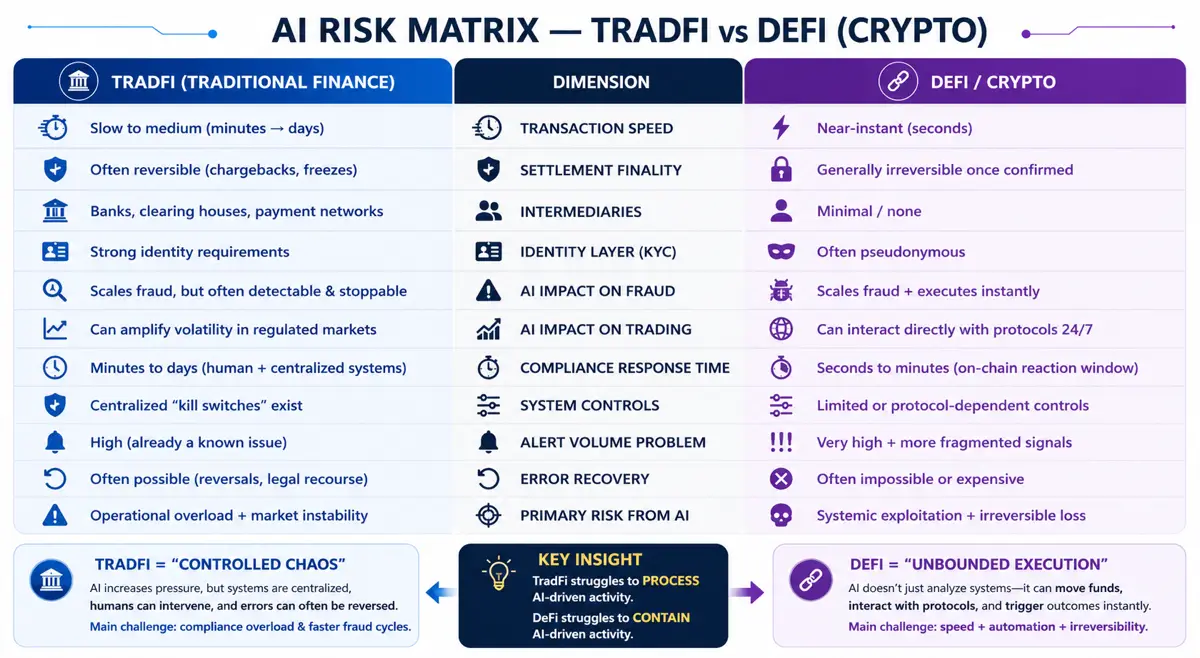
AI commerce risks comparison: TradFi vs DeFi. Image created via ChatGPT
Experts say this creates a fundamental asymmetry. In TradFi, AI increases operational strain and compliance costs. At the same time, with its legacy multi-party checks, transaction amount remains within a controlled environment for a while, giving organizations a head start to tackle the flow. In crypto, AI can directly translate computational speed into financial execution, turning automation into a tool that can move real value instantly and permanently.
Another compounding factor is composability in DeFi. AI agents can chain multiple protocols together in a single automated sequence, borrowing from lending platforms, swapping assets on decentralized exchanges, and leveraging positions across networks. This interconnected structure increases efficiency but also amplifies systemic exposure when things go wrong.
The result is a compliance environment under extreme pressure. AI-driven systems generate high-frequency transaction clusters, complex behavioral patterns, and fragmented signals that are difficult to interpret using traditional rule-based monitoring tools. Security teams are increasingly shifting toward AI-assisted detection themselves, creating a feedback loop in which both attackers and defenders rely on similar technologies.
Even without agentic payments in the loop, AI present significant challenge for the cybersecurity and compliance teams. Just a few days ago, Google discovered the first cyberattack tool it believes was built with AI. The exploit flaw was found in a popular open-source web administration tool. It allowed attackers to bypass two-factor authentication — the extra verification step many services use to confirm a user’s identity. The code contained detailed explanatory comments and a hallucinated security score — patterns typical of AI-generated output. Although the incident was prevented timely, the occurance is a red flag for all security experts.
With agentic commerce, this problem magnifies. Autonomous AI agents and automated trading systems are able to generate transaction volumes at a scale that traditional compliance tools were never designed for. Surely, compliance systems are also getting their AI agent boost today, but the question of which side has more resources and is more proactive remains on top of the agenda for all fintechs, especially those dealing with crypto transactions.
In this AI arms race, crypto is acting as an early stress test for financial systems. While TradFi is better guarded in AI-native environments through centralized control, slower settlement, and regulatory enforcement mechanisms, crypto’s openness and speed make it better for many payment scenarios (e.g. cross-border settlement) but also significantly more vulnerable to automation-driven disruption.
The article was updated on May 19, 2026 with minor corrections.