Gr4vy and Unlimit announced a new integration on October 8, 2026, the latest in a run of connections that also took in Airwallex in June and Plaid in March. Sweetwater went live on the platform in August. The partner list is growing fast, but your own decision probably rests on something else, namely whether a private cloud instance is the right amount of control for your business.
Key takeaways:
- Gr4vy gives every customer a single-tenant cloud instance, yet it describes no self-hosted edition and publishes no price.
- Akurateco goes one step further on control, with deployment on your own servers or cloud account, plus a white-label gateway that PSPs and banks can rebrand.
- IXOPAY’s SLA and contract terms are in print, so you can judge its lock-in before a sales call.
How much of the stack do you actually want to run? The five Gr4vy competitors below suit enterprise merchants and platforms weighing one payment orchestration platform against another. The vendor numbers were read off company sites in October and early November 2026.
Gr4vy in 2026
San Mateo’s Gr4vy has built its pitch on infrastructure, with no public price to argue about.
What it sells
Gr4vy describes itself as infrastructure as a service built in the cloud for enterprise merchants and platforms. Every client has its own dedicated, single-tenant instance with no shared servers, separate sandbox and production hostnames, and data residency in multiple places. Merchants get orchestration, and platforms get a white-label route for sub-merchants.
Its one integration opens 400+ payment methods, and you can activate new PSPs or anti-fraud providers without changing checkout. It states 99.99% platform uptime, though it doesn’t present that as a contractual SLA. Its status page showed a clean 90 days up to October 23, 2026.
What changed
The 2026 news mostly adds rails and names customers. Gr4vy partnered with Ecommpay through a single integration, and three later moves say more about where it’s heading:
- May 5 brought Pix Automatico in Brazil through dLocal, which helps a merchant with recurring payments there.
- June 16 brought Airwallex, giving merchants direct access to global acquiring through orchestration.
- September 22 named Pure Interactive, which uses Gr4vy to run Apple Pay in its US real-money mobile games.
That last one matters if you’re in gaming, because its homepage pitches enterprise merchants and platforms. Ask how much gaming volume it really carries.
What users say
The sample is tiny. SourceForge shows 5.0 out of 5 from 4 user reviews, and Trustpilot and TrustRadius show none (checked October 29, 2026). Four reviews can’t tell you much, so spend your reference calls on customers who changed PSPs after going live.
Gr4vy competitors at a glance
The deployment column does most of the sorting here, because price is rarely public.
| # | Competitor | Best for versus Gr4vy | Deployment | Pricing | Standout |
|---|---|---|---|---|---|
| 1 | Akurateco | Hosting it on your own terms | SaaS, own servers or cloud | Quote | 700+ ready connectors |
| 2 | Primer | Provider cost analytics | Hosted API | No public price | Costs Overview |
| 3 | Payrails | Finance operations on one stack | Vendor-operated vault | No public price | US Merchant of Record option |
| 4 | Yuno | Latin America and the Gulf | Vendor-run, US and EMEA | Add-on unit prices only | 1,000+ integrations |
| 5 | IXOPAY | Enterprise tokens and white label | Vendor-hosted | Tokens from $1,000 a month | Published SLA and terms |
Yuno and IXOPAY show part of their price, so those two can at least enter a first budget.
How the competitors compare
Gr4vy sets a high bar on isolation, so each entry is read against that.
1. Akurateco: one step past a dedicated instance
A Gr4vy instance is yours alone, but Gr4vy still runs it. Akurateco lets you take that job over. The payment orchestration platform and the white-label gateway both run as SaaS, on servers of your own, or in a cloud account you hold on Google Cloud, Oracle Cloud, AWS or Azure. Expect about a month for a cloud account and about two for dedicated infrastructure.
Fraud checks use 150 built-in configurable fraud filters, acquirers you’ve signed plug into 700+ ready connectors, and the uptime SLA reads 99.95%, where Gr4vy states 99.99% without calling it one. Going live averages 5 business days, and a new integration needs about 14.
Best for: a PSP, bank or merchant that must hold data and PCI scope itself, or wants its brand on every screen.
Watch out for: self-hosting moves PCI work to your team, acquiring contracts remain yours, and it opens no merchant accounts.
2. Primer: a clearer view of what providers cost
Primer sells the same enterprise buyer a different story. Accept covers checkout, Optimize handles routing, Fallbacks and network tokens, and Manage covers reconciliation, plus a Costs Overview marked new on its homepage for spotting leakage and benchmarking providers. You configure checkout and routing rules in a dashboard.
A $100 million Series C in May 2026, led by Sofina, funds the push. To take vaulted card details out, you file a support request, though Apple Pay and Google Pay tokens stay bound to Primer’s Token Requestor ID.
Best for: a merchant whose main question is which provider costs too much.
Watch out for: it runs as a hosted API, primer.io/pricing returns a 404, and its partner program treats PSPs as suppliers rather than customers.
3. Payrails: payments plus the finance back office
Gr4vy stops near the payment. Payrails carries on into reconciliation, chargebacks, fee monitoring and payouts, and on October 7, 2026 it added Merchant of Record, which its docs limit to the United States for now. Its vault supports five card networks’ tokens and exports through search and list APIs, with full card numbers handled separately.
Best for: a finance-led buyer who wants fewer vendors and sells across markets with different tax rules.
The trade-off: it operates the vault itself, publishes no price list, and full card numbers need a separate process when you leave.
4. Yuno: reach in emerging markets
A single Yuno API handles pay-ins and payouts, fraud prevention and stablecoins, and it says it reaches 190+ countries through 1,000+ integrations. It’s been adding fast, with Onafriq’s 43 African markets in June, Revolut in September and Coinbase in October. Yuno announced a $45 million Series B on August 12, 2026.
A written request gets your tokens out, provided the receiver holds a current PCI DSS attestation. Hosted payment links can run on your domain with no Yuno branding.
Best for: a merchant expanding into Latin America, the Gulf or Africa.
Watch out for: data sits in two vendor-run regions, US and EMEA, and each order form sets its own Monthly Platform Fee, whatever the add-on list says.
5. IXOPAY: tokens and white label with terms in print
IXOPAY merged with TokenEx in April 2024, so tokens sit at the center of the product. It lists 500+ pre-built adapters, reports $171 billion in payments processed, and sells a white-label edition to ISOs, PSPs, banks, ISVs and payment facilitators. You can read what happens when you leave before you talk to sales.
Its May 18, 2026 agreement rules out leaving for convenience mid-term and leaves migration help to IXOPAY’s discretion, at half the estimated fee upfront. Read that before you sign.
Best for: a big merchant or PSP after token depth and contract detail it can review up front.
The trade-off: the published SLA guarantees 99.90%, a lower figure than Gr4vy’s stated 99.99%, though IXOPAY’s comes with compensation attached.
Where Gr4vy sits among 70 payment platforms
This series has looked at 70 vendors, billing tools and vaults among them, with the same questions for each. On a documented way out for stored cards, 22 of the 63 with a public position have one, and Gr4vy does, along with Primer, Payrails, Yuno and IXOPAY. It imports and exports tokens, and vaulted card data isn’t tied to one PSP.
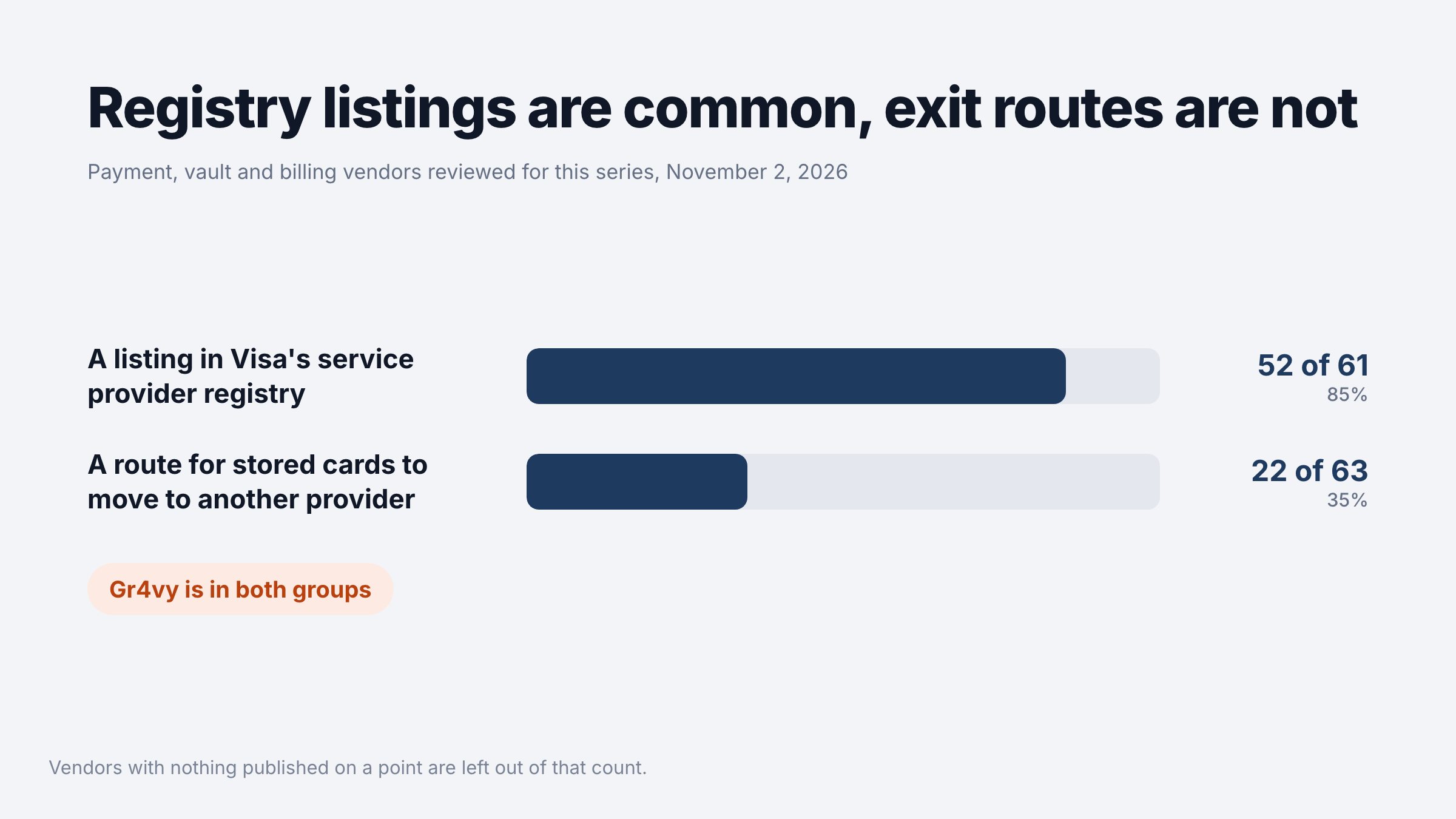
The other test is a listing with Visa as a service provider, and we found 52 of the 61 vendors searched. Gr4vy Inc is listed with a PCI DSS validation valid through May 31, 2027, and Akurateco’s Portuguese company runs through March 31, 2027. The two tests are less rare than a printed price, which only 26 of 70 vendors offer and Gr4vy doesn’t. These counts date from November 2, 2026.
What to verify before you sign
Card volumes justify the effort of getting this right. Two-thirds of US consumer payments go on cards, says the Federal Reserve Financial Services diary, and $34.12 billion went on US debit and prepaid interchange in 2023 by the Federal Reserve’s count. Small routing gains add up at that scale, and so do hidden platform fees.
| Decision area | Question to ask | Evidence to request | Red flag |
|---|---|---|---|
| Uptime | Is the stated figure in our contract? | The SLA clause and credits | A marketing number with no remedy |
| Tenancy | What exactly is shared between customers? | An architecture diagram | “Dedicated” with one shared service |
| Tokens | Which tokens leave, in what format, how fast? | The export procedure | Network tokens left out silently |
| Regional methods | Which local methods are live in our markets? | Live connector list by country | A global count with no country view |
| Price | What’s fixed, what scales, and what’s extra? | A worked quote on our volumes | Platform fee set only after procurement |
If a vendor can’t fill in one of those rows in writing, treat the gap as the answer and price the risk accordingly.
The bottom line
Stay with Gr4vy if a private instance gives you enough control and you don’t want to run infrastructure. Move to Akurateco if data or brand must sit fully under your name. Primer and Payrails suit buyers who care about cost visibility and finance operations, Yuno suits emerging markets, and IXOPAY suits anyone who wants token depth with published terms. Among these Gr4vy competitors, none should get your cards until the export route is in the contract.
Questions about Gr4vy competitors
Is Gr4vy self-hosted?
No self-hosted edition is described. Each client gets a dedicated single-tenant cloud instance, which Gr4vy presents as infrastructure as a service.
Who are Gr4vy’s main competitors?
For enterprise orchestration, Akurateco, Primer, Payrails, Yuno and IXOPAY are the closest. Their differences lie mainly in hosting, regional reach and contract terms.
How much do Gr4vy alternatives cost?
Gr4vy publishes no pricing. Among Gr4vy alternatives here, IXOPAY’s token plans begin at $1,000 a month, Yuno prices add-ons such as $0.0101 for smart routing, and Primer and Payrails quote privately.
Does Gr4vy offer a white label?
Yes, for platforms and their sub-merchants. If you’re a PSP or bank selling a gateway under your own brand, compare it with Akurateco’s and IXOPAY’s white-label products.
Can you export tokens from Gr4vy?
Yes, it imports and exports tokens. Ask for the procedure and any fees in writing, because the public material doesn’t spell out either.