Many industry analysts expected that India’s digital rupee would launch on Amazon and Flipkart by now. However, the central bank’s blockchain currency project is still far from that. Here is the factual record of what the RBI’s CBDC pilot has achieved, who has joined it, and why no full retail launch has happened yet.
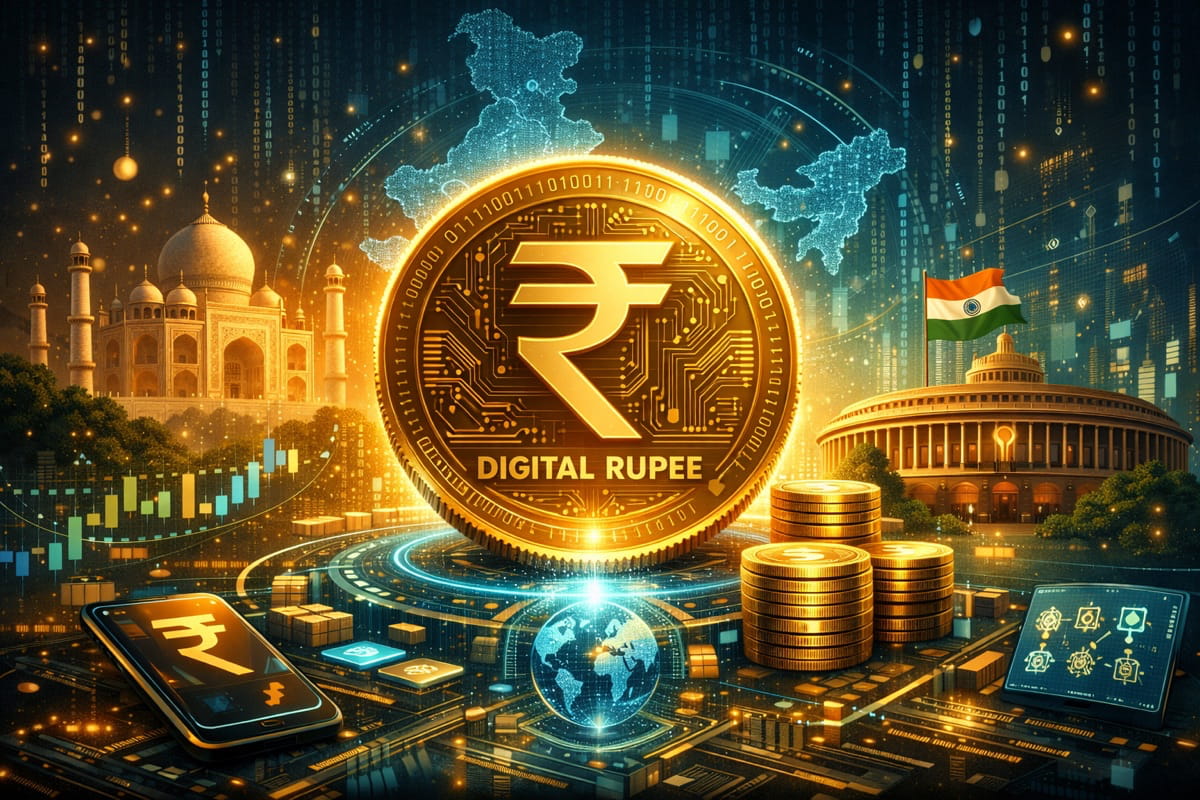
What Is Digital Rupee (E₹)?
The digital rupee, officially designated e₹ or eINR, is India’s Central Bank Digital Currency (CBDC), issued and regulated by the Reserve Bank of India.
Unlike cryptocurrencies such as Bitcoin, the e₹ is not decentralised. It is a tokenised digital form of the Indian rupee, backed by the full faith and credit of the RBI, and operates as legal tender. It runs on distributed ledger technology and can be held in a digital wallet, just like physical cash, and transferred peer-to-peer without requiring a bank intermediary for every transaction.
The RBI launched the wholesale CBDC pilot in November 2022 and expanded to a retail CBDC pilot (CBDC-R) on December 1, 2022. The retail pilot initially covered eight banks across four cities. As of March 2025, the pilot had grown to 17 participating banks, over 6 million (60 lakh) users, and e₹1,016 crore (approximately US$120 million) in circulation, making India’s the second-largest CBDC pilot in the world, behind China’s digital yuan.
Where Amazon And Flipkart Fit In
The origin of some exaggerated viral headlines traces to a real and important policy shift, but one that has been significantly overstated. In April 2024, the RBI announced that non-bank payment companies would be permitted to offer e₹ transactions through their platforms for the first time. Previously, only licensed commercial banks could distribute the digital rupee.
This opened the door for India’s dominant fintech and payment platforms to apply for participation in the pilot. In August 2024, Reuters reported that five non-banking payment firms had applied to join the RBI’s e₹ pilot programme: Google Pay, Walmart-backed PhonePe, Amazon Pay, CRED, and MobiKwik. These companies collectively hold over 85% of India’s UPI (Unified Payments Interface) transaction market share, which is precisely why their potential inclusion matters for the scale of CBDC adoption.
Amazon Pay is the payments division of Amazon India, not the Amazon shopping marketplace itself. It already holds an RBI Payments Aggregator licence and is deeply embedded in India’s digital payments ecosystem. Flipkart, India’s largest domestic e-commerce platform (majority-owned by Walmart), runs Super.money, a fintech app that has become one of India’s top five UPI applications. Neither Amazon (the shopping platform) nor Flipkart has launched e₹ payments for consumers making purchases on their respective marketplaces. The distinction between Amazon Pay as a payments provider and Amazon as a retailer is critical, and is the source of much of the confusion in viral headlines.
By January 2025, MobiKwik and CRED became the first non-banking entities to officially launch e₹ wallets for users, in partnership with Yes Bank as the sponsor bank for CBDC issuance. Amazon Pay and Google Pay had not yet gone live in the pilot as of early 2026, though their applications remained active.
Why No “Full Retail Launch” Has Occurred
The RBI has been deliberate and explicit on this point. Former RBI Governor Shaktikanta Das, in his farewell address in December 2024, acknowledged that India was among the few central banks to have actually launched a CBDC pilot at all — while also noting “no rush” for a complete national rollout.
In September 2024, he reiterated that the RBI was prioritising a thorough assessment of the e₹’s impact on traditional banking systems before proceeding to a full launch. There are structural reasons for this caution.
The UPI system, which already processes over 14,726 crore transactions per year and accounts for roughly 46% of global digital payment volume, sets an extremely high bar. An e₹ rollout must demonstrate clear advantages for users, banks, and the broader economy without destabilising existing financial infrastructure.
A rapid migration of deposits into CBDC wallets, for example, could reduce the lending capacity of commercial banks. Transaction volumes reflect the deliberate pace. After a surge to over 1 million daily retail transactions in December 2023 (which the RBI used to stress-test infrastructure), volumes were intentionally scaled back to between 100,000 and 200,000 daily transactions as of mid-2024 — a controlled phase rather than mass rollout.
What Is New With India CBDC in 2026
Despite the absence of a full launch, substantive progress has been made in 2024 and early 2025 that justifies media attention:
Programmability: HDFC Bank introduced user-level programmable digital rupees in August 2024, allowing transactions to be locked for specific purposes, for example, agricultural subsidies that can only be spent at registered fertiliser outlets, reducing leakage.
Odisha’s Subhadra Yojana: Launched in September 2024, this direct-benefit transfer programme became the first government scheme to use the e₹ at scale, distributing ₹10,000 in digital rupees to over 12,000 women. It demonstrated the CBDC’s potential for last-mile financial inclusion without middlemen.
UPI Interoperability: Several banks, including Canara Bank and Yes Bank, have enabled e₹ payments via existing UPI QR codes, meaning merchants do not need separate onboarding to accept digital rupees. This infrastructure is what makes an eventual integration with platforms like Amazon and Flipkart’s checkout systems technically feasible.
Carbon Credit Settlement: IndusInd Bank completed India’s first programmable e₹ transaction to compensate farmers for carbon credits in April 2024, pioneering a new class of CBDC use cases.
Non-Bank Entry: The January 2025 launch of MobiKwik and CRED e₹ wallets marks a structural shift — CBDC is no longer exclusively a bank product.
CBDC Used at 24/7 Grain ATMs: In February 2026, Gujarat in western India launched a central bank digital currency public distribution pilot in which grain is dispensed from 24/7 automated teller machines (ATMs) as part of the state’s public welfare programme.
What to Watch For
The RBI’s roadmap, as indicated in its Payments Vision 2025 document, points toward three further milestones: offline e₹ functionality for low-connectivity areas, cross-border payment pilots with counterparts, including SWIFT and the Bank for International Settlements, and expanded non-bank distribution through additional fintech platforms.
Should Amazon Pay and Google Pay receive RBI approval to go live in the pilot, that would represent a genuine step-change in accessibility — potentially exposing hundreds of millions of existing UPI users to e₹ for the first time.
Whether that access extends to checkout on the Amazon or Flipkart shopping platforms, however, would require a separate commercial and regulatory decision by each company.