By 2026, India’s Unified Payments Interface (UPI) has done something no private fintech ever managed: turned a domestic public infrastructure into a quietly expanding international standard. Here’s what’s happening — and where Indians can already pay with UPI abroad.

When France became the first European country to accept UPI payments in 2024, starting symbolically at the Eiffel Tower, it looked like a diplomatic gesture. A year later, it looks like the opening move of something far more consequential. In June 2025, Cyprus signed a Memorandum of Understanding with NPCI and Eurobank Cyprus, becoming the second European nation to adopt UPI. Prime Minister Modi was present. The Cypriot president called it “historic.” And with that, a pattern became undeniable: UPI is no longer just India’s payment success story. It is actively auditioning to become a global payments architecture.
The Numbers That Changed the Conversation
The growth curve of cross-border UPI transactions is almost absurd in its steepness. In FY2022, the system processed just 180 international payments. In FY2024, that number was 37,060. By FY2025, it had jumped to over 755,000 — a 20-fold increase in a single year. In the first four months of FY2026 alone, more than 601,000 cross-border transactions were processed, suggesting the full year will comfortably surpass the previous one. The value followed: from a negligible ₹3,000 in FY22 to ₹258 crore ($29.5 million) in FY25.
These are still small numbers relative to UPI’s domestic scale — the system handles over 18 billion transactions monthly inside India, but the trajectory matters more than the absolute figure. Cross-border UPI is in its inflection phase, not its plateau.
Why the UAE Became UPI’s Most Important Global Market
The UAE is the proving ground that validated UPI’s international model. With over 7 million Indian visitors annually — the largest group of international tourists in the country, and a massive Indian expatriate community, the India-UAE corridor is one of the world’s most active remittance and travel payment flows. UPI launched in the UAE in 2021 and has since expanded to over 60,000 retail outlets through NeoPay. Indians can now pay across retail, hospitality, entertainment, and transportation sectors using their familiar UPI apps, with real-time exchange rates displayed and transactions settled in Indian rupees.
NPCI International’s CEO Ritesh Shukla has framed the UAE expansion explicitly as supporting the country’s cashless economy vision — a smart positioning that reframes UPI not as India imposing its system outward, but as a technology partner helping host nations modernize. That framing has been central to UPI’s diplomatic success.
Europe: From Tourist Gesture to Strategic Beachhead
France’s adoption of UPI began with high-traffic tourist locations and expanded via a partnership with Lyra, a French payment company, enabling QR-code payments at merchants across Paris. Cyprus adds a different dimension: as an EU member state and a hub for Indian trade into the Mediterranean, it positions UPI inside the European regulatory perimeter in a way that France alone couldn’t. More EU nations are in various stages of MoU discussions, with the UK, Oman, and Malaysia also in the pipeline.
The EU angle matters structurally. Europe’s payments landscape is fragmented across national systems, and SEPA handles euro transfers but lacks a unified QR-payment layer with the real-time, zero-cost architecture that UPI offers. For Indian travelers to Europe, who collectively represent a significant and growing tourist demographic, UPI acceptance removes the friction of currency exchange and the cost of card network fees, which typically run between 1.5% and 3% per transaction.
The Architecture Behind the Expansion
NPCI International Payments Limited (NIPL), the overseas arm of NPCI, is executing a two-track strategy. The first track is bilateral interoperability: linking UPI directly with another country’s real-time payment system. The Singapore-PayNow link is the most mature example, with UPI accepted at up to 30,000 merchants and enabling peer-to-peer transfers between the two systems. The second track is multilateral: NIPL participates in Project Nexus, a Bank for International Settlements initiative connecting the instant payment systems of India, Malaysia, the Philippines, Singapore, and Thailand into a common network.
Beyond UPI itself, NIPL is helping countries like Peru, Namibia, and Trinidad and Tobago build their own domestic real-time payment infrastructure, with the explicit goal of eventually connecting those systems to India bilaterally. This is a long-term playbook for making UPI not just widely accepted, but structurally embedded in the global payments order.
Where Indians Can Pay With UPI Abroad Right Now
Here is the current map of countries where UPI is live or widely accepted as of 2026:
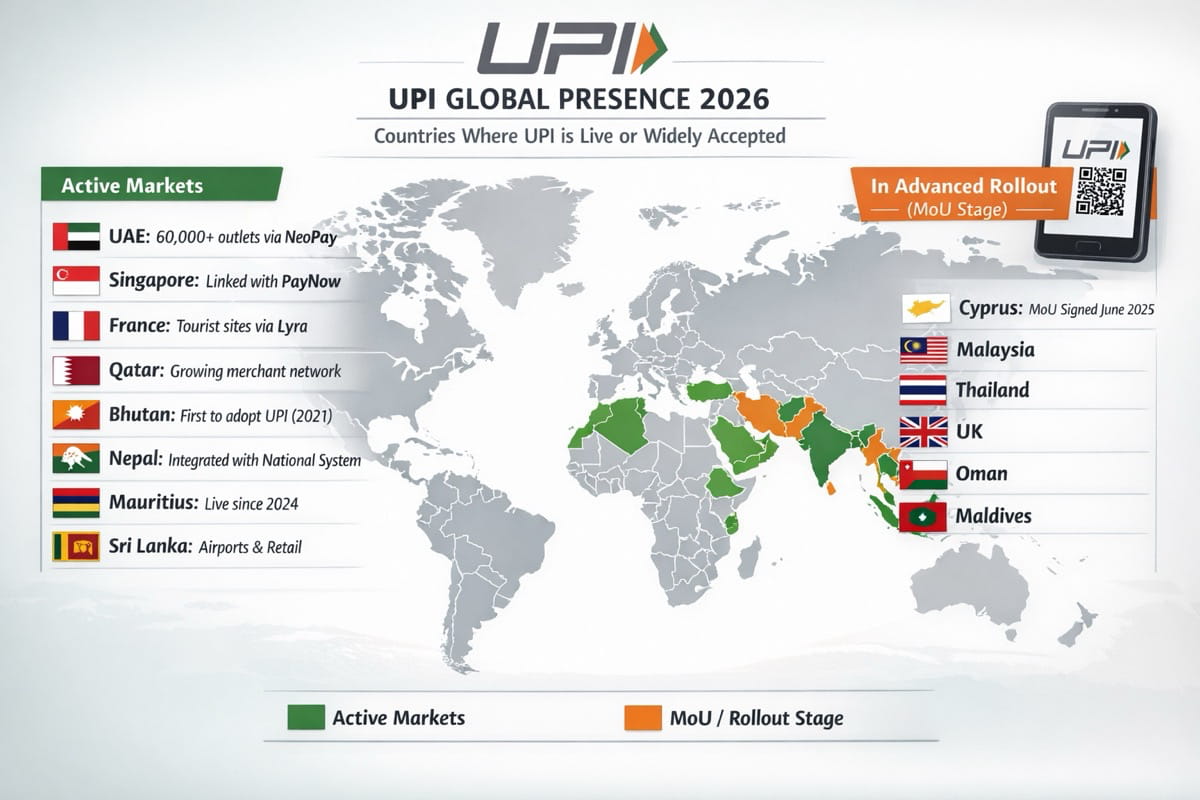
Image created via Sora
For Indian travelers, UPI abroad works through existing apps like PhonePe, Google Pay, Paytm, with international mode enabled. Banks may levy forex fees depending on the corridor, and RBI-mandated transaction limits apply. QR-code scanning is the dominant use case; peer-to-peer transfers are available where bilateral system links exist.
The Bigger Challenge UPI Hasn’t Solved Yet
Honest analysis requires acknowledging the gaps. Cross-border UPI still faces open questions around settlement architecture, e.g. who bears exchange rate risk, how fraud liability is distributed across jurisdictions, and whether zero-fee models are sustainable without monetizing settlement infrastructure. Merchant adoption outside high-Indian-traffic corridors remains thin, and the gap between “MoU signed” and “QR codes live at checkout” can be wide.
These are solvable engineering and regulatory problems. But they explain why UPI’s international growth, while extraordinary in percentage terms, still operates at tourist-payments scale rather than remittance or trade-finance scale. The next milestone is not adding more countries to the list but deepening penetration in the ones already signed.
India’s Quiet Fintech Diplomacy
What is genuinely new in 2026 is the diplomatic register in which UPI is now discussed. It appears in bilateral communiqués, in state visits, and in MoUs signed between finance ministries. India is exporting not just a payment product but a model of digital public infrastructure — the argument that sovereign, open, interoperable systems can outperform private card networks on inclusion, cost, and national interest.
Brazil made that argument with Pix. Singapore made it with PayNow. India is making it at a geographic and demographic scale that neither of those systems has attempted. NPCI aims to have UPI active in 20+ countries by FY2029. Whether it becomes a genuine global standard or remains a valuable niche for Indian travelers will depend on deals being made right now — in regulatory negotiations, settlement architecture decisions, and bilateral fintech agreements that rarely make headlines.