An increasing demand for digital financial services in Argentina has driven substantial growth of the local payment gateway ecosystem. Businesses preparing to enter this prospective LatAm market should be aware of the available options that best suit their needs.
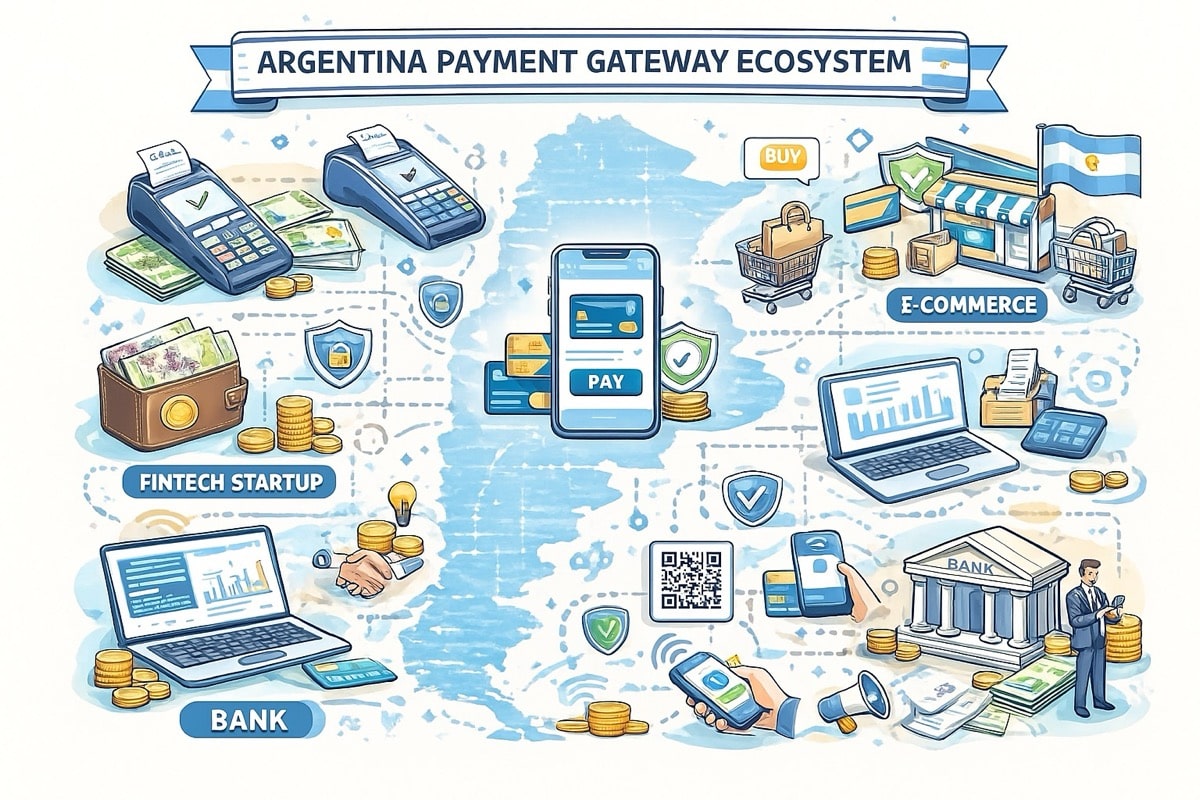
Being one of the top three largest fintech markets in Latin America, Argentina has seen a tremendous growth of e-commerce and digital payments lately. The presence of a large unbanked population share makes Argentina’s payment landscape more versatile than, for instance, its European counterparts. The same may be said about its payment gateway ecosystem, which we’ll be navigating today.
Digital Payment Market of Argentina
To understand the requirements for payment gateway in Argentina, you should know a few things about local payments. First and foremost, cash transactions in this country are rapidly declining, giving way to electronic payments of all kinds. While not so long ago, half of Argentina’s payment volume was paper money-based, today this type of payment declined to less than a third of the total turnover.
Meanwhile, Argentina’s e-commerce market is booming. Online and mobile sales grew well over 200% last year, bringing merchants that leverage digital channels trillions of pesos. There’s a strong shift in local consumer behaviour, with thousands of buyers trying out e-commerce for the first time in their lives due to the widespread adoption of digital wallets, QR-code-based payments, online and social media marketing, and of course convenient digital payment gateways Argentina produced.
According to research made by Statista, the total value of transactions in the digital payments market of Argentina will reach almost $78 billion in 2025, growing further to $147 billion by 2030. That robust market expansion requires strong and secure payment gateway solutions that support all the popular payment methods in Argentina.
How to Pay Like a Local in Argentina
Argentinians use globally accepted payment methods like credit/debit cards, of course. However, there’s also a number of unique payment systems, digital wallets and other popular digital and mobile-first payment solutions that outsiders might have no idea about.
Mercado Pago
Mercado Pago is both a trusted payment gateway and a digital wallet service in Argentina. The app provides users with a digital account that works like a virtual wallet. Local businesses can integrate it with their website or application to offer customers a choice of different payment methods like card upfront payments, bank transfers, cash vouchers, QR-code payments, card installments and wallet payments. Mercado Pago is a dominant solution of this kind in the local market, with 63% of Argentinian consumers identifying it as their primary digital wallet.
Rapipago
Rapipago is one of the top offline cash payment methods in Argentina. It enables cash payments for online purchases at more than 10,000 offline locations across the country. Over 6,000 local merchants and service providers support Rapipago as a payment method. Besides cash, Rapipago offers payments and top-ups with debit cards. The service is available via its website or WhatsApp account.
MODO
MODO is a popular digital wallet and account-to-account (A2A) payment platform. It is backed by dozens of public and private banks in Argentina. This fintech solution integrates all user’s bank accounts and cards into a single app, facilitating daily transactions. The wallet enables in-store payments via QR codes, P2P transfers without sensitive bank details, online transactions, and access to bank offers, discounts, and cashback.
Ualá
Argentina’s digital wallet and neobank platform, Ualá offers its clients a prepaid card, digital payments and transfers, savings, investments, personal loans and mobile phone top-up. This fintech’s services are available even to those without bank accounts or formal income, which makes it highly popular among financially-excluded population groups.
PagoFácil
As about 30% of the population in Argentina is still unbanked or underbanked, there’s a need for cash-based payment networks like PagoFácil. This payment collection service allows users to pay for utilities, mobile services, taxes, loan repayments, e-commerce purchases, subscriptions, education services, and more in cash at thousands of affiliated stores, kiosks, and partner branches throughout the country.
Naranja X
Naranja X is a major credit and debit card company based in Argentina. This popular fintech brand has a convenient mobile app that empowers millions of users with instant online payments, consumer loans and insurance policies. Despite its domestic nature, Naranja also partners with global card networks, Visa, Mastercard, and American Express, to make transaction processes across the globe smooth and hassle-free.
Payment Gateways Popular in Argentina
Support for local payment methods and currencies, flexibility and multi-functionality is what defines a good payment gateway able to satisfy local market needs. It’s no different for Argentina that has an extensive network of fintech providers delivering suitable payment gateway solutions both customers and merchants like.
Mercado Pago
As we’ve already mentioned, Mercado Pago offers not only a digital wallet service but also a full-fledged payment gateway. It was created by Mercado Libre, the most visited e-commerce website in the LatAm region with approximately 100 million unique active buyers annually. This fact alone makes the payment gateway popular and trustworthy, as it integrates deeply with Mercado Libre platform. It is also widely used by small merchants, offering convenient features and tools like POS, subscriptions, invoicing, and APIs. Mercado Pago supports both one-time, recurring and BNPL installment payments.
PayU GPO
PayU is a payment gateway platform of choice for the purpose of international shopping. It is often used by global companies selling their services and goods to Argentinian customers, SaaS businesses and international e-commerce marketplaces. The gateway supports multi-currency payment methods, recurring transactions, and more with established connections to local acquiring banks and alternative payment methods. The platform is also customisable and offers enterprises added-value services such as AI-driven analytics, payment performance reporting, robust security features, and compliance measures.
Rebill
Rebill is one of the newer payment solutions on the market, combining a payment gateway and a subscription management platform. It is tailored for large enterprises operating in Argentina or across Latin America. Its functions are most useful to startups and scaleups with high transaction volumes operating in SaaS, EdTech, HealthTech, and subscription e-commerce sectors. One of its core attractions is multiple PSP support, allowing businesses to route payments and reduce failed transactions. This payment gateway is built natively for LatAm markets, solving major payment issues for local businesses and providing smart switchover between processors due to regional card/payment instability. In addition, Rebill has a customisable checkout system, which leverages intelligent logic to boost conversion rates by up to 35%.
TodoPago
Backed by Prisma Medios de Pago, major local processor for card payments and POS systems, TodoPago integrates with leading banks and retailers in Argentina. This payment gateway and digital wallet platform offers both online and in-person payment solutions for businesses, entrepreneurs, and individuals. TodoPago’s primary benefit is integration with installment payment plans (cuotas), access to which is highly-desirable in Argentina’s inflation-driven economy. Besides, its wallet app offers consumers access to promotions and bank-linked discounts. As for enterprise tools, the platform pitches plugins for popular e-commerce platforms, SDKs and APIs for custom development, and integration with ERP systems and online invoicing tools.
Mobbex
Mobbex payment gateway is designed to help businesses in Argentina process payments both online and in-store through seamless integrations with major commerce systems. The gateway has a strong focus on installment payments (cuotas) and offers multi-acquirer routing, which is a desirable trait for many merchants looking to offer flexible payment options and maximize approval rates. Along with payment orchestration, Mobbex’s smart checkout that adapts to customer and merchant preferences helps to reduce cart abandonment. Finally, Mobbex is one of the few payment gateways in Argentina that allow merchants to accept cryptocurrency transactions via a strategic alliance with Binance Pay.
How to Integrate Payment Gateway: Argentina Edition
Integrating a payment gateway into your website, app, or platform involves several main steps:
- Evaluating payment software providers and choosing the one that fits your needs.
- Registering your business with the payment gateway through KYC procedure.
- Choosing a preferable integration method (hosted checkout, embedded checkout, API, etc).
- Technical implementation and sandbox testing.
Launching Payment Gateway in Argentina
Sometimes, browsing the offers available in the market doesn’t bring businesses any desirable results. Therefore, new PSPs rise all the time, offering fresh perspectives to payment acceptance. However, launching your own payment gateway in a heavily-regulated market like Argentina can be tricky.
The payment service provider that wants to enter the market must thoroughly study the regulatory framework established by the Central Bank of the Argentine Republic (BCRA) and other authorities in the field of financial services. The company that would want to launch a payment gateway in Argentina needs an official status of a PSP (Proveedor de Servicios de Pago) and partnerships with banks, acquirers, or payment networks. Sticking to Anti-Money Laundering (AML) and Know Your Customer (KYC) policies as well as PCI DSS certification for card data security adds to the list of requirements.
To register as a PSP in Argentina, the fintech entity must provide detailed documentation on its corporate structure, source of funds, business plan and tech model, AML/KYC compliance processes, and more, as well as maintain transparent traceability of funds and user balances.
A simpler and faster way to launch a payment gateway for businesses in Argentina might be a white-label payment gateway. Instead of building a gateway from scratch, companies can license a ready-made, fully developed payment processing system and customize it with the brand interface, logo, and domain. This way, the launch of a branded payment gateway solution shortens to weeks instead of months or years. Besides, it can save significant costs on development, infrastructure, technical maintenance, and compliance.
The simplicity and cost-efficiency of the white-label payment gateway mode goes along with additional benefits like monetization of payment processing, company’s own branding of the payment interface, API-first architecture, in-built analytics dashboards, ready-made customisable fraud detection tools, frictionless onboarding experience, and seamless scalability.
Argentina’s Payment Gateway Ecosystem in Brief
Argentina’s payment gateway ecosystem is rapidly evolving in response to soaring demand for digital financial services and a booming e-commerce market. With cash transactions declining, Argentina offers one of Latin America’s most diverse and adaptable digital and hybrid payment landscapes. This versatility is driven by both global and uniquely local solutions that cater to a wide spectrum of consumer preferences, including the large unbanked and underbanked population.
From mainstream digital wallets like Mercado Pago and MODO, to hybrid offline-online solutions like PagoFácil and Rapipago, businesses have access to a rich blend of tools that facilitate seamless transactions. Gateways such as Rebill, Mobbex, TodoPago, and PayU further enhance flexibility through features like customisable checkouts, installment payments, multi-currency support, and even cryptocurrency acceptance.
Merchants entering the Argentinian market can integrate payment systems tailored to local habits while still meeting global standards. Whether through full-scale custom platforms or cost-efficient white-label gateways, the infrastructure supports scalable, secure, and conversion-friendly payment experiences, making Argentina a uniquely versatile hub for payment innovation in the region.
The article was updated on July 30, 2026 with minor alterations.