Primer’s third-quarter 2026 release notes list connections built by Nuvei, Ecommpay and Fat Zebra through its Primer for Partners program, four months after a $100 million Series C led by Sofina. Most of that money is pointed at the US, where it wants revenue to grow from about a fifth of the business to more than a third by 2028.
Key takeaways:
- Primer’s card export comes with a limit: Apple Pay and Google Pay tokens, and network tokens, belong to its Token Requestor ID and can’t be transferred.
- Akurateco adds a white-label gateway that can run on your own servers or cloud account.
- No Primer price is public, and its pricing page returns a 404. Spreedly’s vault from $750 a month is the only amount in this list.
So what should you test first, the checkout features or the exit? The five Primer.io competitors below are ranked for a merchant or platform buying payment orchestration, using figures read from vendor sites and filings in October and November 2026.
Primer in 2026
The homepage now reads “Unified intelligence for payments”, so the category needs pinning down first.
What it sells
Underneath, Primer is a London-headquartered payment orchestration platform founded by former PayPal executives. It isn’t a processor. It connects the processors, gateways and fraud tools you already use, and your processor contracts stay with you.
Products sit in three groups. Accept covers checkout, Optimize covers dynamic routing, Fallbacks, adaptive 3DS and network tokens, and Manage covers tracking, reconciliation and analysis. Global Accounts collects, converts and moves money beside them. Costs Overview, marked new on the homepage, benchmarks providers so you can reroute to protect margin.
Contract terms are public even though prices aren’t. Under Merchant Terms v3.45 (May 22, 2026), your order form sets a minimum term, and the agreement then rolls over yearly unless one side gives notice 30 days or more ahead.
What changed
Three dated events and one status figure frame the buying decision:
- In May 2026 Primer raised its $100 million Series C, led by Sofina with Peak XV Partners and all existing investors, and planned up to 50 US hires.
- A September 28 FinTech Magazine profile describes it extending Global Accounts, Reconciliation and AI Companion, with partners such as Zip and dtcpay.
- Third-quarter release notes list partner-built connections from Nuvei, Ecommpay and Fat Zebra.
- Its status page published 11 incidents in the 90 days to October 23, 2026, one of them major.
Selling into the US means selling into cards. Federal Reserve Financial Services found credit and debit cards account for two-thirds of US consumer payments, so card routing and tokens deserve most of your testing there.
What users say
Trustpilot shows 1.6 from 21 reviews (as of October 19, 2026), but most come from consumers disputing subscription charges they link to one merchant, so they say little about the platform. A better signal is Banxa’s former head of payments, who says on Primer’s homepage that authorization rates rose and customers began sending more volume. Treat that as one customer’s view.
Primer.io competitors at a glance
Two columns decide most shortlists here, where the platform runs and whether anything is priced in public.
| # | Competitor | Best for versus Primer | Deployment | Pricing | Standout |
|---|---|---|---|---|---|
| 1 | Akurateco | Self-hosting and a white-label gateway | SaaS, own servers or cloud | Quote | 150 built-in fraud filters |
| 2 | Payrails | Payments and in-person on one stack | Vendor-operated vault | No public price | US Merchant of Record option |
| 3 | Gr4vy | Airlines and security-led buyers | Dedicated cloud instance | No public price | 400+ payment methods |
| 4 | APEXX Global | Travel merchants wanting a neutral router | Hosted on AWS | Savings assessment, no list | No acquiring of its own |
| 5 | Spreedly | Cards in an independent vault | Multi-tenant SaaS | Vault from $750 a month | 150+ gateway connections |
You’ll still need a sales call for four of these five, which is also where Primer leaves you.
How the competitors compare
Each profile below notes what these Primer.io alternatives add beyond Primer and what you give up.
1. Akurateco: your own gateway, on your own infrastructure
Primer runs as a hosted API with one production endpoint. Akurateco gives you a choice. Keep it as SaaS, or install it on servers of your own or in an Azure, AWS, Google Cloud or Oracle Cloud account, which takes about 60 days on dedicated infrastructure and about 30 on a cloud account. Its catalog centers on the payment orchestration platform and a white-label payment gateway for PSPs and banks.
Acquiring contracts are yours to negotiate, and 700+ ready connectors carry them into the platform. Screening rests on 150 built-in configurable fraud filters, with a 99.95% uptime SLA behind it. On average, processing begins 5 business days in, and a fresh integration needs about 14 days.
Best for: a payment business or regulated merchant that wants control over where the stack runs.
Watch out for: funds never pass through Akurateco and it opens no merchant accounts, which leaves every bank contract and license with you.
2. Payrails: payments and finance on one stack
Payrails describes a modular payment and financial infrastructure platform covering orchestration, payouts, tokenization, unified analytics, automated reconciliation and in-person payments, the last still in preview. Its 100+ integrations include Stripe, Adyen, Forter and SAP, and customers include Puma, Vinted and Flix. A $32 million Series A in June 2025 took its funding past $52 million.
Two details stand out against Primer. Its Merchant of Record service, US-only in the docs so far, resells digital products under Payrails’ entities and handles sales tax, invoicing and disputes, and when you import cards it groups different representations of one card into a single instrument with several provider tokens.
Best for: a large merchant that wants in-store and online on one stack, with a tax-handling route for new markets.
Watch out for: no price list is published, and its pricing page returns Page Not Found.
3. Gr4vy: a separate cloud instance for each client
Every client gets its own single-tenant cloud instance at Gr4vy, with no servers shared across merchants and data residency available in several places. It offers 400+ payment methods through one integration, and you can activate a new PSP or anti-fraud provider without changing checkout.
On August 20, 2025 it announced an exclusive airline-sector partnership with Datalex, plugging its orchestration into Datalex’s DLX Pay. Tokens can be imported and exported, and vaulted card data works across several PSPs without re-tokenization.
Best for: an enterprise merchant or airline whose security review rules out shared infrastructure.
The trade-off: nothing is priced publicly, and its pricing page returns “Page not found”.
4. APEXX Global: routing with no acquiring of its own
APEXX has no acquiring platform, so it argues it has no incentive to send a transaction anywhere but the best provider. On September 10, 2025 it announced Jet2 as a customer, with APEXX its exclusive orchestration partner and central connection for all acquiring and alternative payment methods. Finch Capital led an investment of up to $10 million on February 5, 2026.
Its homepage claims its AIRE routing engine lifts acceptance by 8-12%, without giving a basis. A new acquiring bank added during implementation usually takes around ten working days to issue live MIDs.
Best for: a travel or retail merchant that wants a router with no stake in the acquiring.
Watch out for: instead of a price list you get a savings calculator and an assessment. The only portability article we found dates from February 2018 and covers CSV exports of transactions, so ask how tokens leave.
5. Spreedly: an independent vault with routing on top
Spreedly connects to 150+ gateways and sells its Independent Vault from $750 a month with unlimited storage. Routing, retries, network tokens and 3DS come with the Performance Optimization tier, which you buy through sales.
Exports are documented in more detail than most. Supported gateways receive cards by API, and other PCI-compliant destinations by encrypted file, generally inside 2 weeks of getting what it needs from you and the receiver.
Best for: a merchant that wants its cards held away from any processor, with a printed starting price.
The trade-off: it runs on a multi-tenant architecture, and routing sits on a quoted tier, so $750 isn’t the full price.
Where Primer sits among 70 payment platforms
Stored cards are where Primer looks strongest in the data we collected for this competitor series. A documented way out exists at 22 of the 63 vendors that say anything on stored cards, Primer, Payrails, Gr4vy and Spreedly among them. Akurateco is in that group too, and APEXX isn’t.
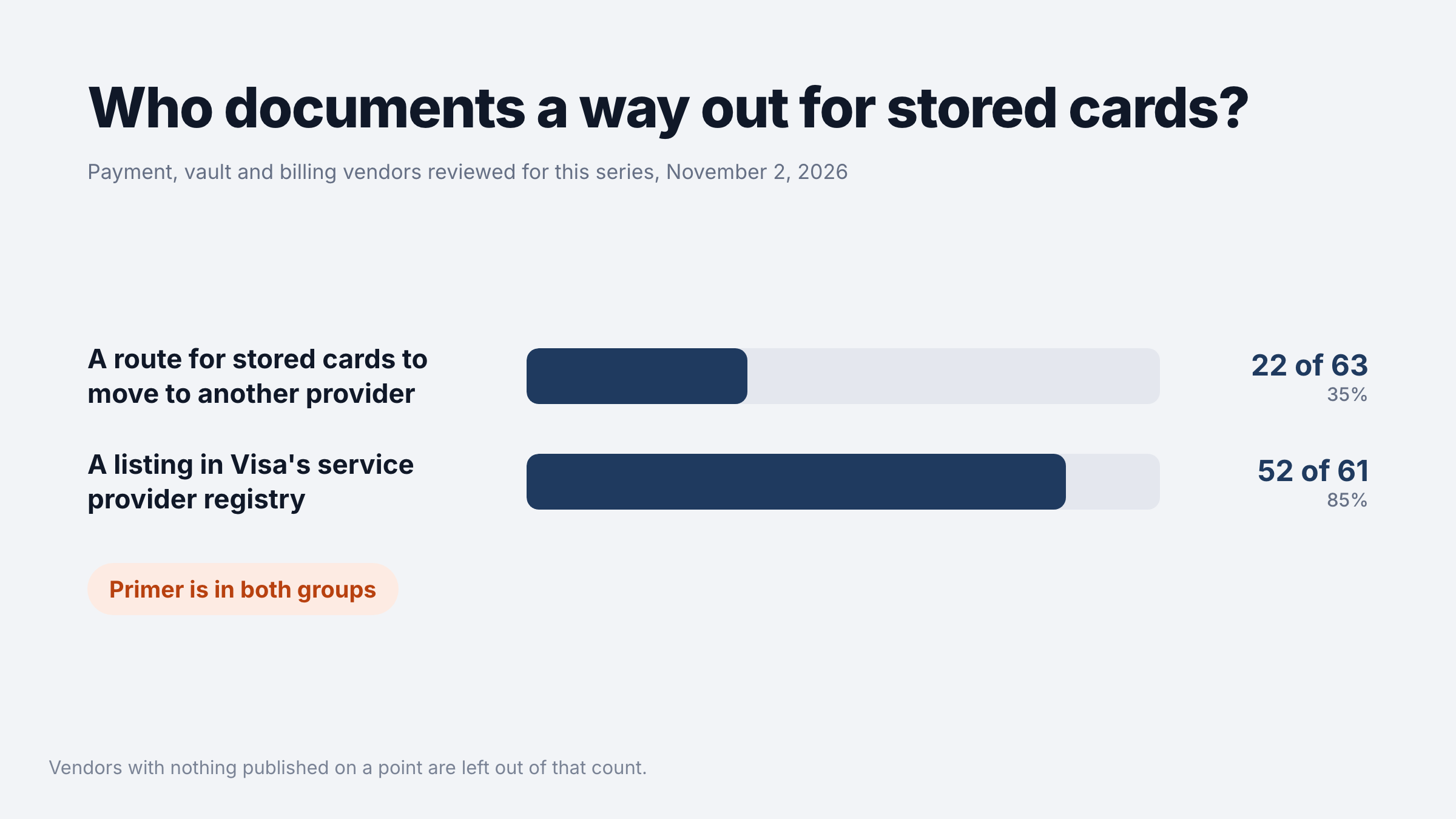
Most vendors clear the registry test. Of 61 vendors we searched for in Visa’s provider registry, 52 appear, and Primer API Limited’s PCI DSS validation runs through September 30, 2027. On price, it falls with the 44 of 70 that show nothing for their core service. These counts date from November 2, 2026.
What to verify before you sign
Ask about tokens first. Visa puts the gain over plain card numbers at a 4.6% authorization lift on card-not-present payments, so some of that is at risk whenever tokens must be provisioned again after a move.
| Decision area | Question to ask | Evidence to request | Red flag |
|---|---|---|---|
| Network tokens | Whose token requestor ID will ours sit under? | The requestor setup in writing | No plan for provisioning again after an exit |
| Wallet tokens | What happens to Apple Pay and Google Pay tokens if we leave? | The migration steps for each wallet | “Customers can add their card again” |
| Term | How long is the minimum term, and when must we give notice? | The order form clause | A short renewal window you learn about late |
| Retries | Are failed attempts and retries billed? | A worked invoice from a similar merchant | A per-attempt fee found after go-live |
| Reliability | Do third-party outages count against the SLA? | Status history for the past 90 days | No public status page |
The answers on tokens and term will shape your exit cost more than any line in the demo.
The bottom line
Decide how you’d leave before you compare Primer.io competitors on features. Primer suits a merchant that values its analytics and is comfortable provisioning network tokens again later. Look at Akurateco if you want a white-label gateway or your own infrastructure, Spreedly if the vault comes first, Gr4vy or APEXX for travel, and Payrails if in-store belongs in the same contract.
Questions about Primer.io competitors
Is Primer a payment processor?
No. It connects the processors, gateways and fraud tools you already use, and your business keeps its own processor contracts.
Which Primer.io alternatives publish prices?
Spreedly prints a figure for its vault, from $750 a month. Payrails, Gr4vy and APEXX don’t publish a price list.
Can you move cards out of Primer?
Yes, for card details on a support request. Apple Pay and Google Pay tokens bound to Primer’s Token Requestor ID can’t be transferred, and the new provider must provision network tokens from the exported card numbers. Clause 17.6 of its Terms also has Primer destroy or dispose of your transaction data at termination, so pull your records first.
Who are Primer’s closest competitors for merchants?
Gr4vy, Payrails and Spreedly sell orchestration to large merchants, and APEXX focuses on merchants in travel and retail. Akurateco serves merchants too, and it also sells a white-label gateway to PSPs and banks.
How long is a Primer contract?
No length is published, because the order form sets the minimum term. After that, renewal is annual and stopping it takes at least 30 days’ notice.